
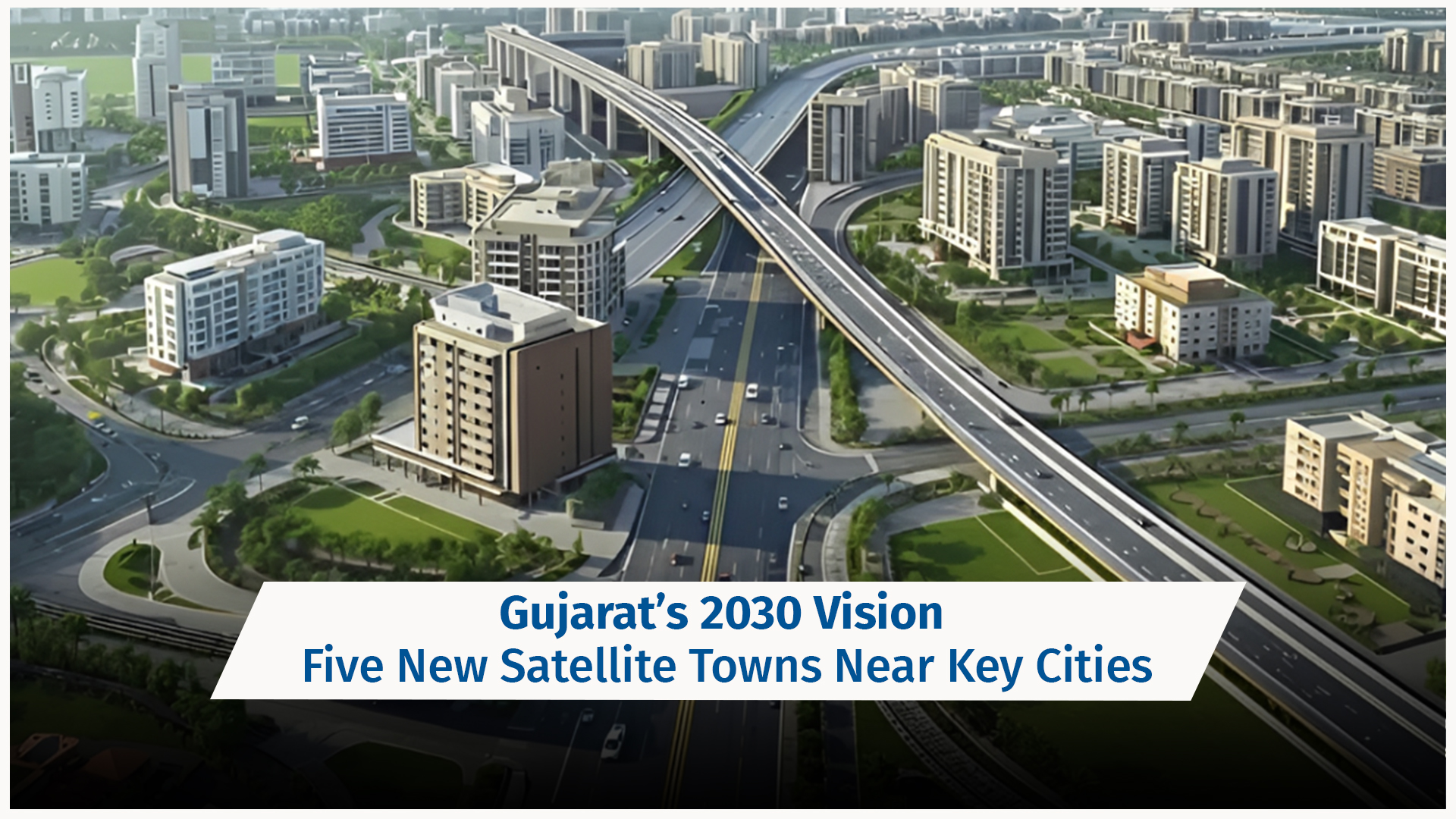
Gujarat’s major cities have expanded rapidly over the past decade. Industrial growth, migration, and rising housing demand have steadily increased pressure on urban infrastructure. To address this, the state government has announced a long-term plan to develop five satellite towns near major cities by 2030. The government's main initiative is planned expansion, building organised urban clusters in Savli, Sanand, Kalol, Bardoli, and Hirasar that can develop in step with Gujarat’s economic growth.
Rather than stretching existing cities beyond their limits, the plan focuses on strengthening nearby towns that already show economic potential. Sanand near Ahmedabad, Bardoli near Surat, Kalol near Gandhinagar, Hirasar near Rajkot, and Savli near Vadodara (Baroda) are strategic selections. Each of these locations has industrial activity, connectivity advantages, or positioning that makes it suitable for structured growth. Early investment in these areas can promote more balanced regional growth across different towns.The government can promote more balanced growth across different regions.
One key part of the vision is a strong focus on infrastructure from the start. Rather than letting unplanned growth shape these towns, the plan includes modern road networks, public transport, and essential civic services right from the beginning. Utilities, drainage systems, green spaces, and community facilities will also be planned early. This careful preparation can help prevent traffic problems and strain on services that are common in rapidly growing cities.
Why Satellite Towns Matter Now
Urban centres across Gujarat are experiencing steady population growth and industrial expansion. As land availability becomes limited and infrastructure faces increasing pressure, planned satellite development offers a practical alternative to unregulated urban sprawl. Instead of responding to growing pressure after problems appear, the 2030 initiative focuses on preparing new growth corridors in advance. This approach reflects a shift toward proactive planning rather than corrective measures.
What the Satellite Town Development Plan Includes
The broader development outline focuses on several core elements designed to support long-term sustainability:
1) Strategic Location Planning
Each satellite town is positioned close to major cities to benefit from connectivity while functioning as an independent urban hub.
2) Modern Road Infrastructure
Improved internal roads and highway access are intended to support daily commuting and commercial movement.
3) Public Transport Integration
Transport planning aims to ensure efficient movement between main cities and satellite towns.
4) Industrial and Economic Zones
Specific zones have been planned for manufacturing, business parks, and commercial activity to create employment opportunities within the region.
5) Residential and Mixed-Use Development
Planned housing clusters, along with commercial and institutional spaces, are designed to create self-sustaining communities.
6) Civic Infrastructure from the Start
Water supply, waste management, drainage systems, and utilities are included in early-stage planning to support organised growth.
7) Green and Recreational Spaces
Open areas and landscaped zones are proposed to maintain environmental balance and improve liveability.
A Practical Example of How This Could Unfold
Sanand provides a useful reference point. Over the years, as industrial investment increased and connectivity with Ahmedabad improved, the surrounding region gradually witnessed higher residential activity and developer interest. The transformation developed steadily as infrastructure and employment opportunities expanded. A similar pattern could emerge in towns like Savli or Hirasar if development progresses as planned.
Impact on Gujarat’s Real Estate and Economic Landscape
Large-scale infrastructure initiatives often influence real estate and commercial activity over time. When connectivity improves and civic planning is organised, businesses explore expansion opportunities beyond crowded city centres. This can create housing demand and support local economic ecosystems.
While long-term outcomes will depend on execution and policy continuity, the satellite town initiative reflects a broader shift toward decentralised development. Instead of limiting growth to a few large urban centres, the state appears to be encouraging expansion across multiple corridors. This approach could gradually reshape Gujarat’s urban landscape over the coming decade.
Conclusion
As Gujarat moves toward its 2030 urban roadmap, the development of these five satellite towns represents a forward-looking step in city planning. By focusing on structured expansion rather than reactive growth, the state aims to reduce infrastructure pressure while creating new centres of opportunity. If implemented consistently, this initiative could support more balanced and sustainable urban development in the years ahead.
Disclaimer:
This article is for informational purposes only. The development plans and projections mentioned are based on publicly available information and government announcements. Implementation timelines and outcomes may vary. Readers are advised to conduct independent research before making any property or investment decisions.

28 Aug 2025

29 Aug 2025

25 Aug 2025
06 Oct 2025

26 Aug 2025
 Login
Login
 Contact Us