

Buying a property can be exciting, but one wrong decision can cost you years of savings. Many buyers get impressed by glossy brochures, sample flats, and attractive offers, only to discover hidden legal issues, approval gaps, or delayed possession later. The truth is, what looks perfect on the outside is not always safe on paper.
Before you pay even a token amount, there are a few critical checks that can protect your money, your ownership, and your peace of mind. In this guide, we break down the 7 essential property verification steps every smart buyer should know before making the final move.
The real estate landscape has evolved significantly, yet buyers face an increasingly complex environment. While regulatory frameworks have improved transparency, the market still features sophisticated challenges that require careful navigation: Proximity to high-velocity transit networks heavily influences asset pricing. Make sure to track Phase 2 corridor expansions through the latest Ahmedabad Metro updates to confirm the real distance from the project gate to the nearest station platform before paying a premium location charge."
Aggregator platforms are often crowded with outdated, ghost, or duplicated listings designed solely to capture leads, masking the actual availability and status of a property.
Sales lounges frequently deploy high-pressure tactics such as "closing fast" discount windows or flashing inventory boards to push buyers into signing booking forms before conducting proper due diligence.
A developer might have valid permissions to build the first four floors of a tower, or only Phase 1 of a massive township, while actively selling units in unapproved higher floors or future phases.
The advertised base price of a property rarely reflects the actual amount you will write on the final cheque.
Consider a common scenario in Ahmedabad's high-growth micro-markets, such as Shela or Gota. A buyer enters a premium sales lounge and is pitched a spacious apartment with a headline basic rate of ₹4,909 per sq. ft. For a 1,750 sq. ft. unit, the basic cost appears highly competitive on paper.
However, once you express serious intent and sit down for the final cost sheet negotiation, a series of essential, mandatory additions begins to surface:
| Cost Component | Pricing Details / Calculation | Running Total |
| Base Brochure Price | Basic Price (4909 * 1750) | ₹85,89,950 |
|
Floor-Rise Premium Preferential Location Charges (PLC) |
₹150 per sq. ft. for 14th floor (1750 - 1,800 sq. ft.) Garden-facing or corner unit premium |
+ ₹270,000 |
| Allotted Parking Space | Covered basement parking fee | + ₹100,000 |
| Goods & Services Tax (GST) | 5% on under-construction premium property (If Agreement goes after 45 L ) | + ₹2,25,000 |
| Stamp Duty & Registration | ~6% total (4.9% Stamp Duty + 1% Registration) | + ₹2,62,550 |
| Advance Maintenance & Deposit | 2 years upfront + basic fit-out charges | + ₹200,000 |
| AEC, AMC & AUDA Charges | Torrent Power setup + Ahmedabad Municipal Corp connection | + ₹3,00,000 |
| Running Maintance | One-time contribution to the society's capital fund (30 Ruppes per Sq.Ft- Approx) | + ₹52,500 |
| Actual Net Payable | The true cost of ownership | ₹1,00,00,000 |
What began as a ₹85.89 Lakh basic property price has rapidly scaled into a ₹1.00 Crore absolute liability, representing a hidden increase of roughly ₹806 per sq. ft. across the package. If you pay a non-refundable token amount based purely on the basic brochure price without uncovering these line items, you risk overextending your finances or losing your deposit.
The Golden Rule: Never pay a token amount, sign a booking application, or hand over a cheque until you have systematically completed the property verification process.
The Real Estate (Regulation and Development) Act (RERA) is a critical shield for property buyers in India. Overseen nationally by the Ministry of Housing & Urban Affairs, every commercial and residential real estate project where the land area exceeds 500 square meters or features more than 8 apartments must be registered with its respective state’s RERA authority.
Developers are legally mandated to display their RERA registration number and the official portal URL on all marketing collateral, including brochures, newspaper advertisements, billboards, and digital landing pages. Look for a string that matches the state's format, such as PR/GJ/AHMEDABAD/... for Gujarat.
Once you locate the number, do not take its validity for granted. Follow this process to verify it directly:
Once you pull up the official project page, cross-verify the following details against the claims made by the sales team:
Promoter Name and Parent Entity: Ensure the company owning the land and building the project matches the entity listed on your booking receipt.
Phase Boundaries: Large townships are built in phases. Verify exactly which towers or blocks are covered under the specific RERA number you are looking at. If your flat is in Tower E, but the RERA certificate only covers Towers A, B, and C, that specific unit is not yet legally cleared for sale.
Approved Possession Timeline: Sales representatives frequently promise verbal delivery timelines, such as "We will hand over keys by December 2027." However, check the RERA End Date on the portal. This is the legal deadline the builder has committed to the government. If the portal lists December 2029, the builder has a two-year cushion during which you cannot easily claim compensation for delays.
Sanctioned Architectural Plans: Download the approved layout, floor plans, and specification sheets uploaded to the government site. Compare them directly with the marketing brochure. If the brochure shows a sprawling clubhouse or an extra green zone where the RERA layout shows a future residential tower phase, trust the RERA layout.
Litigation and Complaint History: Scroll to the bottom of the project page to view any active or resolved complaints filed by previous buyers against the promoter. A high volume of disputes or structural complaints is a clear warning sign.
Missing RERA Number: The sales team claims, "The project is approved; we are just waiting for the physical RERA number to clear next week." Do not touch the project. Selling, advertising, or accepting bookings without an active RERA number is illegal.
Mismatched Project Names: The marketing name is "Azure Luxury Residences," but the RERA portal lists it under "Shree Balaji Enterprises Phase 3." While using a trade name is common, ensure your booking form explicitly connects the two names legally.
Expired Registration: The project’s RERA end date has passed, but construction is still ongoing, and no official extension is visible on the portal. This indicates a project in financial or regulatory distress.
When a property has a "clear and marketable title," it simply means the seller or developer owns the land completely, without any disputes, and has the absolute legal right to sell it to you. If the title isn't clear, you could buy a flat only to find out years later that the land belongs to someone else, or that a family dispute has locked the entire building in court.
To ensure your investment is safe, you must look past the sales brochure and verify how the developer obtained the rights to the land.
Land doesn't just appear; it changes hands over decades. A clear title requires a continuous, unbroken chain of ownership. You or your legal representative must trace this history back at least 30 years using a document called Index II (the public record of registration) and Mutation Entries (which show how ownership shifted from one person to another in government revenue records). If there is a missing link, such as a property that was inherited but never officially registered in the new owner's name, the title is fractured, and the property is unsafe to buy.
Developers rarely buy massive plots of land outright anymore because it requires too much upfront capital. Instead, they usually enter into a Joint Development Agreement (JDA) with local landowners.
In rapidly developing areas, land history is often layered. A single project plot might be stitched together from five different agricultural sectors, previously owned by various farming families, divided by ancestral inheritances, or caught up in old corporate mergers.
If the land records show multiple power-of-attorney transfers, sudden re-registrations, or complex family partitions, you cannot take the builder's word for it. You must ask for a formal Title Search Report. This is a document prepared after scouring local sub-registrar archives to prove that no hidden claims exist on the land.
While you can check RERA numbers yourself, analysing land laws requires professional expertise. You must hire an independent property lawyer if you notice any of these scenarios:
The Golden Rule: Never rely on the legal opinion or "title clearance certificate" provided by the builder’s internal legal team. They represent the developer’s interests, not yours. Spending a small fee on an independent property lawyer to review the paperwork before you pay a token amount can save you from a lifetime of legal disputes.
Even with a clear title chain, a property can be financially burdened. You must verify that the land or the specific inventory has not been pledged as collateral for a loan and is free from active lawsuits.
An Encumbrance Certificate is an official document issued by the local sub-registrar’s office. It provides a chronological record of all registered financial transactions, mortgages, transfers, and legal liabilities tied to the specific plot of land over a defined timeframe (typically 15 to 30 years).
A "Nil" Encumbrance Certificate indicates that no registered mortgages or outstanding financial liabilities exist on the land for the specified period.
If a mortgage is active, often because the developer took a construction finance loan from a wholesale lender or NBFC, the EC will detail the charge created on the property.
Sales managers frequently point to a banner of leading public and private banks at their entrance and say, "The project is pre-approved by SBI, HDFC, and ICICI, so you don't need to worry about legal checks."
It is important to understand what a bank's Advanced Project Approval (APA) does and does not cover:
If the developer has taken corporate construction finance, the entire land parcel is typically mortgaged to a bank or trustee. In this scenario, before you sign a sale agreement or make substantial payments, the developer must provide a unit-specific No Objection Certificate (NOC) or Tripartite Agreement from their lender. This document confirms that upon receiving your payment, the bank will waive its charge on your specific apartment, allowing you to secure a clean, unencumbered title.
A common issue in real estate occurs when the physical building layout deviates from the government-sanctioned blueprints. Unapproved constructions run the risk of demolition orders, utility disconnections, or a refusal of final occupancy certificates by local municipalities.
Key Certifications and Approvals to Audit
Before committing to a purchase, request copies of the following regulatory clearances and verify their issue dates and terms:
In the context of the Ahmedabad real estate landscape, the governing planning authority shifts based on the exact geographic coordinates of the development:
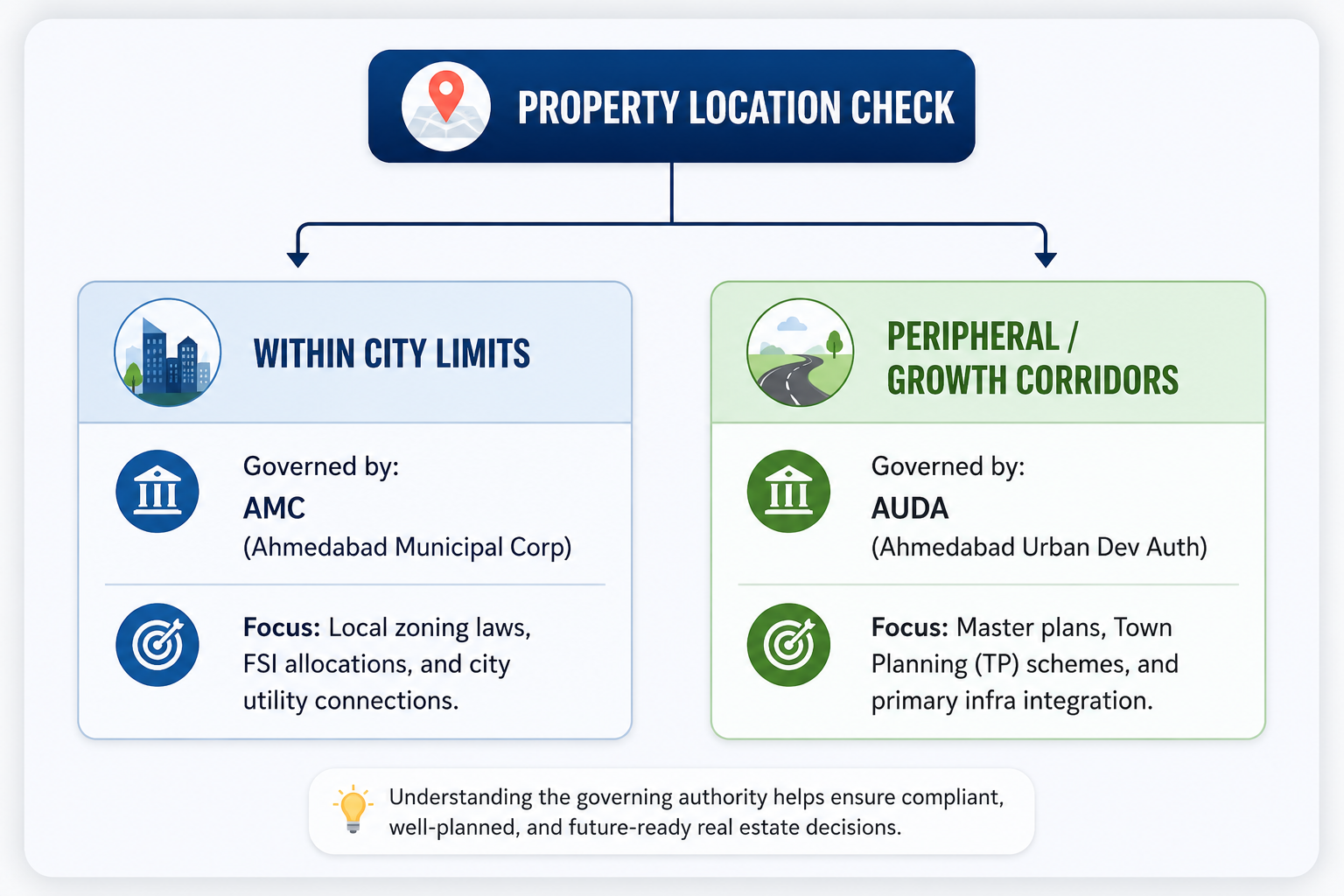
Always verify that your structural approvals are stamped by the specific competent authority holding jurisdiction over that parcel. For properties inside the city core, verify utility linkages directly via the official AMC E-Services Portal. If a project claims to be under an upcoming Town Planning (TP) scheme, cross-check the official AUDA or AMC draft maps to confirm that your specific building plot is not zoned for public parks, road-widening buffer lines, or government infrastructure. You can read our complete market drilldown in within the city core, verify utility connections directly through Ahmedabad 2041 Blueprint
Marketing campaigns can make any developer appear flawless. To understand your ownership experience, we can use a simple method to improve your sales presentations and historical performance by analysing past data.
Before choosing a developer, conduct an independent review using these five criteria:
Transparency in real estate information is shifting dramatically. As covered in a recent Times of India Ahmedabad real estate report, GujRERA is expanding public access by actively displaying developers' past project records and pending complaint track records right alongside new project registration profiles. Because the regulatory authority is making complete partner history transparent to help consumers verify the performance of a brand, you should never make a booking decision relying on verbal promises alone. Always check the official data layers to ensure your hard-earned capital is fully protected against unnecessary project delivery delays
To get an accurate picture, look past polished marketing testimonials and seek out real customer experiences:
A sample flat built inside a standalone sales gallery is designed to optimise space, lighting, and premium aesthetics. It is a marketing asset, not a direct blueprint of your final apartment. Real due diligence requires a physical evaluation of the actual construction site.
When exploring a sample flat, keep in mind that developers often use specific design techniques to make spaces appear larger and more luxurious:
When walking the actual layout of your under-construction tower, verify the true dimensions, structural beam drops, window placement, and wall thicknesses using a measuring tape. Bookmark our field handbook, the How to Choose the Perfect Home, before heading out.
When visiting the physical site, evaluate these key operational and environmental factors:
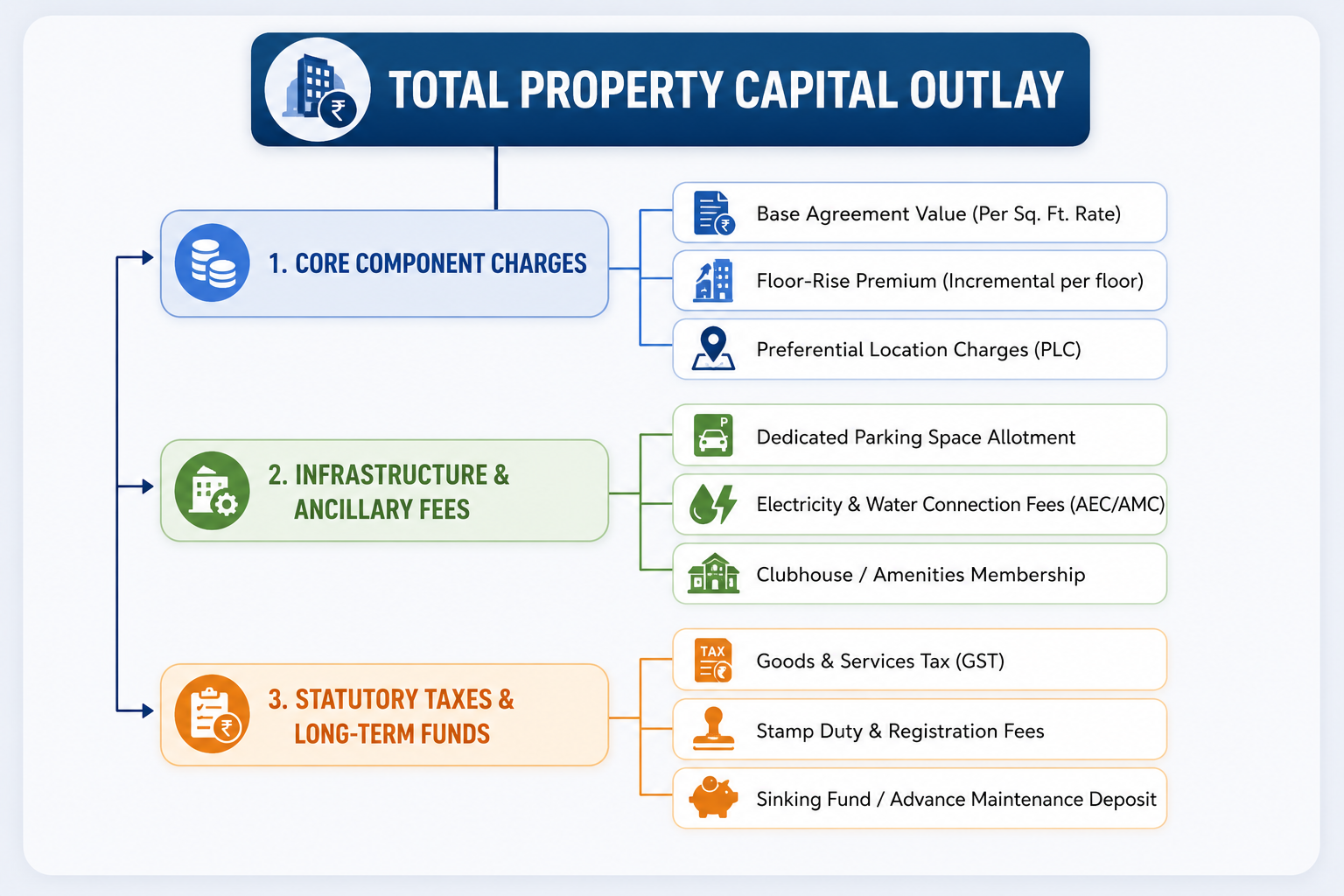
To avoid financial surprises, request a comprehensive cost sheet that breaks down every expense associated with the transaction, moving well beyond the basic per-square-foot rate.
A transparent real estate cost sheet should break down expenses into three main categories: core components (base value, floor rise, PLC), infrastructure/ancillary fees (allotted parking, utility setups, clubhouse fees), and statutory taxes/society funds (GST, stamp duty, corpus funds). Before signing, cross-check current rate slabs via the Gujarat Stamp Duty Guidance portal to confirm that your registration fees are mapped correctly. The ripple effect of major financial hubs heavily dictates property values across North Ahmedabad. Buyers looking for capital growth near the Gandhinagar corridor should monitor the infrastructure milestones on the official GIFT City IFSC portal to separate real economic demand from standard sales-lounge hype.
In real estate, verbal assurances hold very little weight during a dispute. If an agreement or promise is not documented in writing or captured in immutable digital records, it effectively does not exist.
Before handing over a booking cheque or signing a financial agreement, create a dedicated digital vault for your transaction and secure the following records:
High-Resolution RERA Portal Screenshots: Capture the active project details screen, the recorded RERA end date, the uploaded sanctioned floor layouts, and the formal developer declaration sheet.
The Original Signed Cost Sheet: Store a copy of the itemised sheet signed and stamped by the authorised sales director or channel partner, detailing the exact unit number, floor-rise details, PLC waivers, and the agreed-upon payment schedule.
The Official Sample Flat Layout: Take clear photographs and video walkthroughs of the sample flat during your tour. Document the exact positions of structural walls, electrical plug points, plumbing fixtures, and the specific brands used for window frames, switches, and sanitary ware. This gives you clear reference material if the developer swaps out materials for lower-grade alternatives during the final build phase.
All Official Communication Channels: Save all formal email chains, official pricing quotes, and important updates sent via the developer's verified WhatsApp Business account. This includes any written timelines for construction milestones, payment flexible windows, or promised modifications to internal finishes.
Conducting comprehensive property verification requires a significant investment of time, research, and technical knowledge. Navigating public land registries, checking local planning municipal databases, tracking title deeds, and conducting on-site engineering audits can easily become overwhelming for an individual buyer.
This is exactly why we built the EXIO Rating System.
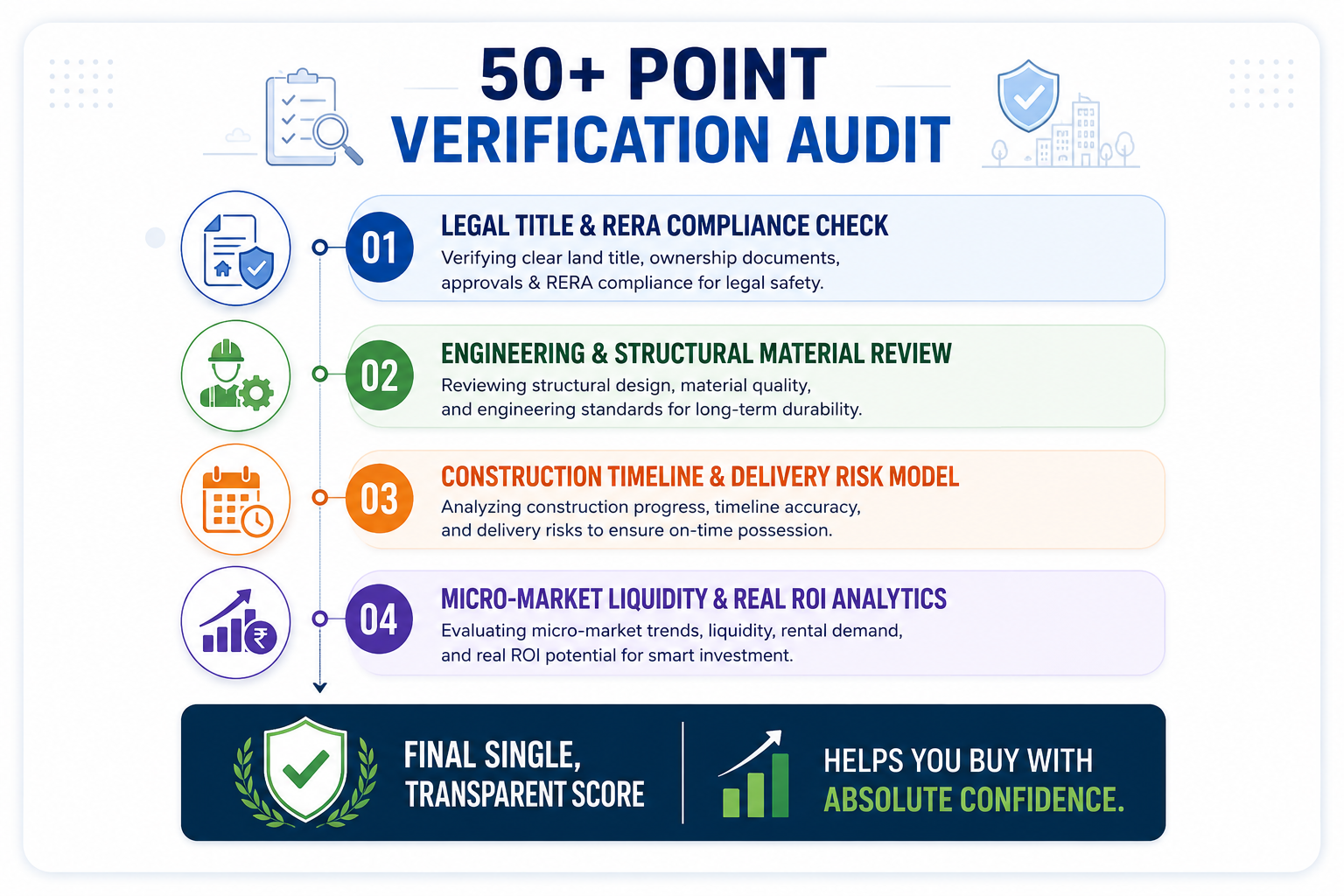
Our system condenses this complex due diligence process into a clear, transparent evaluation. Every project featured on our platform undergoes a thorough 50+ point verification audit managed by independent property lawyers, structural engineers, and real estate market analysts. We handle the background checks so you can focus on finding the right property:
By distilling these data points into a single score, the EXIO Rating helps you skip the guesswork and invest with clarity and confidence. If you want to bypass filtering altogether, you can explore our pre-vetted catalogue of RERA-verified projects.
Don't rely on verbal promises. EXIO evaluates over 50 technical and structural parameters for developments across Ahmedabad and Gandhinagar so you can review the facts before making a move.
RERA Validation: Confirmed legal end dates and approved layout tracking.
Financial Baseline: True cost itemisation to avoid hidden sales lounge premiums.
On-Site Audit Metrics: Independent assessments of build quality and lift-to-flat ratios.
Download Property Insight Report
Can't decide between two or three developments in the same neighborhood? Use our comparison portal to view structural ratings, pricing breakdowns, and possession velocities side by side.
Select your top properties, see how they measure up against each other, and instantly export the complete layout analysis as a clean, single report.
Compare & Download Comparison PDF
Yes. Any commercial or residential project with a land area exceeding 500 square meters, or proposing more than 8 apartments, must be registered with Gujarat RERA before the developer can advertise or sell units.
Walk away. A reputable developer with clean paperwork will never hesitate to share title documents or JD agreements with a serious buyer's legal counsel. Refusal is a massive red flag.
No. Bank project approvals (APF numbers) indicate the bank is willing to lend against the project, but it does not replace a personalised title search and legal opinion regarding your specific unit and the underlying land.
A thorough legal and technical verification by an independent lawyer and civil auditor typically takes 7 to 14 days, depending on the complexity of the land history and the responsiveness of local authorities (AMC/AUDA).
Yes. Through our premium advisory services, the EXIO team can conduct a comprehensive audit on any prospective property, ensuring your capital is deployed safely.

28 Aug 2025

25 Aug 2025

29 Aug 2025

06 Oct 2025

26 Aug 2025
 Login
Login
 Investment Advisory
 Contact Us