
 Login
Login
 Investment Advisory
 Contact Us

Imagine finding two almost identical homes in Ahmedabad. One is an under-construction apartment priced several lakhs lower, while the other is a ready possession home that's available today. Most buyers assume the cheaper option is the smarter investment, but what if that decision ends up costing more because of GST, construction delays, rent + EMI, or hidden ownership costs?
That's the question every homebuyer should ask before booking. In this guide, we'll compare under construction vs ready to move Ahmedabad, uncover the real cost beyond the price tag, explain your GujRERA rights, and help you choose the option that truly fits your budget, timeline, and long-term goals.
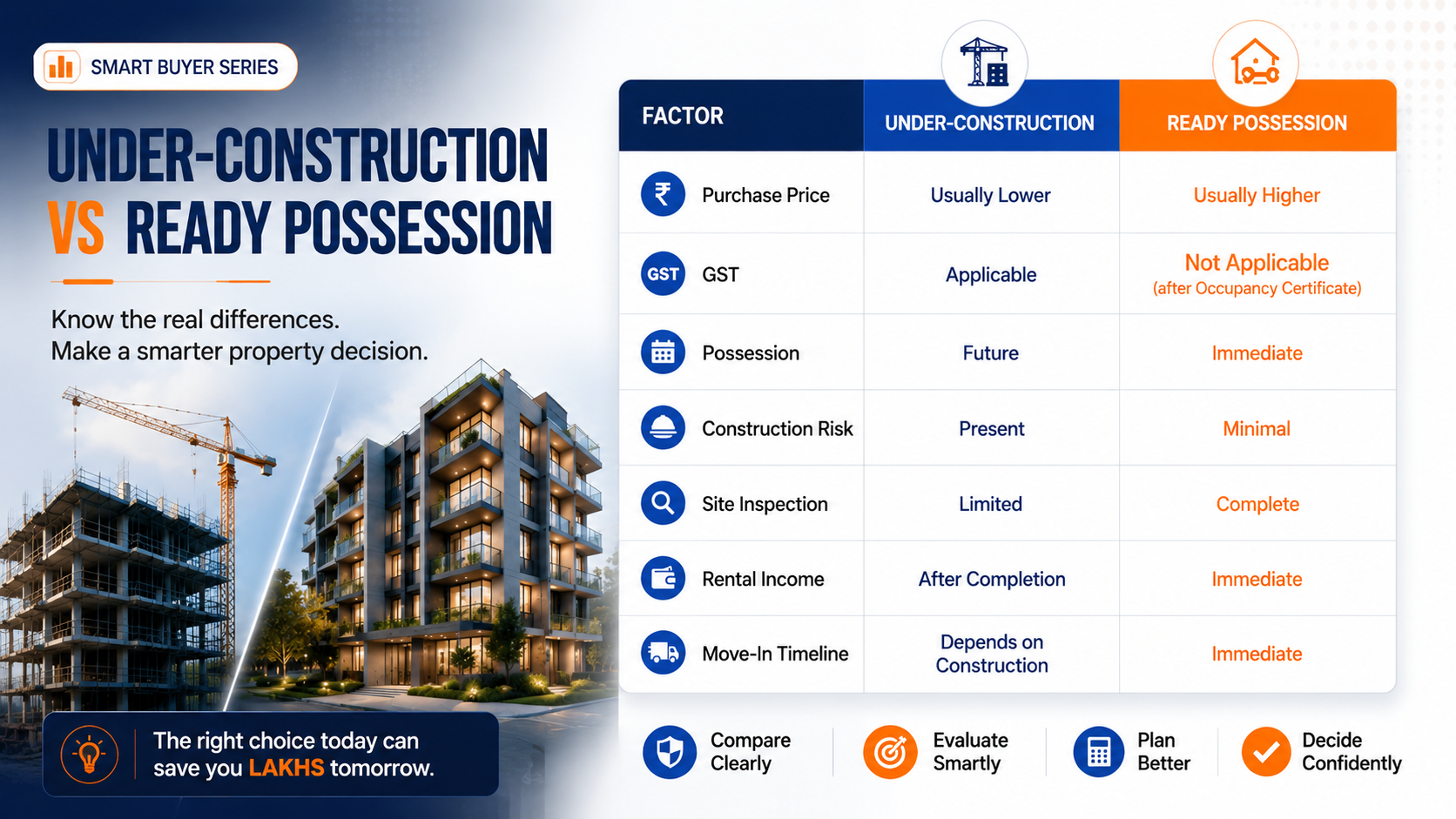
The Cost Gap, And What Actually Drives It
One of the biggest misconceptions in Ahmedabad's property market is that under-construction homes are always cheaper than ready possession properties.
While the initial booking price is often lower, the purchase price alone doesn't tell the complete story.
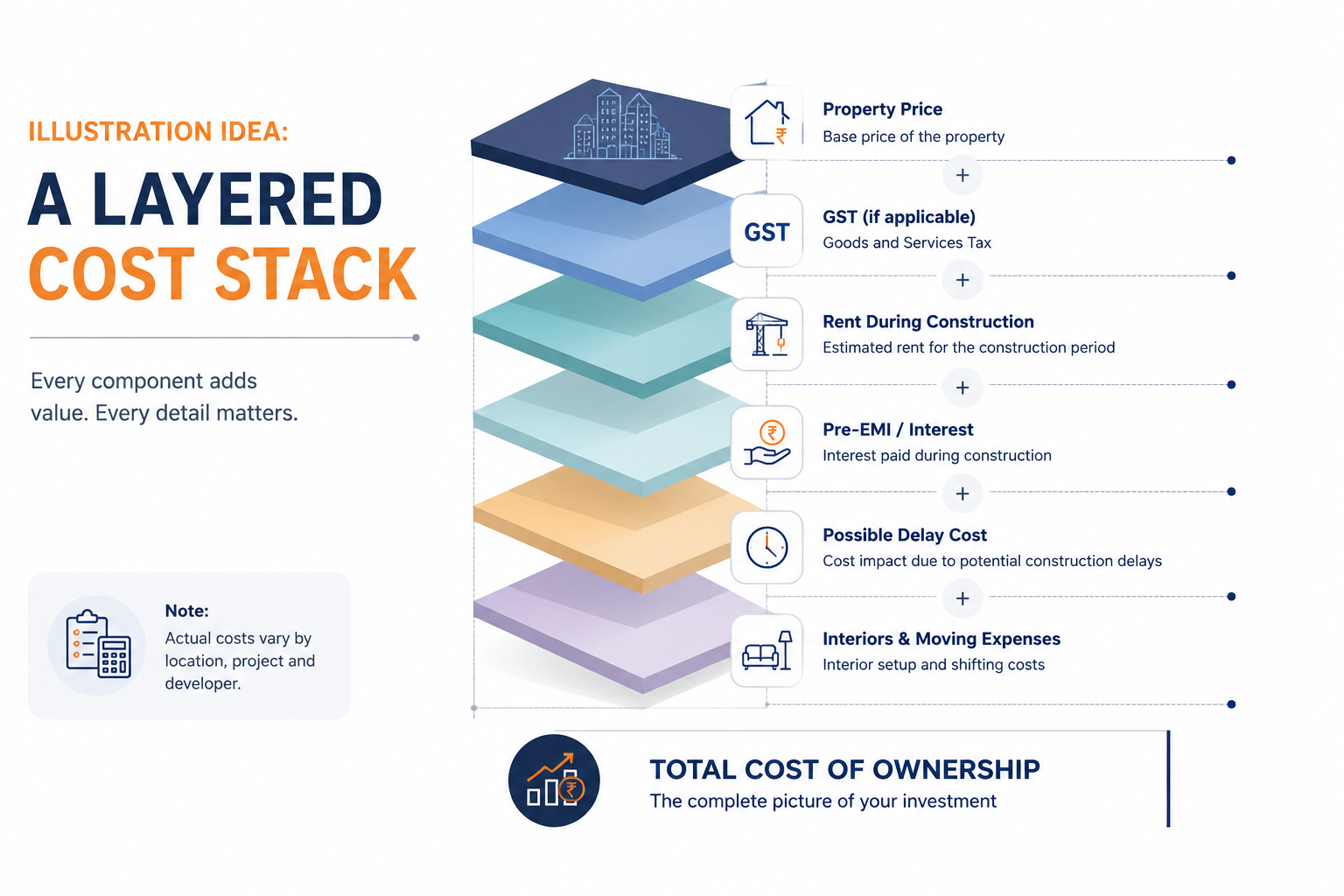
A property's true cost includes everything you spend from booking until the day you actually move in, or start earning rental income.
Let's understand what creates the price difference.
Why Under-Construction Projects Cost Less Initially
Builders typically launch projects at lower prices during the early stages of construction to attract buyers and generate cash flow.
These projects often offer:
- Early-bird pricing
- Flexible construction-linked payment plans
- Lower upfront investment
- Better unit selection
- Higher appreciation potential if the location develops as expected
For long-term investors, these advantages can create meaningful capital appreciation by the time the project is completed.
However, lower entry pricing comes with trade-offs.
Since the property is still under construction, buyers also take on risks related to project execution, delivery timelines, and changing market conditions.
Why Ready Possession Properties Command a Premium
A ready possession apartment represents certainty.
What you see is exactly what you're buying.
You can:
- Inspect the construction quality.
- Verify natural lighting and ventilation.
- Check parking availability.
- Evaluate the neighbourhood.
- Understand maintenance standards.
- Move in immediately or rent the property without waiting.
This certainty naturally increases demand, which often results in a higher purchase price.
However, the premium isn't simply for a completed building; it's for eliminating many of the uncertainties associated with construction.
The Hidden Costs Buyers Often Ignore
Many buyers compare only these two numbers:
Under Construction: ₹95 lakh
Ready Possession: ₹1.05 crore
The immediate assumption is that buying under construction saves ₹10 lakh.
But the calculation doesn't end there.
Before deciding, buyers should also account for:
- GST (where applicable)
- Rent paid while waiting for possession
- Pre-EMI or home loan interest during construction
- Registration timing
- Interior and shifting expenses
- Possible construction delays
- Opportunity cost if possession is postponed
Once these expenses are included, the overall cost difference may become much smaller than it initially appears.
For example, a buyer paying ₹28,000 in monthly rent while also servicing a home loan during construction could spend several lakhs before even receiving possession of the property. That hidden financial burden rarely appears in marketing brochures, but it has a significant impact on the overall affordability of an under-construction purchase.
EXIO Advisor Insight
When evaluating a property, don't ask "Which home is cheaper?" Instead, ask "Which option will cost me less over the next three to five years?"
Looking beyond the booking price often leads to a more informed financial decision, especially for first-time homebuyers.
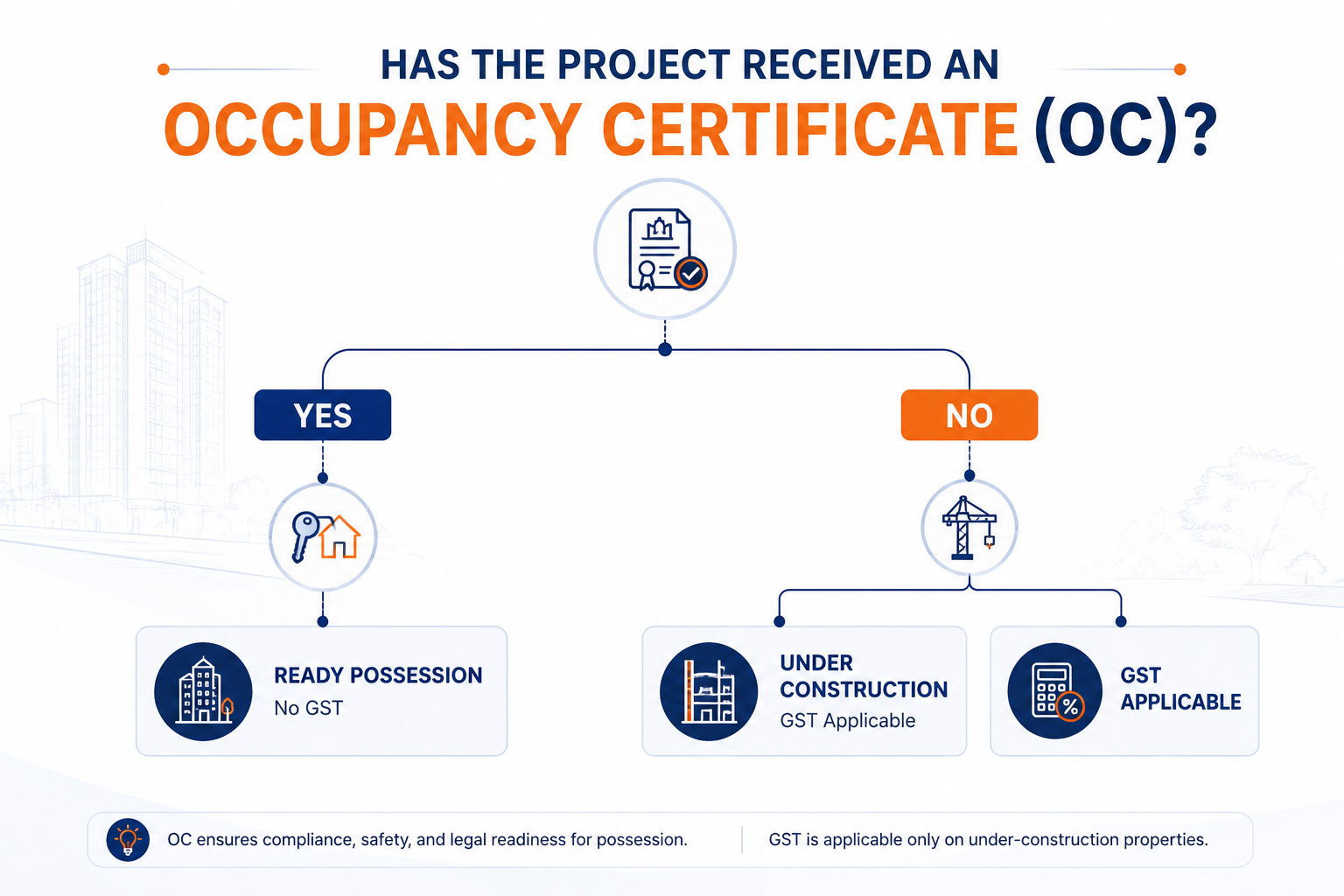
GST: Why It Changes the Comparison
For many homebuyers, GST is one of the most misunderstood aspects of purchasing a property. Yet it can significantly influence the overall cost, especially when comparing an under-construction project with a ready possession apartment.
The key factor isn't whether a building looks complete, it's whether it has received an Occupancy Certificate (OC).
Under the current GST framework, under-construction residential properties generally attract 5% GST (or 1% for eligible affordable housing projects), without input tax credit. This tax is payable because the property is considered to be under construction at the time of sale.
In contrast, a ready possession property that has already received its Occupancy Certificate is not subject to GST, as the transaction is treated as the sale of completed immovable property rather than a construction service.
This distinction can make a noticeable difference to your final purchase cost, particularly in higher-value homes.
Key Takeaway
The Occupancy Certificate (OC) is the legal dividing line between an under-construction property and a GST-exempt ready possession property. Before assuming that a project is "ready," always ask the builder or seller to provide a copy of the Occupancy Certificate.
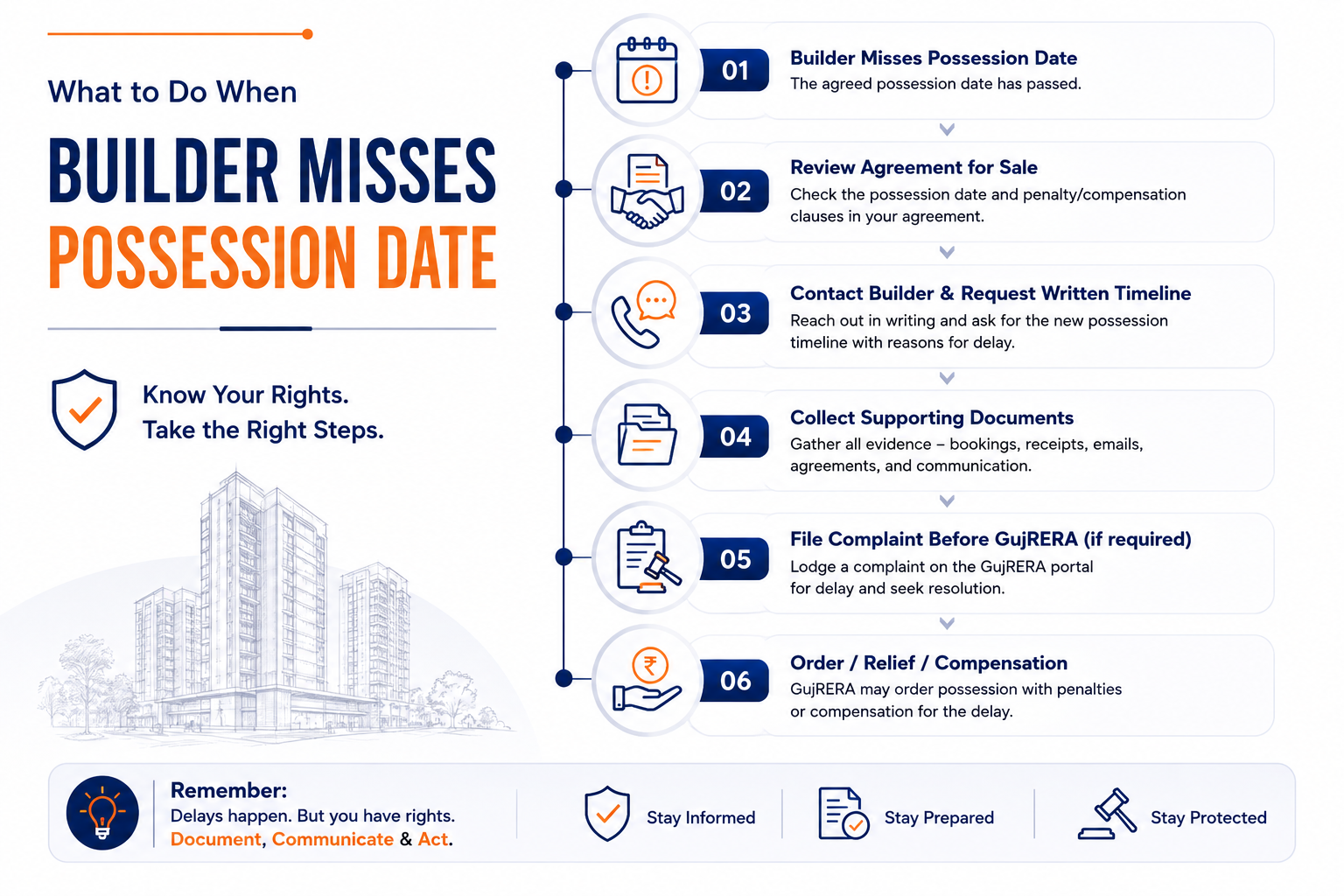
Possession Risk - What Happens If Your Dream Home Gets Delayed?
When buyers compare under construction vs ready to move Ahmedabad, they usually focus on price. But in reality, time is often more expensive than money.
A project delayed by 12 to 18 months doesn't just postpone your move-in date, it can disrupt your finances, family plans, children's school admissions, and even your investment returns.
This is where the biggest difference between an under-construction property and a ready possession home becomes clear.
Unlike a ready flat, an under-construction project carries execution risk. While many reputed developers deliver projects on time, delays can happen for various reasons, some within the builder's control and others outside it.
Why Do Projects Get Delayed?
A construction delay doesn't always mean the builder is unreliable. Real estate projects involve multiple approvals, contractors, suppliers, and government agencies.
Some common reasons include:
- Delays in statutory approvals or revised permissions.
- Labour shortages or contractor issues.
- Rising construction material costs.
- Supply chain disruptions.
- Financing challenges for the developer.
- Changes in project design or specifications.
- Unexpected legal disputes or environmental clearances.
For buyers, the reason may matter less than the outcome: you still have to wait longer than expected.
What Protection Does GujRERA Offer Buyers?
The Real Estate (Regulation and Development) Act, 2016 (RERA) was introduced to improve transparency and accountability in the real estate sector. In Gujarat, these provisions are implemented through GujRERA.
If a registered project is delayed beyond the possession date mentioned in the Agreement for Sale, subject to the terms of the agreement and applicable law, a buyer has legal remedies available.
Depending on the circumstances, buyers may:
- Seek possession with applicable interest for the delay.
- Request a refund with interest if they choose to withdraw.
- File a complaint before GujRERA for relief.
- Track project details and updates through the GujRERA portal.
These rights are governed under the provisions of the Real Estate (Regulation and Development) Act, 2016, which aims to protect homebuyers while ensuring accountability from developers.
EXIO Advisor Insight
RERA provides important legal protection, but it shouldn't be your primary risk-management strategy. The better approach is to evaluate a builder's delivery history before booking. A developer with a consistent track record of timely possession generally presents a lower execution risk than relying on legal remedies after a delay occurs.
Before You Book: Verify These 5 Things
Many buyers only ask, "When will I get possession?"
A better question is:
"How likely is the builder to deliver on that promise?"
Before booking an under-construction property, verify these five factors:
1. Check the Builder's Delivery History
Look beyond glossy brochures.
Ask questions like:
- How many projects has the builder completed?
- Were previous projects delivered on time?
- Have buyers reported recurring delays?
- Is construction quality consistent across projects?
Past performance doesn't guarantee future results, but it is one of the strongest indicators available.
2. Verify the Project's GujRERA Registration
Every eligible project should have a valid RERA registration.
The GujRERA portal allows buyers to verify:
- Registration number
- Approved project details
- Construction progress updates
- Expected completion timeline
- Regulatory disclosures
If a builder hesitates to share the RERA number, treat it as a warning sign.
3. Visit the Construction Site
Photos on marketing brochures rarely tell the complete story.
A site visit helps you assess:
- Actual construction progress
- Number of workers on-site
- Quality of materials being used
- Whether the pace matches the promised timeline
Even a single visit can reveal whether the project appears active or stagnant.
4. Read the Agreement Carefully
Don't focus only on the payment schedule.
Pay close attention to:
- Possession date
- Grace period clauses
- Delay provisions
- Cancellation terms
- Refund conditions
Understanding these clauses before signing can prevent disputes later.
5. Understand the Local Infrastructure Timeline
Sometimes the apartment is ready, but the surrounding infrastructure isn't.
Check whether the area has:
- Functional access roads
- Water and drainage connections
- Public transport
- Schools and hospitals
- Daily convenience stores
A beautiful apartment in an underdeveloped neighbourhood may still require years before offering the lifestyle you expected.
Rent + EMI: The Hidden Cost Most Buyers Never Calculate
One of the biggest financial mistakes homebuyers make is comparing only the property's purchase price.
What they often ignore is the overlap period between their current living expenses and their future home loan.
This overlap can quietly cost several lakhs.
| Monthly Expense | Amount |
|---|---|
| Current House Rent | ₹28,000 |
| Pre-EMI During Construction | ₹34,000 |
| Total Monthly Outflow | ₹62,000 |
If the project gets delayed by 18 months, the additional outflow becomes:
₹62,000 × 18 = ₹11.16 lakh
That's more than many buyers negotiate as a discount while booking the property.
The longer the delay, the larger this hidden cost becomes.
EXIO Advisor Commentary
When advising first-time buyers, we don't compare properties based only on price per square foot.
We also compare time-related costs.
A project that appears ₹8–10 lakh cheaper at launch may lose much of that advantage if construction extends well beyond the planned possession date and the buyer continues paying rent alongside loan obligations.
That's why evaluating builder credibility, project progress, and realistic delivery timelines is just as iortant as negotiating the purchase price.
What You Can, and Cannot, Verify Before Buying
After discussing costs, GST, and possession risks, there's one question every buyer should ask:
"Am I buying a promise, or am I buying a finished product?"
This is where the comparison between under construction vs ready to move Ahmedabad becomes even more important.
A beautifully designed brochure, a sample flat, and a 3D walkthrough can certainly help you visualise your future home, but they cannot replace physically experiencing the completed property.
With a ready possession apartment, what you see is exactly what you'll receive. With an under-construction project, some aspects can only be assessed after completion.
Understanding this difference can help you avoid unpleasant surprises after possession.
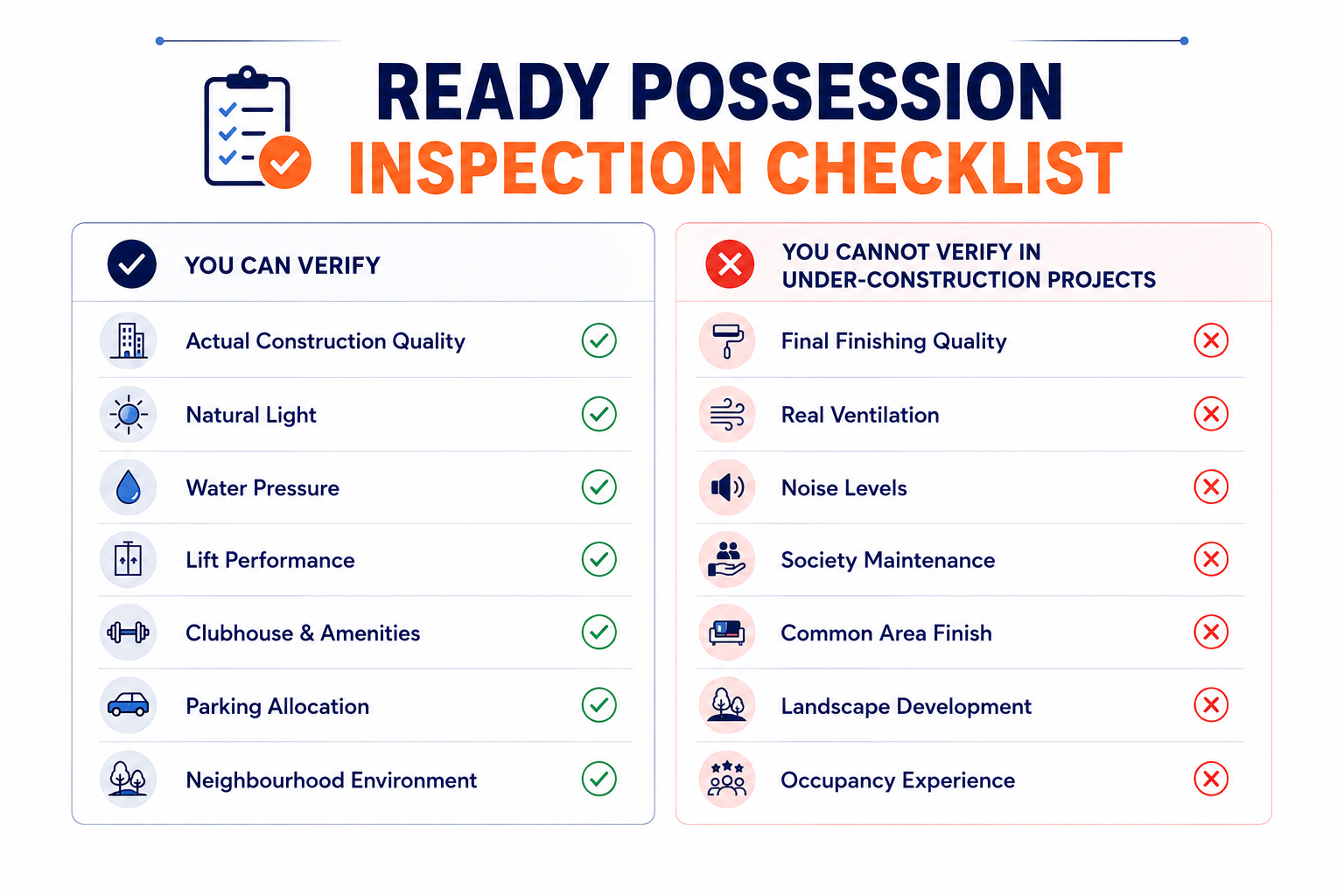
What You Can Verify in a Ready Possession Flat
A ready possession property gives buyers something that under-construction projects simply cannot, certainty.
Before making your purchase, you can inspect almost every aspect that affects your everyday life.
1. Construction Quality
You can personally examine:
- Wall finishing
- Tile installation
- Paint quality
- Doors and windows
- Waterproofing
- Bathroom fittings
- Balcony finishing
Instead of relying on promises, you're evaluating the actual product.
2. Natural Light and Ventilation
Marketing brochures often describe homes as "well-ventilated" or "naturally lit."
A site visit tells the real story.
Visit the property at different times of the day to understand:
- Morning sunlight
- Afternoon heat
- Air circulation
- Cross ventilation
- View from the balcony
These are factors that significantly influence comfort but cannot be judged from a floor plan alone.
3. Common Areas and Amenities
A completed project allows you to inspect:
- Clubhouse
- Swimming pool
- Gym
- Children's play area
- Landscaped gardens
- Internal roads
- Security systems
- Visitor parking
- Lift quality
- Power backup
Instead of asking "Will this be completed?", you're asking "Is this maintained well?"
4. Neighbourhood Experience
Location is more than a pin on Google Maps.
Spend time around the project.
Check for:
- Traffic during peak hours
- Noise levels
- Nearby schools
- Grocery stores
- Hospitals
- Public transport
- Waterlogging after rain (if possible)
- Future infrastructure development
A ready property lets you evaluate the complete lifestyle, not just the apartment.
5. Society Occupancy
One overlooked advantage of ready possession homes is that you can interact with existing residents.
Ask questions like:
- How reliable is the water supply?
- Are maintenance charges reasonable?
- Does the builder respond after possession?
- How active is the residents' association?
- Are there recurring maintenance issues?
Real experiences from current residents often provide more valuable insights than any sales presentation.
What You Cannot Fully Verify in an Under-Construction Property
This doesn't mean under-construction projects are bad investments.
Many excellent projects are purchased years before completion.
However, buyers should recognize the limitations.
Before possession, you generally cannot verify:
- Actual room finishing
- Paint quality
- Waterproofing
- Lift performance
- Water pressure
- Clubhouse functionality
- Landscaping quality
- Parking convenience
- Society management
- Construction workmanship in completed form
You're making a decision based largely on:
- Builder reputation
- Approved plans
- Sample flat
- Technical specifications
- Construction progress
- Legal documentation
That's why builder credibility becomes one of the most important evaluation factors.
EXIO Advisor Commentary: There Is No Universal "Better" Option
One of the biggest mistakes buyers make is asking:
"Which is better, under construction or ready possession?"
The better question is:
"Which is better for my financial situation, timeline, and risk tolerance?"
At EXIO, we don't automatically recommend either category.
Instead, our advisory process evaluates every buyer's requirements alongside the project's overall quality.
Rather than focusing only on price, we assess factors such as:
- Builder delivery history
- RERA compliance
- Construction quality
- Location fundamentals
- Long-term appreciation potential
- Financial viability
- Buyer's investment horizon
- Family requirements
- Cash flow and loan obligations
This helps buyers choose the option that aligns with their goals rather than simply following market trends.
How EXIO Weighs Different Buyer Profiles
Every buyer has different priorities.
Someone purchasing their first home usually values certainty and financial stability, while an investor may be willing to accept construction risk for better long-term appreciation.
Here's how EXIO typically approaches different buyer profiles:
| Buyer Profile | Under-Construction | Ready Possession |
|---|---|---|
| First-Time Buyer | Suitable if the builder has a strong delivery record and the timeline fits your financial plan. | ✅ Often preferred for immediate certainty and easier budgeting. |
| Home Upgrader | Works well if your current home's sale and the new possession timeline can be coordinated. | ✅ Ideal when avoiding temporary rental accommodation is a priority. |
| Long-Term Investor (5–7 Years) | ✅ Can offer better appreciation when entering early in a quality project. | Suitable if immediate rental income is the main objective. |
| NRI Buyer | Appropriate with a reputed developer and strong legal due diligence. | ✅ Lower execution risk when managing the purchase remotely. |
| Retired Buyers | Delays can affect relocation plans. | ✅ Generally preferred due to immediate usability and predictability. |
Decision Matrix: Which Option Fits Your Priorities?
Instead of asking "Which property is better?", identify what matters most to you.
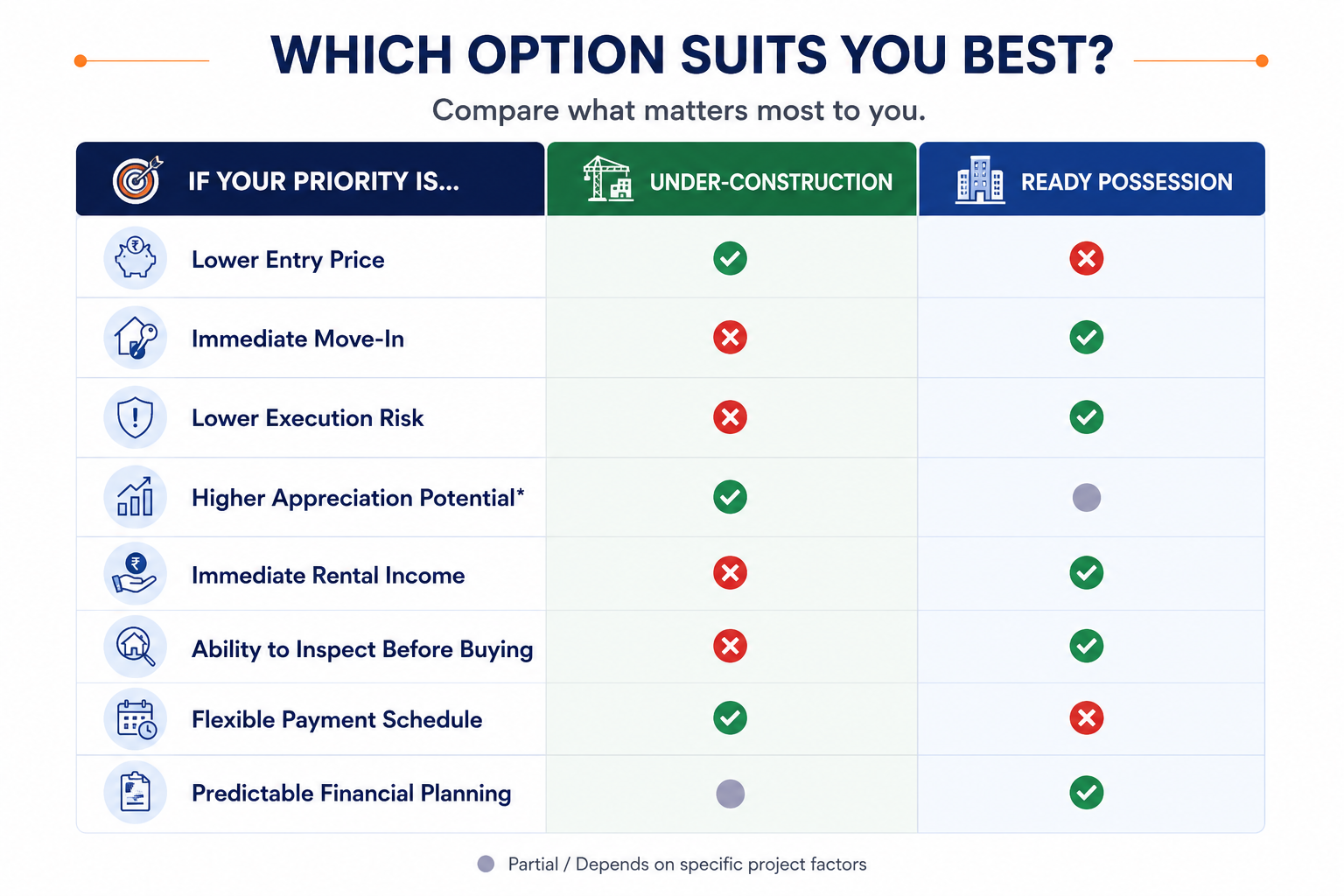
*Appreciation depends on location, builder quality, infrastructure growth, and market conditions, it is not guaranteed.
A Quick Self-Assessment Before You Decide
Before signing your booking form, ask yourself these questions:
- Do I need to move into the property within the next 12 months?
- Can I comfortably manage both rent and home loan payments if possession is delayed?
- Have I verified the builder's previous delivery record?
- Am I relying on expected future appreciation, or buying primarily for self-use?
- Have I inspected all available legal documents, including the RERA registration?
- Is this purchase aligned with my long-term financial goals?
If you answer these questions honestly, your decision becomes much clearer, and less influenced by promotional offers or market hype.
Who Should Choose Under-Construction and Who Should Choose Ready Possession?
By now, you've seen that the debate around under construction vs. ready-to-move Ahmedabad isn't about which option is universally better.
It's about choosing the option that aligns with your financial capacity, lifestyle needs, risk appetite, and timeline.
Two buyers can purchase homes in the same locality at similar prices, and yet, one makes a smart investment while the other struggles with unexpected costs. The difference often lies in choosing the right type of property, not just the right project.
Let's simplify the decision.
Choose an Under-Construction Property If…
An under-construction property can be a rewarding choice when you have time on your side and are investing in the right project.
It may be the better option if:
- You're buying for the long term (5–10 years).
- You don't need to move in immediately.
- You want a lower entry price and flexible payment plans.
- You're comfortable with market fluctuations during the construction period.
- The project is being developed by a builder with a strong delivery history.
- The location has upcoming infrastructure that could drive future appreciation.
- You have sufficient financial flexibility to handle unforeseen delays if they occur.
Best Suited For
- First-time buyers with a flexible possession timeline
- Long-term investors
- Young professionals planning for the future
- Buyers looking to maximize appreciation potential
EXIO Advisor Note
A lower launch price is valuable only when paired with a developer who has consistently delivered projects on time and maintained construction quality. Price should never be evaluated in isolation.
Choose a Ready Possession Property If…
Ready possession homes offer certainty, something many buyers value more than saving a few lakhs upfront.
A ready possession property is often the better choice if:
- You need to shift within the next few months.
- You want to avoid the uncertainty of construction delays.
- You're currently paying rent and want to eliminate the rent-plus-EMI overlap.
- You prefer inspecting the actual apartment before making a purchase.
- You're purchasing the property for immediate self-use.
- You want rental income to begin immediately.
- You prefer predictable budgeting without waiting for possession.
Best Suited For
- Families upgrading to a larger home
- Buyers relocating for work
- Retired individuals
- NRIs seeking lower execution risk
- Investors focused on immediate rental returns
EXIO Advisor Note
Although ready possession properties may have a higher purchase price, they often reduce uncertainty, hidden holding costs, and financial stress, especially for end users with fixed timelines.
Quick Decision Checklist
If you're still undecided, use this simple checklist before making your final decision.
| Question | If Your Answer is YES | Consider |
|---|---|---|
| Do you need to move within the next 6–12 months? | ✅ | Ready Possession |
| Are you comfortable waiting for possession? | ✅ | Under Construction |
| Is your monthly budget tight? | ✅ | Ready Possession (to avoid prolonged rent + EMI overlap) |
| Are you investing for long-term appreciation? | ✅ | Under Construction |
| Do you want to inspect the exact apartment before buying? | ✅ | Ready Possession |
| Is the builder known for timely project delivery? | ✅ | Under Construction becomes a stronger option |
Find the Right Property with EXIO
At EXIO, we believe buying a property should begin with research, not sales pressure.
Unlike traditional property platforms that simply display listings, EXIO helps buyers make confident decisions through expert advisory, verified project insights, and transparent comparisons. Every recommended project is evaluated across critical parameters such as builder credibility, legal compliance, construction quality, location potential, lifestyle value, and long-term investment prospects.
Whether you're looking for an under-construction project with strong appreciation potential or a ready possession home you can move into immediately, EXIO offers carefully curated opportunities across Ahmedabad and Gandhinagar to match different budgets, timelines, and buyer goals.
Instead of asking, "Which property should I buy?" start by asking, "Which property is right for me?" That's where EXIO's advisory approach makes the difference.
Explore verified under-construction and ready possession properties with EXIO, compare projects side by side, and make your next property decision with confidence.
Discover Better. Own Smarter.
Conclusion: The Right Property Isn't the Cheaper One, It's the Right One for You
Choosing between an under-construction and a ready possession property isn't about finding a universally "better" option. It's about finding the one that fits your timeline, financial situation, and long-term goals.
If you're comfortable waiting and investing with a reputed developer, an under-construction property can offer attractive long-term appreciation and a lower entry price. On the other hand, if certainty, immediate occupancy, and lower execution risk matter more, a ready possession home may deliver better overall value despite the higher initial cost.
The smartest buyers don't make their decision based solely on price. They evaluate the builder's credibility, legal approvals, possession timeline, total ownership cost, and future growth potential before signing the booking form.
In today's market, informed decisions outperform emotional ones. Whether you're buying your first home, upgrading for your family, or investing for the future, taking the time to compare every factor, not just the price, can save you from expensive mistakes later.
Disclaimer: This article is for informational purposes only and should not be considered legal, tax, financial, or investment advice. Any prices, timelines, calculations, or examples mentioned are illustrative and may not reflect actual project or market conditions. Readers should independently verify project details, RERA registration, Occupancy Certificate (OC), applicable GST, and other legal documents before making any property-related decision.

Frequently Asked Questions
Usually, yes. Under-construction properties often have a lower booking price. However, buyers should also consider GST, rent during the waiting period, home loan interest, and possible delays before concluding that they are less expensive overall.
Generally, no. If the property has received its Occupancy Certificate (OC) before the sale, GST is not applicable. Always ask the builder or seller for a copy of the Occupancy Certificate before assuming the property is GST-free.
Every under-construction project carries some execution risk. The level of risk depends on factors such as the builder's track record, financial stability, project approvals, and construction progress. Proper due diligence significantly reduces this risk.
The local authority issues an Occupancy Certificate after confirming that the building complies with approved plans and applicable regulations. It signifies that the building is legally fit for occupation and is a key factor in determining GST applicability on residential property sales.
Not always. If a first-time buyer has a flexible timeline and chooses a reputed developer with a strong delivery history, an under-construction property can be a good long-term investment. However, buyers who need certainty and immediate occupancy often find ready possession more suitable.

