

For most families, buying property is the biggest financial transaction of a lifetime. Yet, when searching for a trusted real estate investment company or a premium property investment company, buyers are forced to make a multi-crore decision based on little more than glossy brochures and smooth sales pitches. Even with RERA in place, the market hides massive, unseen blind spots. How do you actually know if the building is structurally sound, if the layout is highly inefficient, or if the developer is facing a hidden liquidity crisis that could stall your project for years? The truth is, under the traditional market setup, you don't.
When you search for a property advisor near me, you shouldn't get a salesman; you need a data-driven real estate advisory framework that uncovers the critical flaws developers try to hide. The reality of the local market is alarming: when subjected to strict, independent structural and financial testing, nearly 40% of local housing and commercial projects are completely rejected. What are these developers hiding, and how does your prospective property stack up against these hidden risks? Let’s pull back the curtain on the exact checklist used to audit the market, why traditional real estate consultants in Ahmedabad or Gandhinagar miss these red flags, and the rigorous framework a modern real estate advisory firm uses to separate safe investments from financial traps.
The Indian real estate sector has historically operated as an unorganised landscape masked by premium branding. When an investor approaches the stock market, they have access to standardised metrics: P/E ratios, debt-to-equity margins, and quarterly audited reports. If an institutional fund wants to purchase debt papers, they rely on credit rating agencies to tell it the exact probability of default.
However, when a retail buyer walks into a developer's experience centre, they are met with a completely different reality:
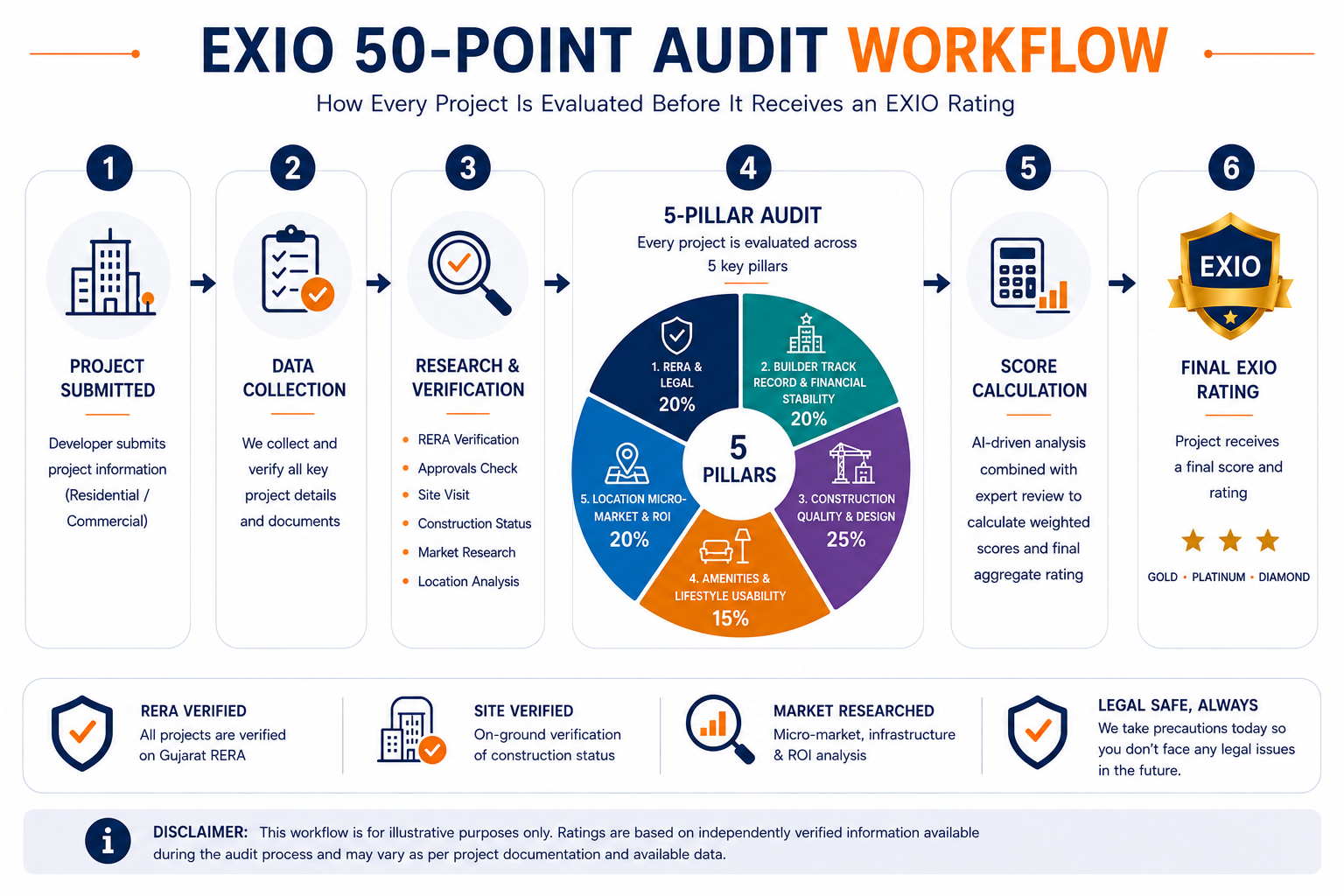
Recognising this critical institutional deficit, we realised that the market did not just need another real estate aggregator, it needed an independent, transparent auditing framework. What is exio rating? It is the transition from speculative buying to quantified risk assessment. We built it to level the playing field, providing regular homebuyers with the same data assets that institutional private equity firms use when underwriting multi-crore real estate deals.
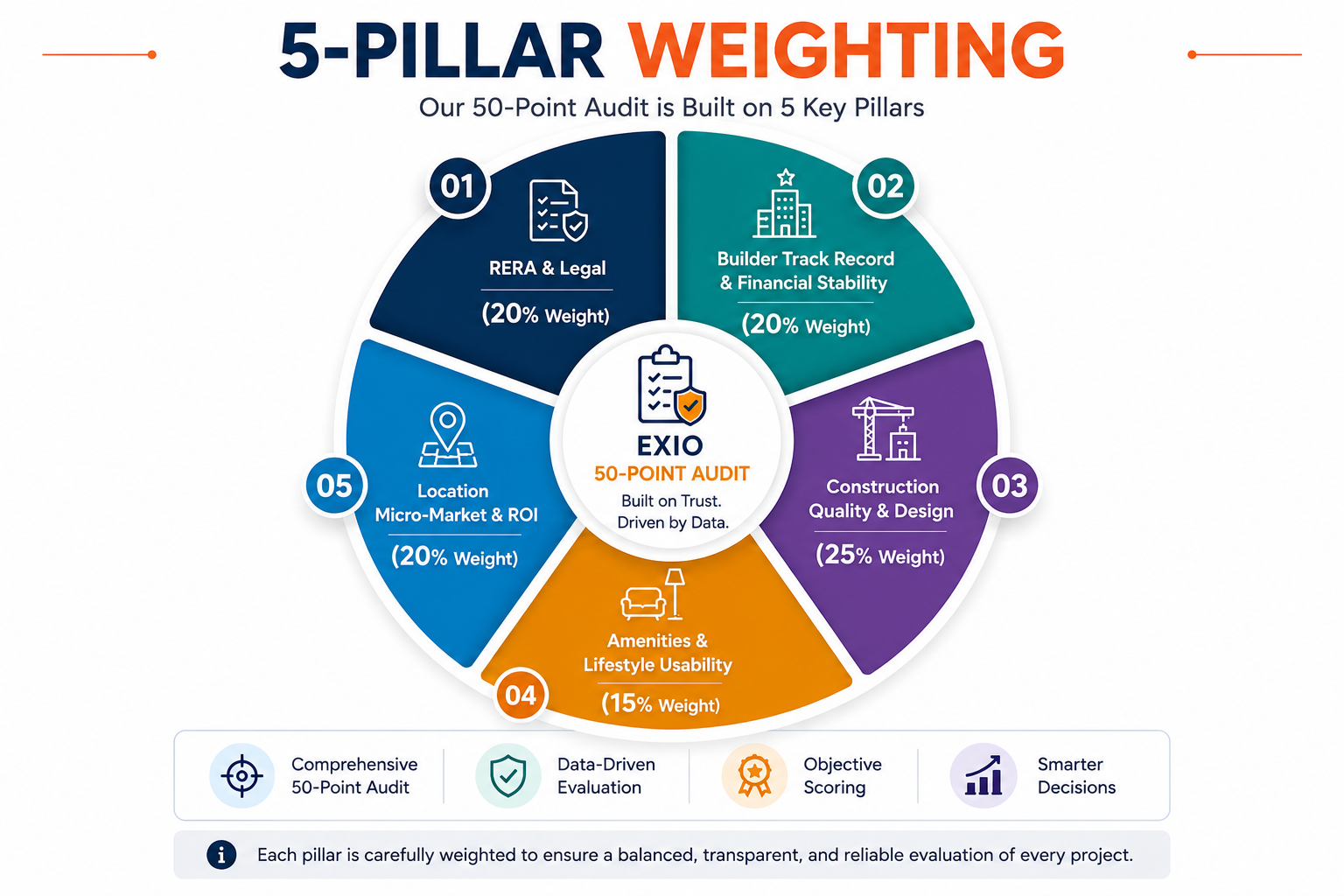
This is the absolute gatekeeper of our system. If a project suffers from fundamental legal infirmities, the audit process terminates immediately, and the project is flagged as uncertified. We deep-dive into 10 sub-checks:
A developer's past performance is the most accurate indicator of their future behaviour. We look past corporate public relations to measure hard delivery metrics.
Holding the highest weight in our framework, this pillar shifts from paperwork to physical engineering. A home must be built to endure for generations.
Modern projects frequently boast long lists of amenities that look impressive on a sales brochure but quickly turn into operational liabilities. We assess long-term usability.
This pillar grounds the asset in its geographic and macroeconomic reality, focusing heavily on modern urban corridors like the real estate rating Ahmedabad micro-markets.
To understand how Ahmedabad's upcoming infrastructure projects, growth corridors, and long-term urban planning could influence future property values, explore our Ahmedabad 2041 Blueprint: Why Smart Investors Are Positioning Now.
The final Exio Rating is an aggregate, weighted reflection of all 50 data points. To understand how this works in practice, let us review a worked example of a premium residential development currently under audit.
The formula for the final score is mathematically represented as:
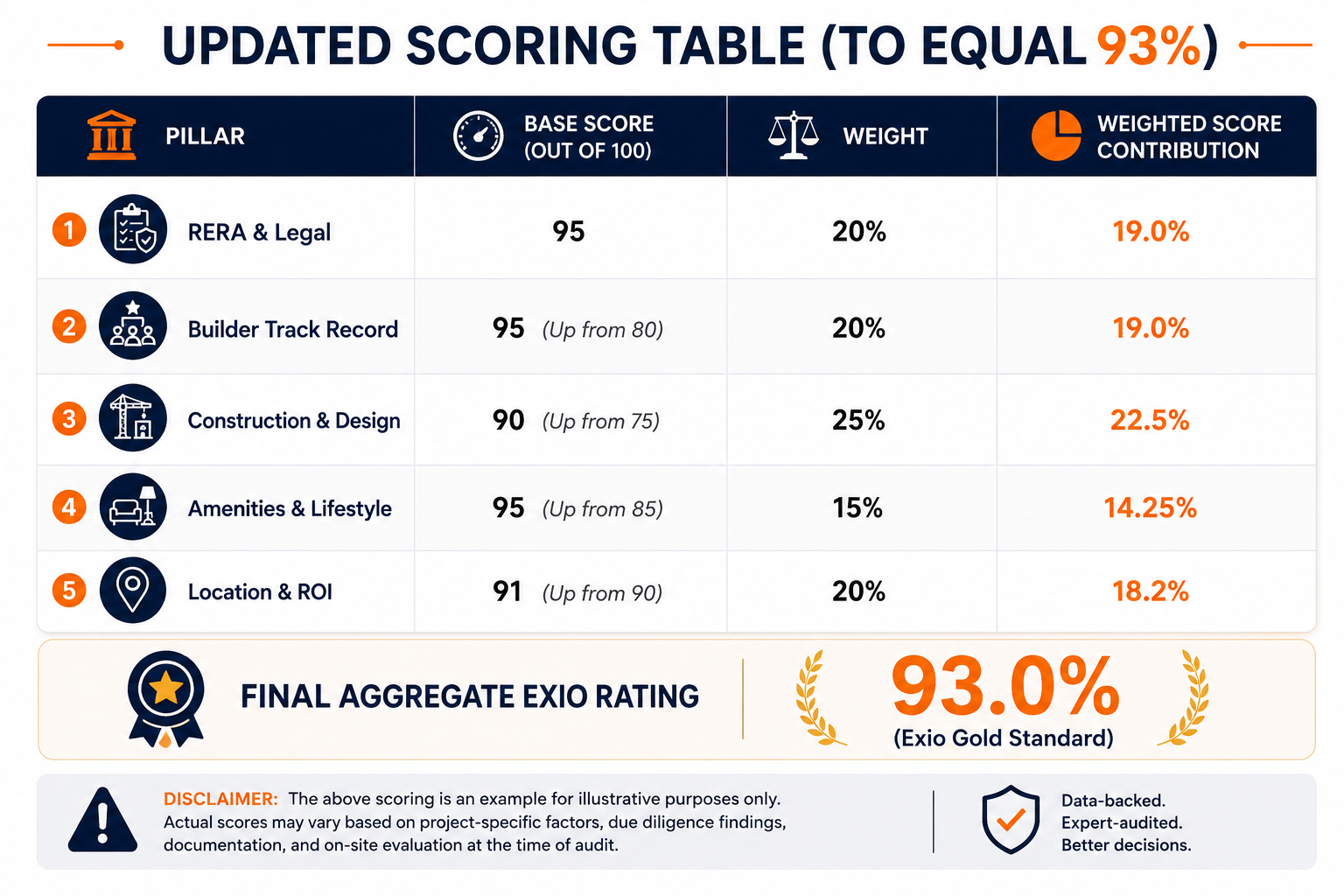
Anatomy of a Score: Even though this project scored exceptionally well on location & ROI (91), Amenities & Lifestyle (95) and legal clearances (95), its construction quality score (90) and moderate builder track record (95) pulled the final rating down to 93%. This provides buyers with a transparent view of exactly where the minor risks lie before they sign the purchase agreement.
Curious how other developments compare? Browse our Exio Certified Projects to explore properties evaluated using the same 50-point audit methodology.
The true value of a rating system lies entirely in its independence and willingness to say no. Our strict adherence to the exio rating methodology means that nearly 40% of audited projects fail to receive our stamp of approval.
Automatic Disqualification Thresholds: Any project that scores below 70% in either the Legal or Construction pillars is automatically denied certification, regardless of how exceptional its location, ROI projections, or luxury amenities may be. We do not compromise on structural safety or legal ownership.
Common Failure Points: The primary drivers behind project rejections include unapproved layout modifications hidden from buyers, a history of delivery delays exceeding 18 months without valid cause, severe debt leverage on the project land bank, or highly inefficient floor plans with excessive super-built-up loading.
Unbiased Standards: Because our audit processes operate independently of developer sponsorship, our reports protect consumer capital from structural delivery risk. We do not accept payment to alter scores.
This provides buyers with a transparent view of exactly where the minor risks lie before they sign the purchase agreement. While the Exio Rating simplifies property evaluation, buyers can also perform their own due diligence using our detailed 7-step property verification guide.
While the Exio Rating is designed as a protective shield for property buyers, it also offers immense value to high-quality real estate developers. In a crowded marketplace where every builder claims to be premium, an exio certified meaning translates to verified trust.
Accelerated Sales Velocity: Certified projects bypass traditional consumer hesitation. Because the legal, financial, and structural due diligence is already laid bare, buyers can transact with confidence, significantly lowering customer acquisition costs for the developer.
Market Differentiation: An Exio Certification separates institutional-grade developers from speculative builders, highlighting compliance, financial discipline, and engineering excellence.
B2B Claim Flow: Developers who want to demonstrate their commitment to transparency can officially apply to initiate an audit for their active or upcoming projects through our structured B2B claims pipeline. Once a request is logged, our independent engineering panels, legal teams, and financial analysts deploy to the site, inspect the documentation, verify the physical benchmarks, and publish the verified rating directly to our live public project database.
Don’t gamble your life savings on marketing promises and glossy brochures. Get access to the hard data before you invest.
Access our verified database to explore the elite tier of local real estate. Every project listed here has passed our rigorous 50-point framework with an institutional score of 90% or higher.
If you build with uncompromising quality, prove it to your buyers. Put your active or upcoming project through our independent legal, financial, and structural vetting panels to earn your certification.
No, never. A builder can pay a standard fee to cover the cost of sending our inspectors to their site, but they cannot buy a higher score. Our marking system is fixed. If a project has bad construction quality or hidden legal issues, it fails our test, no matter how big or wealthy the developer is.
A score of 90% or higher means the project is in our Elite Tier. It indicates that the property is very safe. The paperwork is completely clean, the rooms are spaced out efficiently without wasted wall gaps, and the builder has a strong history of handing over keys on time.
Buildings change every month, so we check them constantly. While the location stays the same, we review the actual building speed and the builder's money status every three months. This ensures the score you see on our website matches exactly what is happening on the ground.
Yes, absolutely. If our team sees that work on the site has stopped, hangups are delaying the project by more than three months, or the builder changes the room maps without telling the buyers, the score drops immediately. If it drops too low, we remove our stamp of approval completely.
We don't use regular salesmen or brokers to judge these properties. Our checking team is made up of independent building inspectors, real estate lawyers, and property finance experts. They work to protect your money by finding the traps that salesmen try to hide.
1. Statement of Independence: The Exio Rating Framework is an entirely independent, proprietary data-analytics and research research asset operated solely by Exio Property. Exio Property is a private real estate advisory firm and is not a government regulatory authority, an official extension of RERA, or a structural financial partner/joint-venture stakeholder in the real estate projects reviewed.
2. Sourcing of Data: Project ratings, legal compliance tracking, and structural score cards are formulated using verifiable public data records. This includes documents, deeds, title reports, and financial files uploaded by developers to public state regulatory portals (such as the Gujarat RERA repository) under compliance mandates. Where on-site physical evaluations are conducted, scores reflect observations made at the specific time of engineering inspection.
3. Not Financial or Legal Advice: An Exio Rating represents a comparative market opinion based on our proprietary 50-point audit framework. Ratings, score metrics, and text analysis do not constitute a formal legal opinion, architectural warranty, or guaranteed investment return. All prospective real estate buyers and institutional investors are strictly advised to conduct their own independent due diligence and consult certified legal experts prior to executing any binding financial transaction.


28 Aug 2025
26 Jun 2026

25 Aug 2025

29 Aug 2025

06 Oct 2025
 Login
Login
 Investment Advisory
 Contact Us