
 Login
Login
 Investment Advisory
 Contact Us

Imagine visiting a new flat in December. The entrance is clean, the basement is dry, the walls look perfect, and the road outside is easy to drive on. You like the property and leave thinking, “This could be my home.”
Now imagine visiting the same property during a heavy Ahmedabad monsoon. The road may tell a different story. Water could collect near the entrance, old marks may appear in the basement, and a balcony may reveal how quickly rainwater actually drains. The property hasn't changed. The weather has, and suddenly, you can see what a normal site visit could miss. That is what makes a monsoon site visit in Ahmedabad valuable.
Why a Monsoon Site Visit Tells You More Than a December One
A dry-season visit is useful for checking the things you can see every day: layout, room sizes, sunlight, ventilation, amenities and finishing. Monsoon adds another layer; it lets you observe how the property and its surroundings handle actual rainfall. Water moves across approach roads, toward entrances and through drainage points, while balconies, terraces, external walls and lower-level areas face prolonged moisture.
Ahmedabad's long-term rainfall data shows why July to September are particularly useful months for this kind of observation. According to India Meteorological Department (IMD) climatological data for 1991–2020, Ahmedabad receives 783.6 mm of normal annual rainfall.
| Month | Normal rainfall | What a buyer can observe |
|---|---|---|
| July | 310.1 mm | Approach-road water accumulation, drainage response and entrance access |
| August | 242.2 mm | Seepage clues, balcony drainage, basement conditions and common-area moisture |
| September | 120.2 mm | Whether drainage conditions improve or recurring moisture remains visible |
| December | 0.9 mm | Useful for general property inspection, but very little rainfall exposure |
July–September together account for approximately 85.8% of Ahmedabad's annual normal rainfall, based on the IMD monthly figures above. December, by comparison, averages only 0.9 mm and 0.1 rainy days.
So the advantage of a monsoon site visit is not simply that you can see rain. It is that rainfall allows you to observe how the approach road, drainage, entrance, basement, balcony and other parts of the property respond under wet conditions.
Source: India Meteorological Department (IMD), Ahmedabad climatological data, 1991–2020.
Start With the Approach Road, Not the Apartment
Your property inspection should actually begin before you enter the project. The approach road is the first part of the property experience that rainfall can test. A residential project may have well-maintained internal areas, but residents still need to travel through the surrounding roads every day. If the final stretch becomes difficult during heavy rainfall, that can affect the practical convenience of living there.
During a monsoon visit, look at how water is moving along the road rather than simply checking whether there is a puddle. Notice whether water collects beside the kerb, crosses the road, gathers around low points or reaches the project's entrance. Mud, silt deposits and visible water marks can also provide clues about what happened after earlier rainfall. Ahmedabad Municipal Corporation's own monsoon-related documentation includes dewatering arrangements for waterlogged and low-lying areas during heavy rain and monsoon conditions.
- What to observe
- Water accumulation on the approach road
- Low-lying sections
- Roadside drainage
- Water flowing toward the project entrance
- Mud or silt deposits
- Pedestrian accessibility
- Two-wheeler and car movement
- Condition of the final road connection to the main road
The important question is not simply whether water appears. It is whether the condition affects access, movement and everyday use.
Understand Waterlogging Through Depth, Duration, Frequency and Impact
Seeing waterlogging on an Ahmedabad road during monsoon does not automatically tell you whether the location is a serious concern. The more useful question is how the water behaves. Two properties in the same locality can have very different experiences depending on how deep the water gets, how quickly it clears, how often it happens and what it actually affects.
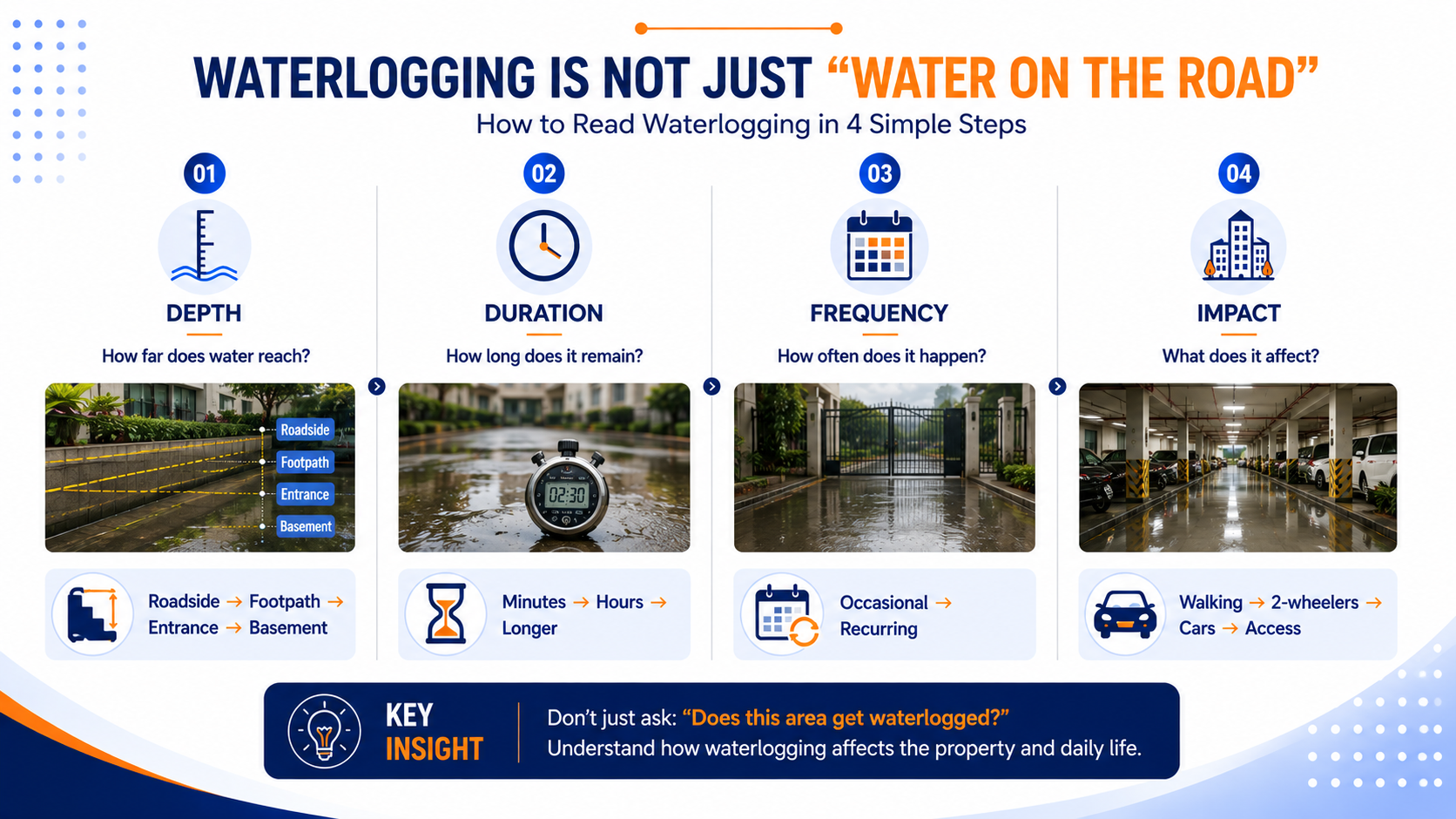
Depth: How far does the water reach?
Look at the water level against things you can easily identify, such as the kerb, footpath, vehicle tyres, entrance steps or basement ramp. You do not need to measure the exact depth. The purpose is to understand whether the water is staying at the roadside or reaching areas that residents need to use.
Duration: How long does it stay?
The situation can be very different if water disappears soon after rainfall compared with water that remains for hours. During your visit, note whether the rain has stopped and whether the accumulated water is already receding. If possible, also find out how long residents usually see water remaining after heavy rain.
Frequency: Is it occasional or recurring?
One heavy-rain event cannot tell you the complete story. Consider whether similar water accumulation happens regularly during the monsoon or mainly during unusually intense rainfall. Residents, security staff or facility teams may provide useful historical context, but recurring conditions are more meaningful than a single isolated event.
Impact: What does the water actually affect?
Finally, look at the practical consequence. Can people walk through normally? Are two-wheelers or cars able to pass comfortably? Does water reach the project entrance, parking area or basement ramp? Waterlogging becomes a more meaningful property concern when it starts affecting how residents enter, leave or use the property.
The same approach is useful when comparing residential locations across Ahmedabad and Gandhinagar. Access, surrounding infrastructure and the area's development can all influence how practical a property is for everyday living. If you are considering Gandhinagar, see our guide to Sargasan's residential market
The approach road is part of the property experience too. During heavy rainfall, check whether water accumulates on the surrounding road, how it affects access to the project and whether visible drainage points are able to move the water away. Ahmedabad Municipal Corporation (AMC) is responsible for civic drainage services and has also documented measures related to waterlogging and stormwater management across the city.
Look at the Project Entrance for Evidence of Previous Rain
Before entering the project, take a moment to look at the entrance and the areas around it. During monsoon, water may not remain visible for long, but it can leave behind useful clues. Check the compound walls, entrance flooring, security area and nearby drainage points for discolouration, mud or silt marks, algae, peeling paint and damp patches.
These signs should not immediately be treated as construction defects. A water mark simply tells you that the surface has experienced moisture or water exposure; it does not tell you the exact cause. What matters is where the mark appears, how extensive it is and whether similar signs can be found repeatedly.
For example, an isolated mark on an exposed external wall may have a very different explanation from recurring dampness around the entrance or drainage point. Look at the surrounding area as well: where does rainwater collect, where does it move, and are there visible signs that it has reached the entrance before?
The aim is not to find a perfectly dry entrance during rainfall. It is to understand how the entrance handles water and whether what you see suggests a condition that needs further verification.
Check Walls and Ceilings for Water Seepage
Rain can make moisture-related problems easier to identify, particularly around exposed walls and ceilings.
Inside the apartment, pay attention to ceiling corners, external walls, areas adjoining balconies and surfaces close to exposed parts of the building.
Look for:
- Dark or discoloured patches
- Peeling or bubbling paint
- Damp surfaces
- Brownish ceiling marks
- Repaired sections
- Moisture around wall junctions
However, visible moisture should not automatically be called "rainwater seepage." A damp patch can have different possible sources, including plumbing, condensation, waterproofing or rainwater. The appearance alone may not establish the technical cause. For a homebuyer, the useful first step is to identify where the condition is, how extensive it appears and whether it looks recent or recurring.
| Observation | What It May Tell You | What Requires Further Verification |
|---|---|---|
| Dark wall patch | Visible moisture/discolouration | Source and recurrence |
| Ceiling stain | Previous or current staining | Cause and whether it is active |
| Peeling paint | Surface deterioration | Reason and repair history |
| Damp balcony junction | Moisture near an exposed area | Drainage/waterproofing source |
| Repaired patch | Previous maintenance | Whether the condition returned |
That distinction helps buyers avoid both extremes: ignoring a genuine concern or treating every mark as a major defect.
Pay Attention to Windows and External Wall Junctions
Windows are another area where monsoon conditions can reveal details that are easy to miss on a dry day. The glass may look completely fine while the surrounding junction between the frame, sill and wall experiences moisture. This is why the inspection should include the areas around the window rather than focusing only on the window itself. Look at the frame corners, sill, surrounding wall finish and visible sealant. Staining, dampness, bubbling paint or repeated repair marks around these areas deserve closer attention, particularly where the window is directly exposed to driving rain.
The important consideration is how well the complete window-to-wall junction handles rainfall. A problem in this area may not be obvious from a quick visual inspection, so unusual moisture evidence should be treated as something to understand further rather than immediately diagnosed.
Inspect the Balcony as a Drainage Surface
A balcony may look perfect on a dry day, but monsoon gives you a chance to see how it actually handles rainwater. The important question is not whether the balcony gets wet, it should, but whether the water moves away properly or remains trapped on the floor. Start by looking at the floor slope and drainage point. Rainwater should naturally move towards the designated drain instead of collecting in corners or along the wall. Check whether the drain is clear of leaves, dirt or other debris, and notice if water is gathering around the balcony door, walls or floor edges.
What to check during a monsoon visit
- Water pooling: Does water remain in one area instead of draining away?
- Floor slope: Does the visible slope appear to direct water towards the drain?
- Drainage point: Is the outlet clear and positioned where water can reach it?
- Balcony door: Is there dampness or water accumulation near the door threshold?
- Wall-floor junction: Are there visible damp patches, stains or peeling finishes?
- Drain condition: Is debris blocking the outlet or slowing water movement?
A wet balcony during rainfall is completely normal. Persistent water pooling is the condition worth investigating. If water repeatedly collects near walls, corners or the balcony door, it can keep those surfaces exposed to moisture and may eventually affect surrounding finishes. The goal of this check is simple: follow the water. Where does it enter, where does it collect, and where does it finally leave? That small observation can tell you much more about a balcony's monsoon drainage than its size or appearance ever will.
Give the Basement and Parking a Separate Inspection
Don't stop your inspection at the apartment or your assigned parking slot. During monsoon, the basement can tell you how the project handles water when it moves towards the lowest part of the property. Start from the basement entry and ramp, then look across the parking area instead of checking only the space you may eventually own.
Look for clues left by earlier rainfall: water stains on walls, damp corners, mud or silt deposits, peeling finishes, standing water and marks around drainage channels. The ramp and lower points deserve extra attention because they are places where rainwater can collect or move towards the basement. If drainage outlets, channels or pumping arrangements are visible, check whether they appear clear and properly maintained.
What deserves closer attention?
-
Water marks around the ramp or lower walls
-
Dampness at wall-floor junctions
-
Mud or silt deposits in corners
-
Water collecting near drainage points
-
Blocked or debris-filled drainage channels
-
Repeatedly repaired surfaces
-
Standing water after rainfall
A basement being dry during your visit is not proof that it has never faced water entry. Likewise, finding one damp area does not automatically mean the basement has a serious flooding problem. The useful conclusion comes from connecting the physical evidence with the property's previous monsoon experience and maintenance record. Think of the basement as a simple test: after heavy rain, can the project collect, move and remove water without affecting the area's residents? That is the condition worth understanding before you buy.
For broader context on Ahmedabad's stormwater drainage and monsoon-related civic management, buyers can also refer to information published by the Ahmedabad Municipal Corporation (AMC)
Look Beyond Your Apartment at Common Areas
Your apartment may look perfect while common areas tell a different story.
Walk through the lift lobby, corridors, staircase and other accessible shared spaces. These areas are useful because they expose larger portions of the building to inspection.
Look for ceiling stains, damp walls, peeling paint, water marks and sections that appear to have undergone repeated repair.
A single repaired patch does not necessarily indicate a serious building-wide problem. The more important question is whether similar conditions appear repeatedly or across multiple locations.
Common areas can therefore provide another piece of evidence about the building's overall response to moisture and its maintenance practices.
Inspect the Terrace and Rainwater Drainage
If terrace access is permitted, inspect the visible rainwater outlets and surrounding surface.
The basic principle is simple: rainfall needs a clear path from the terrace surface to the designated drainage system.
Look for:
- Blocked outlets
- Leaves and debris
- Standing water
- Water marks
- Damp patches
- Damaged drain covers
- Areas where water appears to collect
Maintenance is an important part of this assessment. Even a well-designed drainage arrangement can perform poorly when outlets become blocked or are not maintained regularly. So the inspection should consider not only where the water is supposed to go, but also whether the drainage system appears to be maintained for the season when it is most needed..
Understand the Property's Previous Monsoon Experience
A site visit gives you a snapshot of the property. Previous rainfall gives you history. For an occupied project, information about earlier seepage, basement water entry, drainage issues, waterproofing work and terrace maintenance can help explain what you see during your visit.
Past project performance matters beyond monsoon maintenance. The developer's delivery and project history can also help you understand what to expect from a property. See our guide on how to check a builder's track record
This historical context becomes especially useful when a physical observation is unclear. For example, an old water mark becomes more meaningful if similar marks have appeared repeatedly. A repaired seepage patch becomes more reassuring if the issue was properly addressed and has not returned. Conversely, repeated repair work in the same area deserves closer investigation. For an under-construction project, there may be little historical performance data. In that situation, the focus should shift toward the visible drainage arrangement, site levels, construction quality and information that can be independently verified.
Check the Route You Will Actually Use Every Day
The property itself is only one part of your daily journey. Think about the complete route:
Home → Project Exit → Approach Road → Main Road → Office, School or Other Destination
A project can have good internal drainage while the surrounding access becomes difficult during heavy rainfall. This matters particularly for buyers who commute every day.
Look at pedestrian movement, two-wheeler access, car movement and the condition of the road connecting the project to the main network. This can also become a useful comparison point between properties. Two projects may have similar prices, amenities and apartment layouts, but the one with a more reliable approach during monsoon may offer a better everyday experience.
What a Monsoon Site Visit Can and Cannot Tell You
A monsoon site visit gives you something a brochure or a dry-season visit cannot: **real-world evidence of how the property and its surroundings respond to rainfall**. But it should not be treated as a complete property inspection.
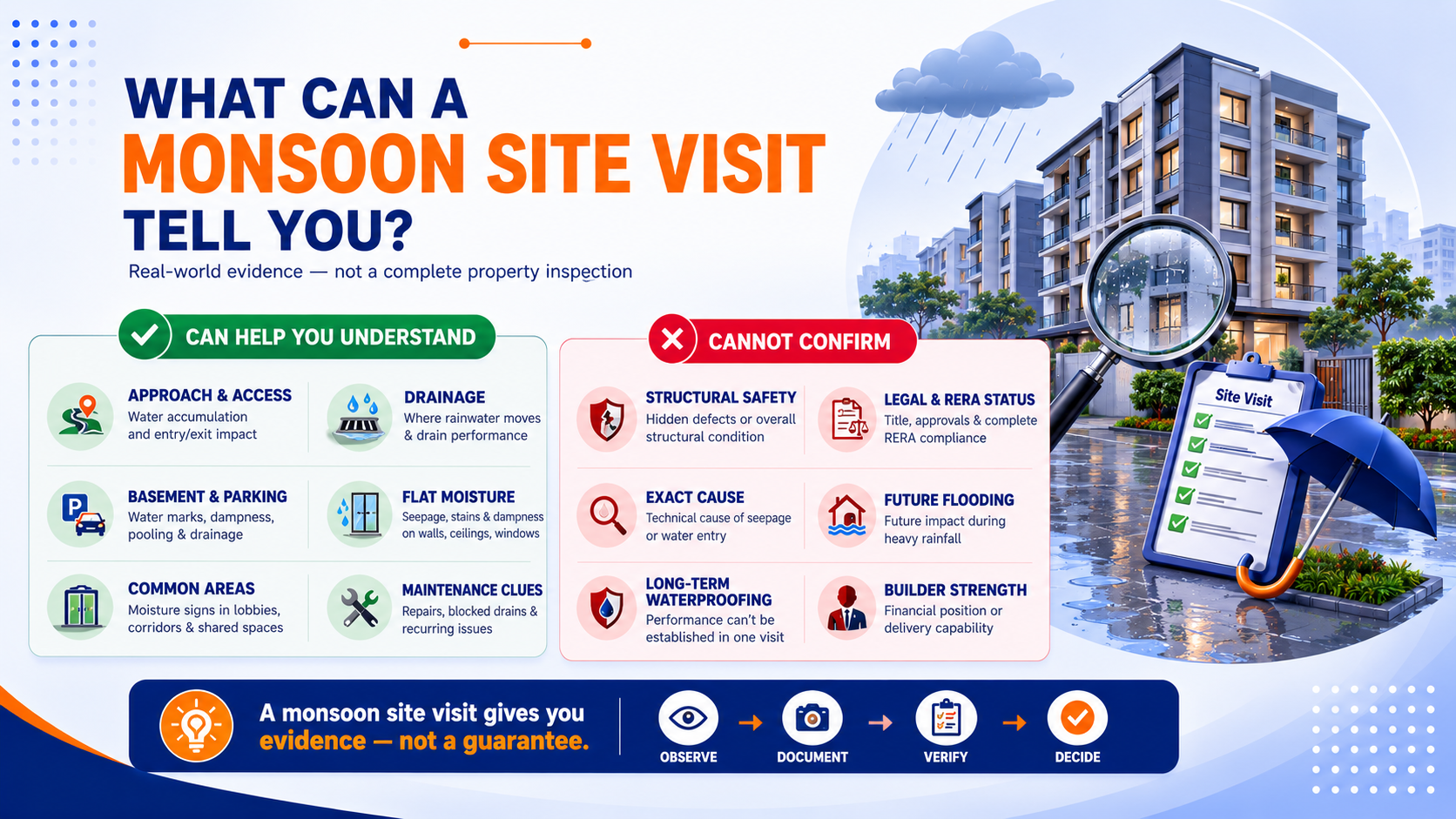
What you can understand
Approach-road conditions: Whether water accumulates
and how it affects everyday access.
Drainage behaviour: Where rainwater moves and whether visible drainage points appear to handle it properly.
Basement and parking: Signs of water entry, dampness, water marks or poor drainage.
Flat-level moisture: Visible seepage, stains or dampness around walls, ceilings, windows and balconies.
Common-area conditions: Whether lobbies, corridors and other shared spaces show signs of repeated moisture exposure.
Maintenance patterns: Visible evidence of repairs, blocked drains or areas requiring regular attention.
What it cannot confirm
- Structural safety or hidden construction defects
- Legal title, approvals or RERA compliance
- The exact technical cause of seepage
- Future flooding or waterlogging risk
- Long-term waterproofing performance
- Builder's financial strength or delivery record
A site visit is only one part of property due diligence. For project registration and RERA-related information, buyers should also verify the project through the official GujRERA portal
The key takeaway is simple: a monsoon site visit gives you evidence, not a guarantee. Use what you observe to identify questions that need further verification, and combine the site visit with legal, technical and financial due diligence before making a property decision.
Monsoon Site Visit vs December Site Visit
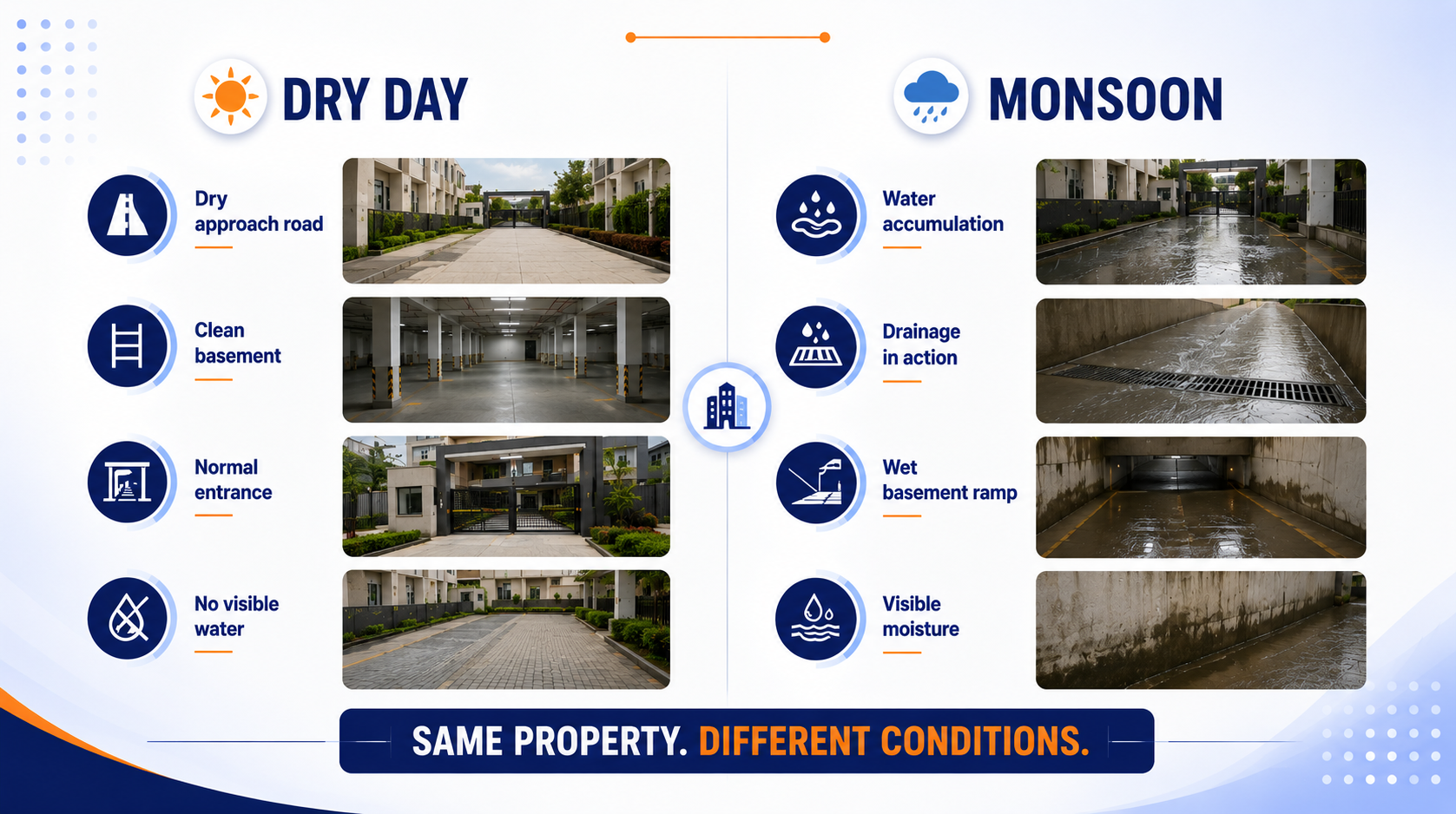
The two seasons can answer different property questions.
| What You Want to Understand | Monsoon Visit | December Visit |
|---|---|---|
| Active rainwater movement | Can be observed | Limited |
| Approach-road waterlogging | Can be observed | Usually unavailable |
| Drainage behaviour | More visible | Mostly inferred |
| Active moisture/seepage | More likely to be visible | May be less apparent |
| Balcony drainage | Can be observed during rainfall | Mostly visual |
| Basement water conditions | Current conditions can be observed | Mostly historical |
| Layout and room sizes | Yes | Yes |
| Sunlight and ventilation | Yes | Yes |
| Amenities and finishing | Yes | Yes |
How EXIO Helps You Look Beyond the Site Visit
A monsoon site visit can reveal how a property responds to rain, but it cannot answer every question a homebuyer needs to ask before investing. EXIO brings the site experience together with project research, developer evaluation, legal checks and investment analysis, giving buyers a broader view before they make a decision.
As a real estate advisory firm, EXIO does not rely only on brochures, sales presentations or what is visible during a single property visit. We assess projects across important areas including RERA and legal information, builder track record, construction and design, amenities, location and investment potential. This makes the site visit one part of the evaluation process, not the entire basis for choosing a property.
A site visit is therefore one part of a much wider property assessment. At EXIO, we combine on-ground observations with legal, technical, builder, location and investment checks when evaluating a project. You can learn more about how this evaluation works in our guide to the EXIO 50-point rating.

What EXIO Adds Beyond a Site Visit
-
Property Screening: Shortlist relevant projects based on your requirements before you spend time visiting multiple properties.
-
Project Evaluation: Review key project details and information beyond the developer's marketing materials.
-
Builder Assessment: Examine the developer's delivery history, experience and track record across previous projects.
-
Location & ROI Analysis: Consider connectivity, surrounding infrastructure, development potential and factors that can influence long-term value.
-
Property Comparison: Compare shortlisted projects across meaningful factors instead of looking only at price, size or amenities.
-
Decision Support: Bring the research, site observations and investment considerations together so you can make a more informed choice.
For people searching for real estate consultants in Ahmedabad, EXIO's role goes beyond simply showing you available properties. As a property investment company, our focus is to help you understand what you are considering before you commit your money, what looks right, what needs further verification and what could become a concern later.
A site visit tells you what you can see. EXIO helps you look at what lies beyond it.
Disclaimer: This article provides general information to help buyers conduct a more informed monsoon site visit. Observations about waterlogging, drainage, seepage, moisture or other visible property conditions are indicative only and do not replace professional technical, legal or financial due diligence. Property and weather conditions can vary, and a single site visit cannot confirm future performance or identify hidden defects. Buyers should independently verify project, builder and RERA-related information and seek appropriate professional advice before making a property purchase or investment decision.

Frequently Asked Questions
Check the approach road, waterlogging, project entrance, drainage, basement and parking, walls and ceilings, windows, balconies, terrace and common areas. Pay particular attention to how quickly water drains and whether previous rain has left visible signs of moisture or damage.
Yes. Monsoon can reveal conditions that are difficult to observe during dry weather, including waterlogging, drainage problems, seepage, basement water entry and moisture around balconies, windows and external walls. It should be combined with normal property, legal and technical due diligence.
Inspect external walls, ceilings, corners, window junctions, balcony doors and wall-floor junctions for damp patches, stains, peeling paint or other signs of moisture. A visible mark does not automatically prove a defect, so the source, recurrence and previous repair history should be verified.
Inspect the basement ramp, drainage channels, low points, walls and wall-floor junctions for standing water, dampness, water marks, mud or silt and repaired surfaces. Also understand how the project manages water entering lower levels during heavy rainfall.
Look beyond whether water is simply present. Check its depth, duration, frequency and impact, including whether it reaches the project entrance, affects cars or two-wheelers, remains after rainfall or creates difficulty accessing the property.


