
 Login
Login
 Investment Advisory
 Contact Us

Driving between Ahmedabad and Gandhinagar during rush hour has always been frustrating. Anyone who commutes via SG Highway or Koba Circle knows how bad traffic gets around peak office hours.
The launch of Ahmedabad Metro Phase 2 fundamentally changes that commute.
Daily commuters no longer have to depend on private cabs or slow buses to reach the international financial district. That single change has shifted where people choose to buy and rent homes along northern Ahmedabad.
If you are looking at flats in Motera, scouting budget-friendly options in Chandkheda, or calculating rental yields near GIFT City, here is a breakdown of the route, the operational stations, and the real numbers behind local property rates.
Metro Phase 2 route map, key stations and the property markets around Motera, Chandkheda, GIFT City and nearby areas, so you can understand the connection before evaluating the investment opportunity.
EXIO EXTRA: Ahmedabad Metro Phase 2 covers a 28.25 km elevated network that seamlessly connects Motera Stadium in Ahmedabad to Gandhinagar (Sector-1 and Mahatma Mandir), with a dedicated spur directly into GIFT City via the GNLU interchange. By slashing peak-hour commutes between Ahmedabad and GIFT City to roughly 25 minutes, the corridor has triggered a 15% to 25% surge in real estate capital values and rental yields across key northern micro-markets, most notably in Motera, Chandkheda, and the GIFT City/Raysan belt.
Ahmedabad Metro Phase 2: Route Map, Lines, and Interchange Stations
Ahmedabad Metro Phase 2 covers a total of 28.25 km of elevated track. Its main job is simple: pick up where Phase 1 leaves off at Motera Stadium and push rapid transit straight into Gandhinagar and GIFT City.
Instead of a single straight line, Phase 2 splits into two distinct corridors connected by a central interchange.
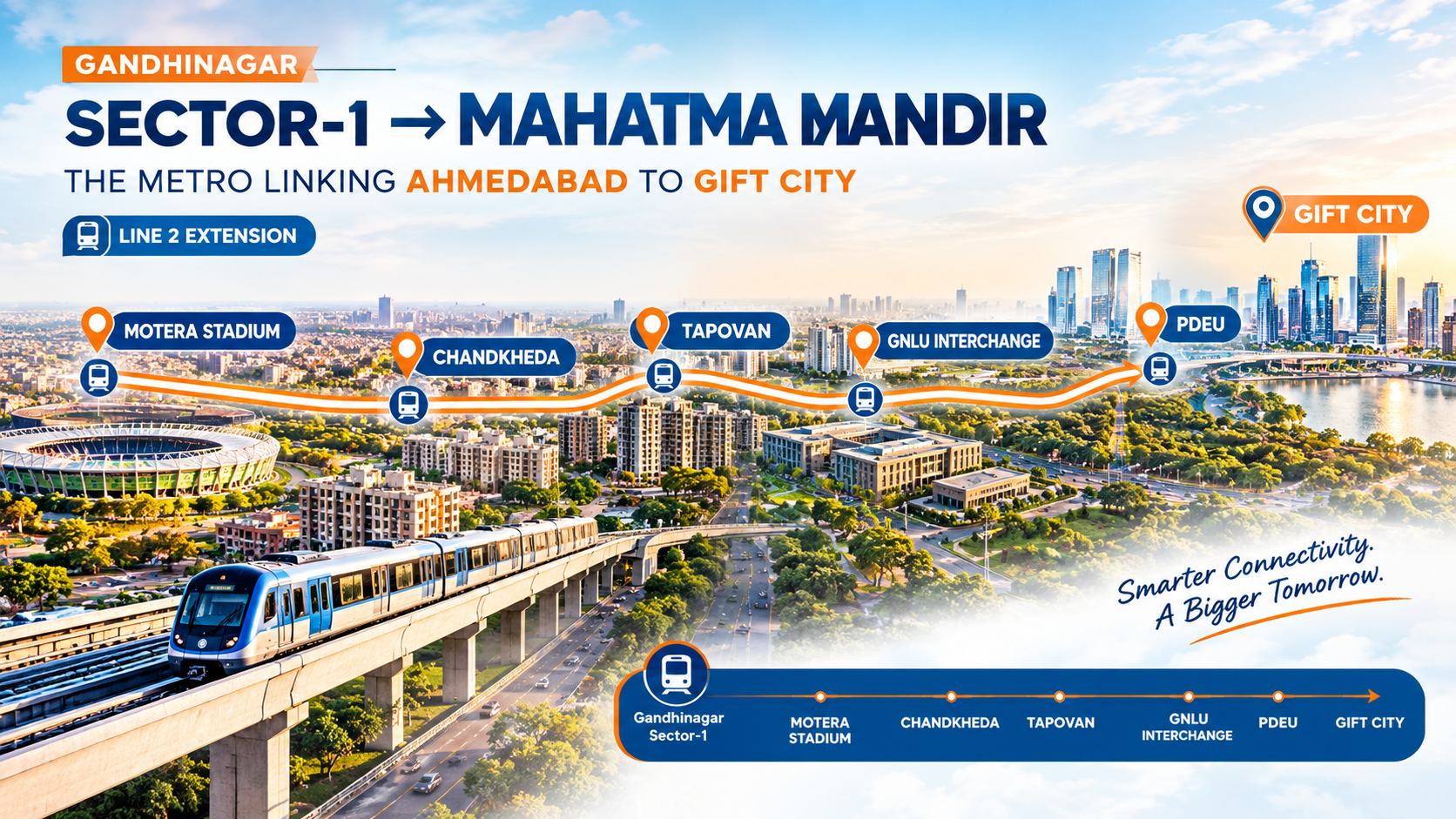
1. Line 2 (North–South Corridor Extension)
-
Route: Motera Stadium ➔ Gandhinagar Sector-1 ➔ Mahatma Mandir
-
Length: 22.8 km
-
Key Stops Along the Way: Motera Stadium, Koteshwar Road, Vishwakarma College, Tapovan Circle, Narmada Canal, Koba Circle, Juna Koba, Koba Gam, GNLU, Raysan, Randesan, Dholakuva Circle, Infocity, and Gandhinagar Sector-1. From Sector-1, the final stretch pushes north past Akshardham and Sachivalaya to terminate at Mahatma Mandir.
This line essentially runs along the eastern bank of the Sabarmati and cuts past the SP Ring Road junction. It gives daily office workers and students an easy bypass around the notorious traffic snarls at Koba Circle and Tapovan Circle.
2. Line 3 / Eastern Spur (The GIFT City Branch)
- Route: GNLU ➔ PDEU ➔ GIFT City
-
Length: 5.4 km
-
Stations: Gujarat National Law University (GNLU), Pandit Deendayal Energy University (PDEU), and GIFT City.
This branch is short, but it carries the heaviest economic weight. It crosses over the Sabarmati River to drop riders directly at the doorstep of the financial district and university campuses.
The Interchange That Makes It Work: GNLU Station
If you are travelling from Ahmedabad (say, Paldi, Ranip, or Motera) to GIFT City, GNLU is the station where you switch trains.
-
Passengers staying on the mainline continue north into Gandhinagar’s administrative sectors.
-
Passengers heading into the financial SEZ switch platforms at GNLU to hop onto the dedicated shuttle train running between GNLU, PDEU, and GIFT City.
What About the Airport Connection?
Many commuters ask why the line skips Ahmedabad Airport. An airport link was originally planned as an offshoot from Koteshwar Road. However, that 5-to-6 km spur has been rolled into the broader Phase 3 / Phase 2A expansion, meaning airport-bound flyers will have to wait a bit longer for direct terminal rail access.
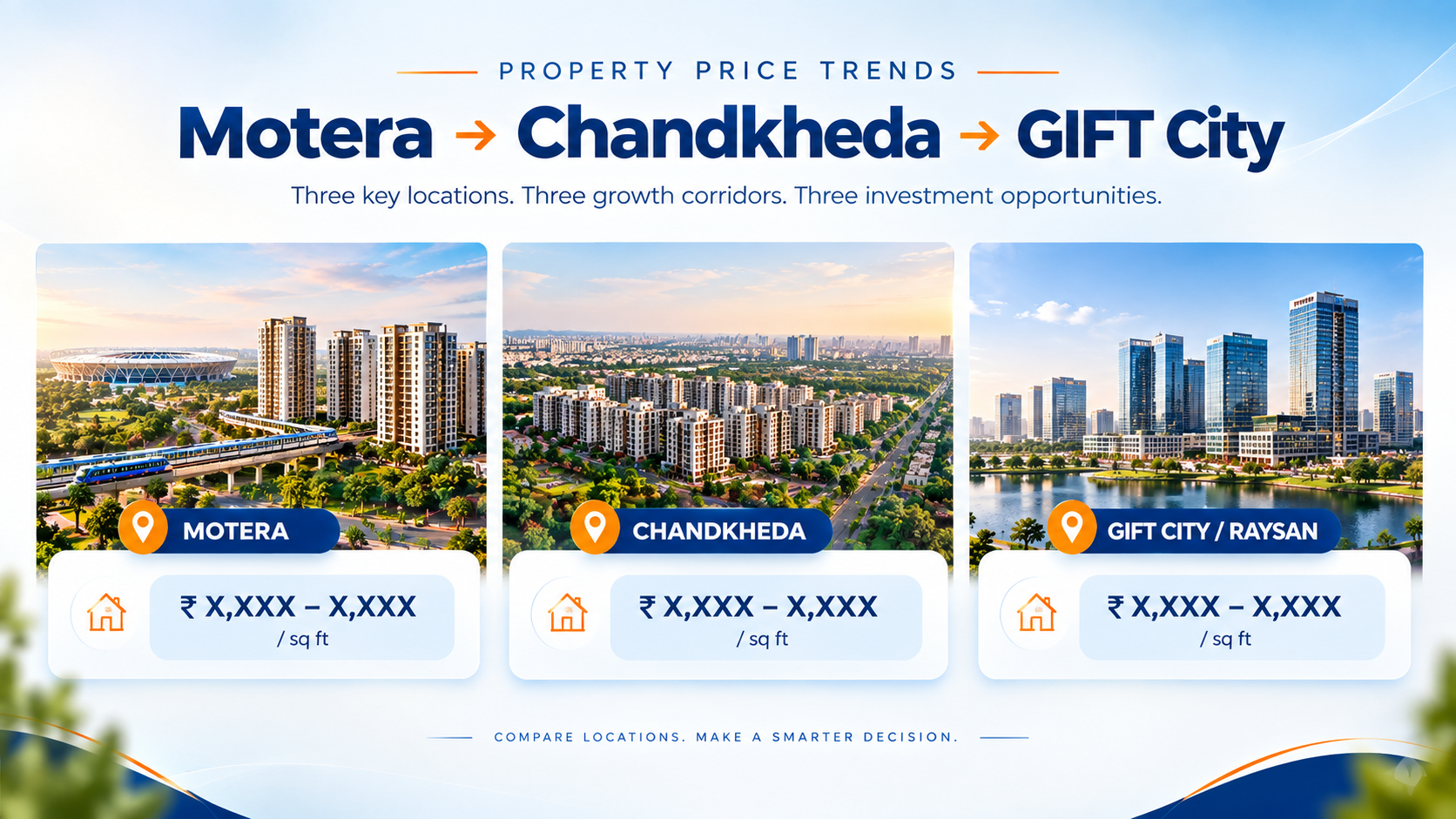
Real Estate Impact: Property Price Trends in Motera, Chandkheda, and GIFT City
Metro lines don't raise property rates evenly overnight. Instead, they create distinct pricing tiers based on who wants to live there and how close the project sits to an active station.
Across the Phase 2 corridor, three micro-markets show the sharpest shift in buyer demand: Motera, Chandkheda, and the GIFT City/Raysan belt.
Here is how the numbers stack up across each market:
| Micro-Market | Nearest Metro Stations | Avg. Sale Rate (₹/sq.ft) | Typical Rental Ask (2BHK / Month) | Primary Buyer / Tenant Segment |
| Motera | Motera Stadium, Koteshwar Rd | ₹5,200 – ₹7,800 | ₹16,000 – ₹24,000 | Mid-to-senior executives, cricket stadium staff, families seeking dual city access |
| Chandkheda | Vishwakarma College, Tapovan Circle | ₹4,400 – ₹6,000 | ₹13,000 – ₹18,000 | Mid-income professionals, bank employees, students, young families |
| GIFT City / Raysan | GIFT City, PDEU, GNLU | ₹8,000 – ₹13,500+ | ₹25,000 – ₹45,000+ | Tech and BFSI workforce, corporate leasees, long-term investors |
1. Motera: The Inter-City Junction Advantage
Motera has moved beyond its image as just a cricket stadium hub. Because it functions as the direct bridge between Phase 1 (connecting down through Ranip, Vadaj, and APMC) and Phase 2 (heading north to Gandhinagar), it is one of the few localities where residents can commute south into old/central Ahmedabad or north into GIFT City with equal ease.
-
Capital Growth: Established societies and new apartment developments within a 1.5 km radius of Motera Stadium Station have seen steady capital appreciation of 12% to 18% over the past two years.
-
The Buyer Profile: Motera appeals heavily to end-users who want mature civic amenities, established grocery markets, schools, and hospitals, without paying the steep premiums of western Ahmedabad hubs like Bodakdev or Thaltej.
To understand how Phase 2 connectivity translates into investment potential, the table below highlights travel times and prevailing real estate price brackets along the Motera-GIFT City stretch:
| Station Name | Distance from Key Landmark | Estimated Commute Time | Average Capital Value (₹/sq.ft) |
| Motera Stadium | 0.4 km from Narendra Modi Stadium | ~22 min to GIFT City | ₹5,800 – ₹7,800 |
| Chandkheda | 1.2 km from Tapovan / Visat Circle | ~18 min to GIFT City | ₹4,900 – ₹6,500 |
| Koba Circle | 0.8 km from Airport–SP Ring Road Crossroad | ~10 min to GIFT City | ₹5,200 – ₹7,200 |
| GNLU | 0.3 km from Gujarat National Law University | ~5 min to GIFT City | ₹6,500 – ₹8,800 |
| PDEU / Raysan | 0.6 km from Pandit Deendayal Energy University | ~3 min to GIFT City | ₹6,800 – ₹9,200 |
| GIFT City | <0.2 km from GIFT One & Two Towers / IFSC | Direct Access | ₹9,500 – ₹14,500+ |
Want to invest near the Ahmedabad Metro Phase 2 corridor? Connect with Exio Real Estate Advisory to find verified, RERA-approved properties near your preferred metro station.
2. Chandkheda: The Value-For-Money Base for GIFT City Workers
Chandkheda has quietly become the biggest residential beneficiary of the Phase 2 launch.
While GIFT City is adding thousands of jobs across banking, finance, and IT, actual residential inventory inside the SEZ is limited and expensive. Many corporate employees look for nearby rentals in areas that already have schools, daily markets, and affordable housing. Chandkheda fits that exact gap.
-
Rental Demand: Rental inventory near Vishwakarma College and Tapovan Circle moves fast. 2BHK units that sat on the rental market for weeks before the metro now get absorbed within days by incoming young professionals.
-
Entry-Level Appeal: At roughly ₹4,900 to ₹5,300 per sq.ft, Chandkheda remains accessible for first-time homebuyers who want to stay under the ₹65–75 lakh budget for a quality 3BHK while retaining a 20-minute train ride to work.
3. GIFT City & Raysan: Premium Pricing and High-Yield Rentals
On the other side of the Sabarmati, the dynamic changes from budget-family housing to investor-driven, high-yield assets.
-
The Walk-to-Work Premium: Inside GIFT City, residential towers carry some of the steepest pricing in the Gandhinagar district, easily crossing ₹8,500 to ₹11,350 per sq.ft for high-floor units. The metro station provides direct platform access into the business district, making these units prime targets for corporate rentals and serviced apartments.
-
Raysan & Randesan Spillover: Not everyone working in GIFT City wants to live inside a high-density commercial zone. Immediately adjacent sectors like Raysan and Randesan, located right near the GNLU and PDEU stations, have emerged as top picks for low-density luxury apartments and plotted schemes. Average rates here hover between ₹6,500 and ₹9,500 per sq.ft, drawing heavy interest from NRI investors and senior executives.
The Policy Multiplier: How Transit-Oriented Development (TOD) and Higher FSI Are Transforming the Skyline
The surge in property values along Phase 2 isn't driven solely by commuter convenience; it is reinforced by urban planning policy.
Under the urban development guidelines set by AUDA and the Urban Development Department of Gujarat, land parcels situated within a Transit-Oriented Development (TOD) corridor (typically within 200 to 500 meters of an active BRTS or Metro station) receive special zoning benefits:
-
FSI Escalation up to 4.0: While base Floor Space Index (FSI) in Ahmedabad residential zones ranges between 1.2 and 1.8, plots within the designated metro TOD belt can utilise a chargeable/premium FSI of up to 4.0.
-
Shift to High-Density, High-Rise Towers: This increased FSI allows developers to build vertically (20+ floors) along the Motera–Chandkheda–Koba stretch. For buyers, this translates into modern, gated vertical communities equipped with multi-level podium parking, clubhouses, and extensive security rather than standalone low-density societies.
-
Mixed-Use Ground Retail: TOD policy encourages retail storefronts, supermarkets, and clinics on the ground and first floors of high-rise societies abutting metro stations. This enables walk-to-shop convenience for residents without adding vehicular traffic to neighbourhood inner lanes.
-
Redevelopment Potential for Older Societies: Older 3- to 4-storey housing board societies in Chandkheda and Motera sitting directly on 24m+ and 30m-wide metro roads are now prime targets for redevelopment, offering existing homeowners larger, updated apartments with elevated capital value.
Commute Compression: How Metro Phase 2 Reshaped Living Patterns
To understand why property prices move along a metro line, you have to look at the daily friction it eliminates.
Before Phase 2 opened, travelling between northern Ahmedabad and GIFT City or Gandhinagar meant negotiating two chronic bottlenecks: Koba Circle and the SG Highway junction. During morning and evening peak hours, a 15 km drive easily stretched into 45 to 65 minutes of bumper-to-bumper traffic, especially around Tapovan Circle.
With the metro operational, that equation has changed:
-
Motera to GIFT City: Takes approximately 20 to 25 minutes by rail (including the train change at GNLU), compared to nearly an hour by road during rain or peak evening rush.
-
Chandkheda (Tapovan Circle) to GNLU/PDEU: Takes roughly 10 to 12 minutes, effectively turning Gandhinagar’s educational and corporate institutions into neighbourhood destinations for Ahmedabad residents.
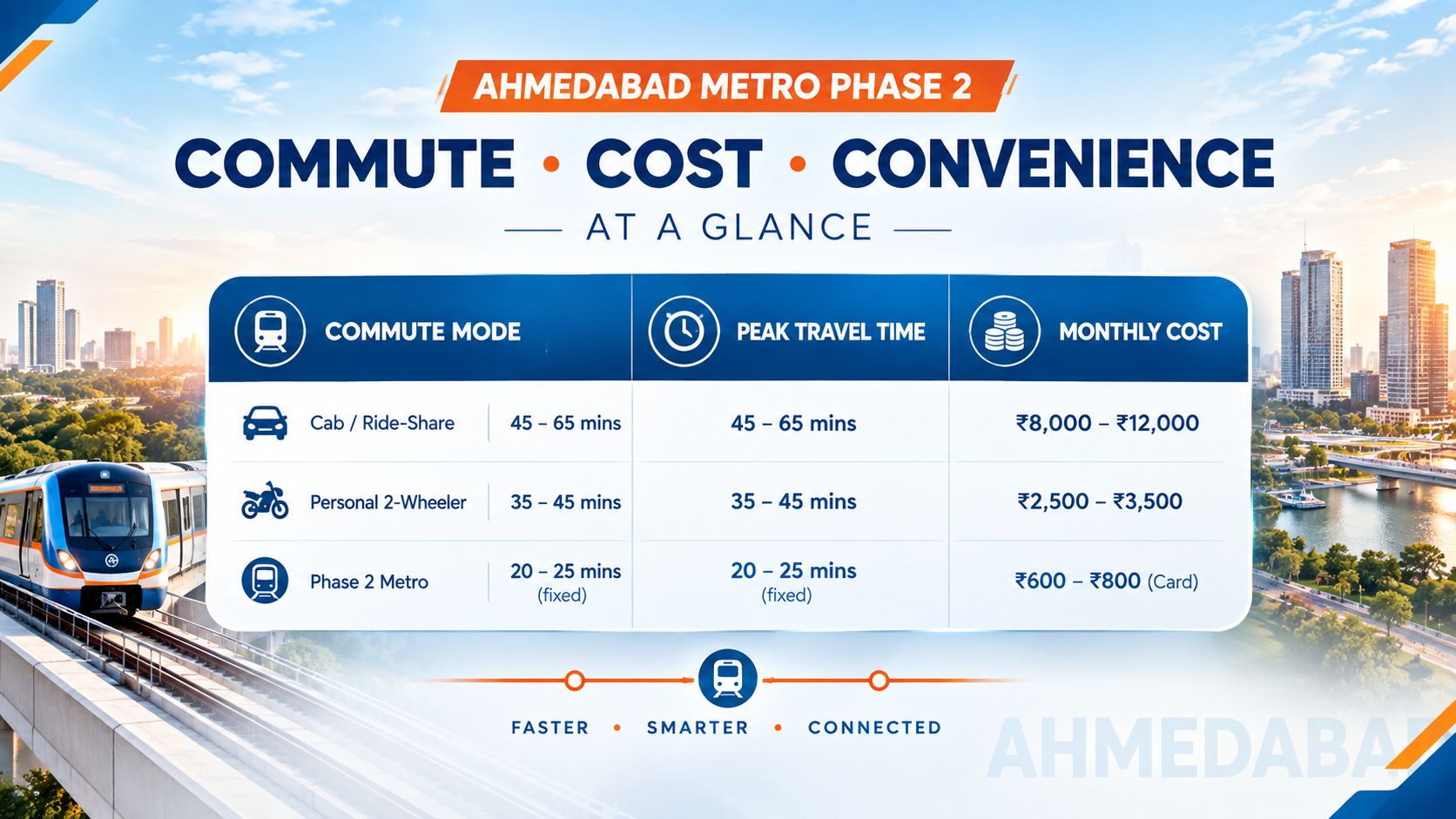
The Emerging "Walk-to-Metro" Premium
This time saving has created a noticeable price gap between properties based purely on walking distance:
-
The 500-Meter Radius (Primary Band): Apartments within a 5 to 7-minute walk of stations like Motera Stadium, Vishwakarma College, and PDEU command a 10% to 15% price premium over identical projects located 2 km deeper into residential lanes. For tenants working corporate shifts, skipping an auto-rickshaw leg twice a day is worth paying an extra ₹2,000 to ₹3,000 in monthly rent.
-
The End of "Work-City vs. Home-City" Separation: Historically, people working in Gandhinagar preferred living in Gandhinagar, while Ahmedabad professionals stayed strictly south of the ring road. Phase 2 has blurred that boundary. A banker can live in an established Motera society with family amenities, while their partner commutes to an IT firm in Infocity or GIFT City without either facing an exhausting daily drive.
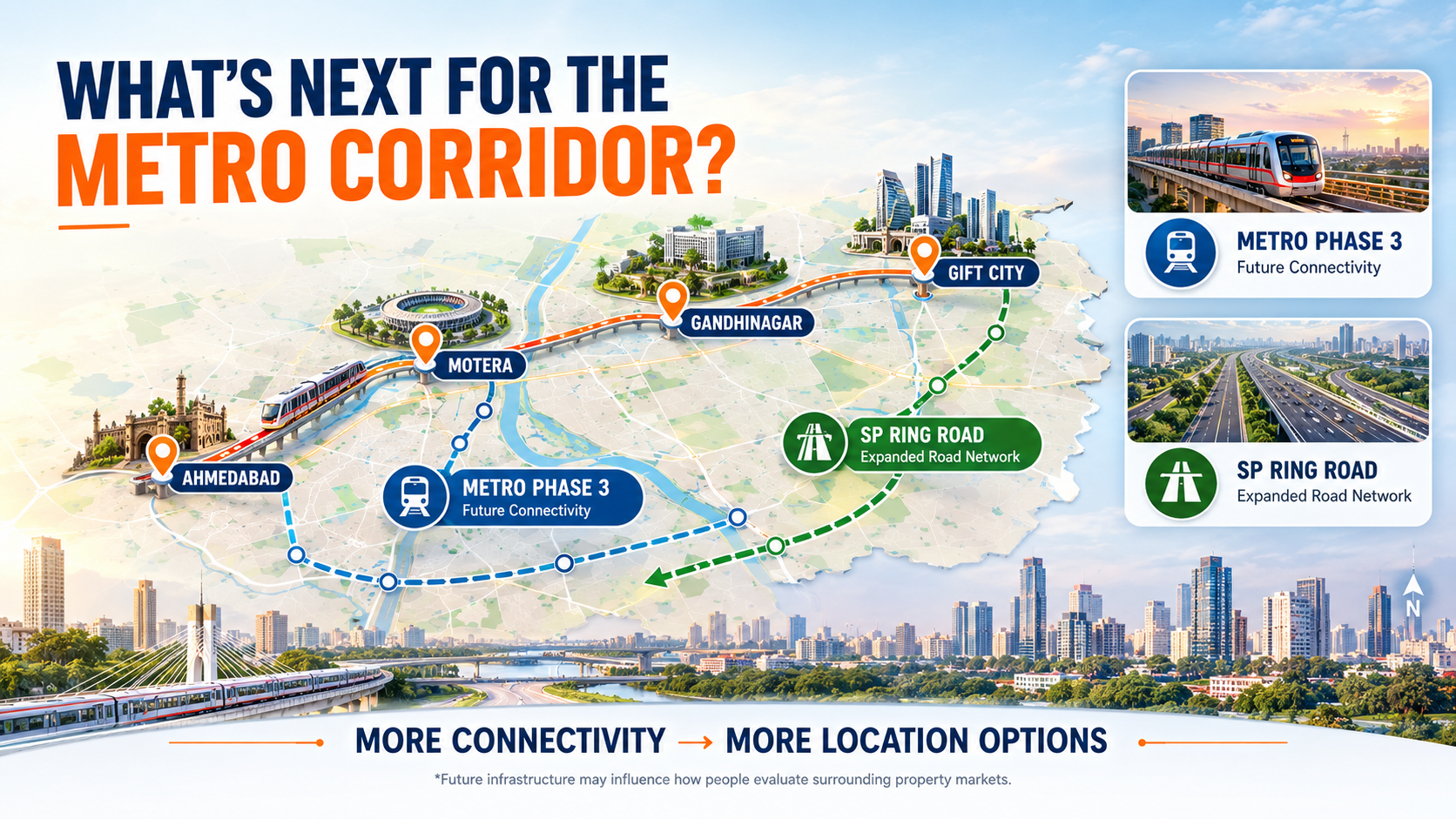
Beyond Phase 2: Ahmedabad Metro Phase 3 & SP Ring Road Expansion
While Phase 2 tackles the north–south commuter corridor into Gandhinagar, the next major infrastructure push is heading west and south. Ahmedabad Metro Phase 3 is officially on the board, having cleared its key statutory milestone with Public Investment Board (PIB) approval.
With preliminary soil testing and utility shifting underway, GMRC is preparing the blueprint for the city's largest expansion yet.
What Does Phase 3 Look Like?
Phase 3 is built to solve two problems: heavy vehicular congestion along the Sardar Patel (SP) Ring Road and the rapid outward sprawl of western residential suburbs.
-
Network Scope: Approximately 60 km of elevated track serving 41 stations across western, southern, and central belts.
-
The SP Ring Road Western Corridor: Starts from Shilaj Canal Road and runs parallel to the SP Ring Road, connecting Thaltej Gam, Shilaj Crossroads, Bopal Crossroads, Shantipura, and down to Sanathal and Badrabad.
-
The SWASA / Sports Arena Spur: Extends west from Thaltej Gam through the canal belt to reach the South West Ahmedabad Sports Arena (SWASA) in Godhavi.
-
The Vadaj Circular Loop: Ahmedabad’s first inner circular ring line. Passing through Shivranjani, Shyamal, Jivraj Park, APMC, and returning via eastern commercial pockets to Vadaj, it will allow commuters to switch lines without congesting central interchange stations.
-
The Dholera Regional Link: The line terminating at Badrabad is engineered as the future launchpad connecting the metro network to the Ahmedabad–Dholera Expressway and international airport corridor.
Early Real Estate Impact: Where is the Smart Money Moving?
Unlike Phase 2, where price jumps are already priced in by operational stations, Phase 3 is currently in the early speculation window. Real estate investors looking for higher percentage capital gains are focusing on western peripheral pockets:
-
South Bopal and Shela: These are already mature residential markets with strong retail and school infrastructure, but daily road commutes to SG Highway during rush hour remain heavy. A metro station near Bopal Crossroads will ease that pinch point, providing long-term support for resale prices and rental yields.
-
Shilaj & Godhavi: Currently seeing heavy activity in plotted layouts, weekend villas, and upcoming mid-rise apartment schemes. The confirmation of direct transit to Godhavi (via the SWASA link) has prompted developers to land-bank along the canal road belt.
-
Commercial Land Parcels along SP Ring Road: Institutional builders are acquiring frontage plots near proposed interchange points (like Shantipura and Sanathal), anticipating Transit-Oriented Development (TOD) policies that grant higher Floor Space Index (FSI) along metro alignments.
Looking to explore new properties in South Bopal, Shilaj, Godhavi, or near SP Ring Road? Let Exio help you find the right one here.
Investor Guide: Where Should You Buy for Maximum ROI?
There is no single "best" area along the metro line. The right location depends on what you care about most: immediate rental cash flow, steady family-driven resale liquidity, or high-upside future land appreciation.
Here is an objective comparison of how each micro-market stacks up for different investment strategies:
1. For High-Yield Rentals: GIFT City & Raysan
-
Ideal for: HNI investors and NRIs who want corporate lease income and hands-off tenants.
-
The Play: Focus on 1BHK and 2BHK serviced or semi-furnished apartments close to GIFT-1 or PDEU stations. Multinational BFSI and tech firms operating in the SEZ drive strong demand for corporate leases and executive housing.
-
The Catch: Entry prices are steep, with projects routinely trading above ₹8,500 to ₹11,350. Because basic social infrastructure (walkable retail markets, schools) inside the SEZ is still developing compared to Ahmedabad proper, tenant demand is closely tied to office occupancy rates.
2. For Low-Risk, Immediate Cash Flow: Chandkheda
-
Ideal for: Mid-budget investors and first-time landlords looking for steady rental income without high vacancy risks.
-
The Play: Target resale 2BHK units or near-possession projects within 1 km of Vishwakarma College or Tapovan Circle stations.
-
The Catch: Capital appreciation here is moderate rather than explosive. Chandkheda is a mature, high-density residential locality, so you are buying for steady, low-vacancy rental income rather than dramatic price doubling.
3. For Central Transit & End-User Security: Motera
-
Ideal for: Families and long-term buyers who prioritise resale liquidity and broad transit access.
-
The Play: Look for well-built 3BHK societies within walking distance of Motera Stadium Station. Because this station serves as the central bridge between central Ahmedabad (Phase 1) and Gandhinagar/GIFT City (Phase 2), it holds long-term value regardless of broader market swings.
-
The Catch: High-demand societies close to the stadium already price in the metro premium, so you must negotiate firmly on older inventory.
4. For Multi-Year Capital Growth: The Phase 3 Western Belt (Bopal, Shilaj, Godhavi)
-
Ideal for: Speculative and patience-driven investors with a 5 to 7-year holding window.
-
The Play: Acquire plotted schemes, commercial land frontage, or early-stage residential towers along the SP Ring Road connecting Thaltej Gam to Bopal Crossroads and Godhavi.
-
The Catch: With Phase 3 in pre-construction and early alignment phases, civil construction will take years to finish. Liquidity is lower today, and returns will materialize only as track work and station framing become physically visible.
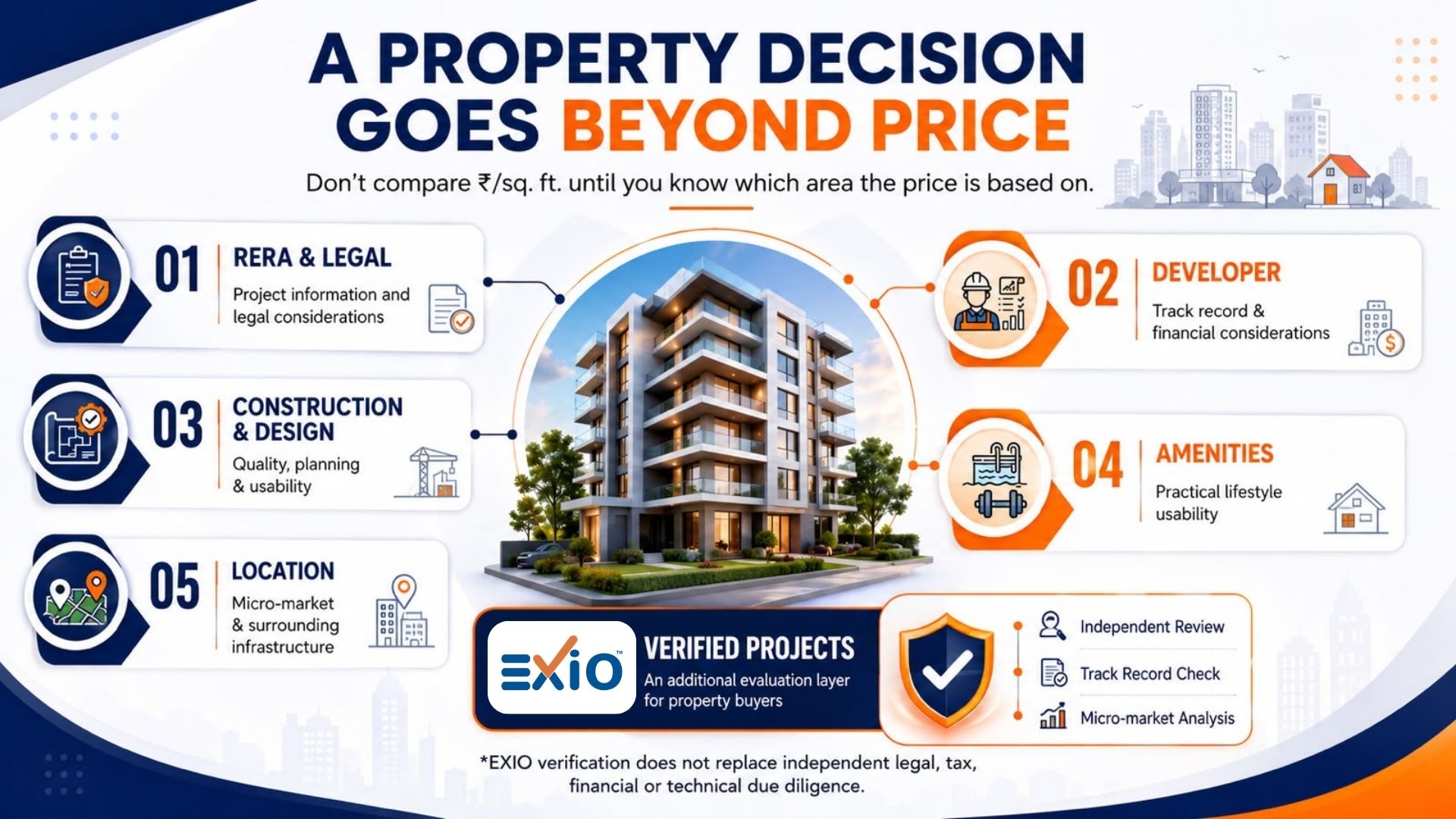
How Exio Helps You Capitalise on the Ahmedabad Metro Corridor
Knowing that property values are rising near the metro is easy; picking the right developer, verifying legal titles, and avoiding overvalued projects is where most buyers struggle.
What EXIO Checks Before You Put Money Down
-
50+ Point Property Inspection: Every project is checked across structural build quality, true usable room sizes, legal titles, government approvals, and practical daily liveability.
-
Ground-Level Neighbourhood Research: Compare Ahmedabad areas based on real tenant demand, actual highway and metro access, and future supply pipelines, not just advertised growth claims.
-
Builder Background Verification: Look past big brand names to check whether the developer delivers projects on time, uses durable construction materials, and maintains healthy finances.
-
True Usable Space Analysis: Compare properties by their actual living area (RERA carpet area) so you never overpay for wasted common corridors or inflated super built-up claims.
-
Net Return Calculations: Get realistic profit projections that factor in government stamp duty, society maintenance bills, local property taxes, and expected vacancy periods.
-
Pre-Screened Projects: Access a curated list of legally clear, RERA-compliant projects so you do not waste time visiting problematic or delayed sites.
Planning a property purchase along the Phase 2 or Phase 3 metro corridor?
Connect with an Exio property advisor for an independent portfolio review, legal audit, and end-to-end guidance from site visit to final registration.
Already have a flat or office in mind?
Get an Independent Project Audit
Before you hand over token money or sign anything, let us run a ground check on it.
-
We calculate your actual usable carpet area (so you don’t pay for wasted corridors).
-
We check GujRERA records, land titles, and past builder delays.
-
We tell you honestly if the price is fair or inflated for that area.
(Send us the project name or brochure for an honest review)
Not sure where to invest your budget?
Book a Free 1-on-1 Consultation
Whether your budget is ₹50 Lakh or ₹2 Crore+, talk directly with our research team before you start visiting sites.
-
Find the right area for your goal (steady monthly rent vs. long-term appreciation).
-
Compare residential flats vs. commercial offices without sales pressure.
-
See only pre-verified, RERA-approved properties that pass our safety checks.
(No sales pitch. Just ground-level facts and numbers)
Disclaimer
The information provided in this article, including metro routes, station alignments, timelines, property rates, and rental yield estimates, is published solely for general informational, educational, and creative analytical purposes. Real estate values, infrastructure master plans, and government approvals (such as GMRC, AUDA, and PIB clearances) are subject to periodic updates, regulatory changes, and local market fluctuations. Nothing published here constitutes formal financial, legal, or investment advice, nor does it form an official offer or binding commitment. Readers and prospective investors are strongly advised to independently verify all project details, GujRERA registrations, and route updates with the relevant municipal authorities and licensed professionals before making any financial or property purchase decisions.

Frequently Asked Questions
Yes, the major 21 km stretch connecting Motera Stadium to Gandhinagar Sector-1 and the eastern branch line to GIFT City is operational. The remaining northern section toward Mahatma Mandir is scheduled for completion in 2026.
Motera is directly anchored by the Motera Stadium Station. Chandkheda commuters primarily access Phase 2 via Vishwakarma College Station and Tapovan Circle Station along the SP Ring Road junction.
Micro-markets within a 1 to 2 km radius of the Phase 2 stations have recorded a 15% to 25% price appreciation over the construction and operational launch period, alongside a 20% spike in rental yields due to incoming corporate tenants.
GIFT City (and adjacent Raysan/Koba) delivers higher gross rental yields (4.5%–6%) due to demand from high-earning finance, tech, and banking professionals. Chandkheda offers steadier, entry-level rental yields (3.5%–4.5%) with virtually zero vacancy because of its established schools, hospitals, and family-friendly infrastructure.
Road travel via the SG Highway or Airport Road takes 45 to 70 minutes during peak rush hours. The metro journey from Motera to GIFT City takes approximately 22 to 26 minutes, cutting commute times by more than half.