
 Login
Login
 Investment Advisory
 Contact Us

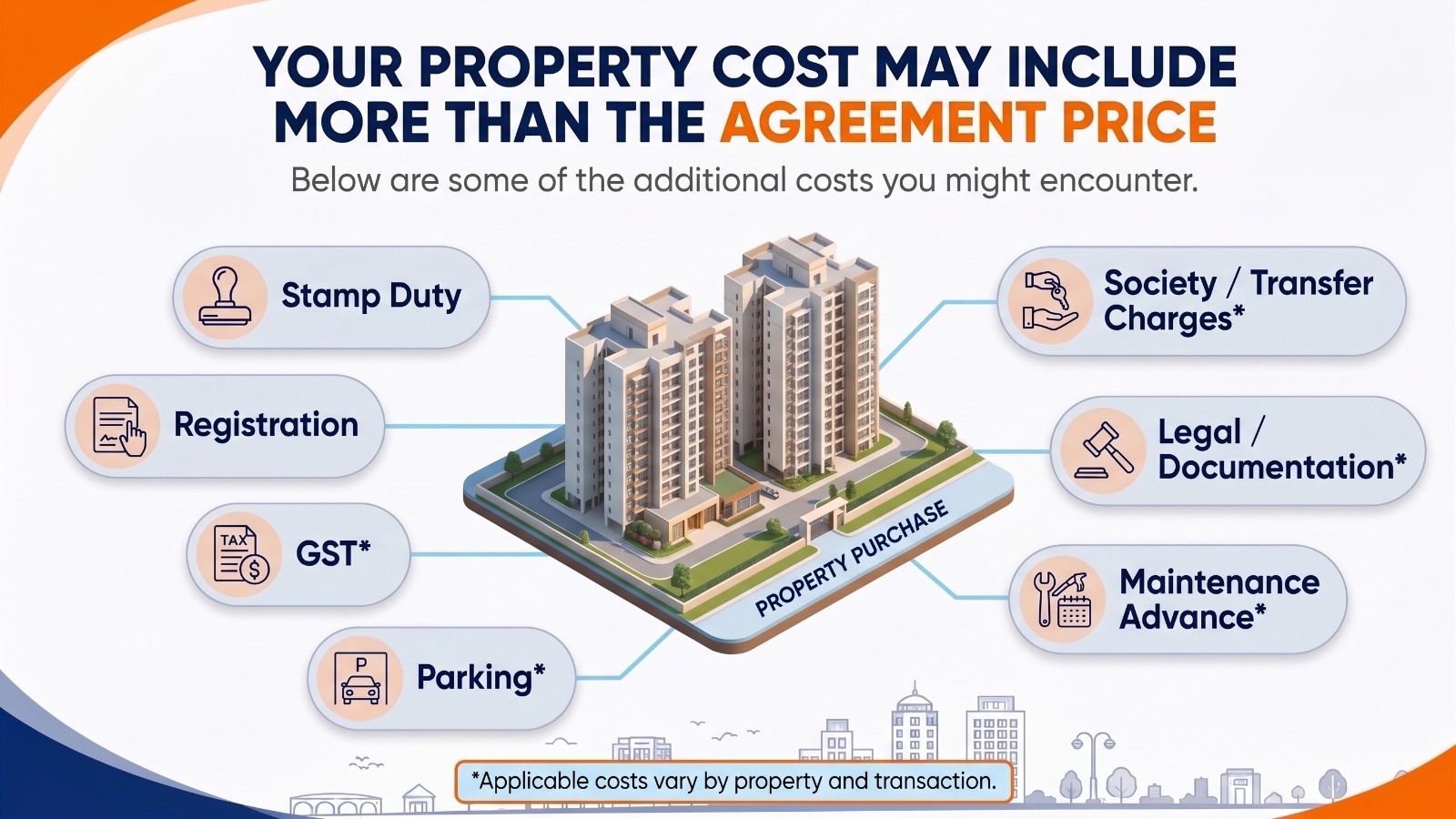
Buying a ₹75 lakh flat does not necessarily mean your total purchase cost is ₹75 lakh. The property price is only the beginning when purchasing a new home. Before the property is legally transferred into your name, you may also need to account for stamp duty, registration charges, GST where applicable, parking, maintenance advances, legal or documentation costs and other transaction-specific expenses.
This is where many first-time buyers miscalculate their budget. They plan for the down payment and EMI, but not for the costs that arrive around the registration stage. This guide explains stamp duty and registration charges in Gujarat in 2026, how the applicable value is determined, what other costs can come into the picture, and how to build a more realistic property cost sheet. It also includes an Ahmedabad example so you can see how the numbers fit together.
| Transaction / Buyer Category | Stamp Duty Rate | Registration Fee | Total Statutory Cost |
| Male Buyer (Sole Owner) | 4.9% (3.5% + 1.4% Surcharge) | 1.0% | 5.9% |
| Female Buyer (Sole Owner) | 4.9% (3.5% + 1.4% Surcharge) | 0.0% (100% Exemption) | 4.9% |
| Joint Ownership (Male + Female) | 4.9% | 1.0% (Full Fee Applies) | 5.9% |
| Gift Deed to Blood Relative | 1.0% | 1.0% (Waived for Female) | 2.0% (Male) / 1.0% (Female) |
| Home Loan / Equitable Mortgage | 0.1% (Capped limit applies) | Nominal SRO / Legal | ~0.1% |
Note: The figures and rates shared above are for general informational purposes only. Stamp duty and registration charges are subject to government revisions; please verify with an authorised legal advisor or the local Sub-Registrar’s Office (SRO) before making final financial commitments.
The Number on the Brochure Is Not the Number You Pay
A property advertisement may show:
Flat price: ₹75 lakh
That is usually the number that catches your attention.
But your actual budget needs to answer a different question:
How much will it cost me to complete the purchase?
Think of the purchase in layers:
Property consideration
- Stamp duty
- Registration fee
- GST, where applicable
- Parking or other separately charged items
- Maintenance advance
- Legal/documentation costs
- Other transaction-specific charges
= Total estimated acquisition cost
Not every buyer will have every one of these costs. A ready-to-move property, an under-construction property and a land transaction can have very different cost structures.
That is why using a simple rule such as "add 6% to the property price" is not always enough.
The better approach is to calculate each applicable cost separately.
Stamp Duty in Gujarat - The Rate and What It Is Charged On Property
In Gujarat, the stamp duty rate is 4.9% of the property's jantri value or market value (whichever is higher), while the registration fee is 1.0% for male buyers and 0% (exempt) for female buyers.
| Buyer Category | Stamp Duty | Registration Fee | Total Government Charges |
| Male Individual | 4.90% | 1.00% | 5.90% |
| Female Individual | 4.90% | 0.00% (Exempt) | 4.90% |
| Joint (Male + Female) | 4.90% | Pro-rated / 1% on male share | ~5.40% – 5.90% |
| Corporate / Firm | 4.90% | 1.00% | 5.90% |
Stamp duty is a government charge associated with the instrument used to transfer property rights. For a typical residential property purchase in Gujarat, the commonly reported 2026 stamp-duty rate is 4.9%, comprising a 3.5% basic duty and a 40% surcharge on that basic duty. Current 2026 property guides continue to report this structure.
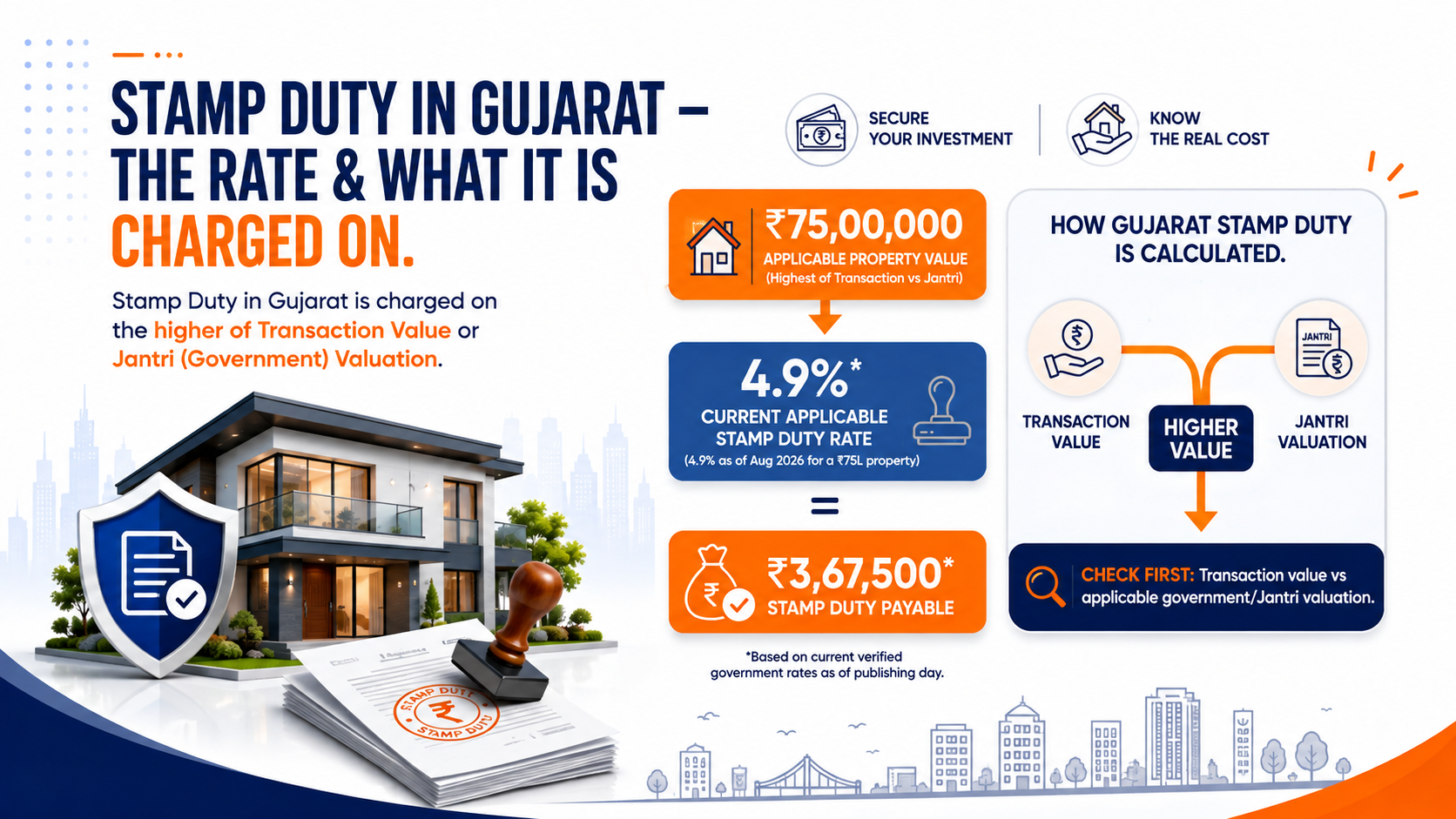
A simple example
Suppose the value used for stamp-duty calculation is:
₹75,00,000
At 4.9%:
₹75,00,000 × 4.9% = ₹3,67,500
So the stamp duty in this example would be ₹3,67,500.
But there is an important point here:
The calculation is not always as simple as multiplying your negotiated price by 4.9%.
The value used for stamp-duty assessment needs to be established under the applicable Gujarat rules. The buyer should compare the transaction value with the applicable government valuation/Jantri information rather than assuming the negotiated price automatically becomes the duty base.
For example, if a buyer negotiates a property at ₹70 lakh but the applicable government valuation results in a higher assessable value, the buyer should not assume that stamp duty will simply be calculated on ₹70 lakh.
Before registration, check the applicable valuation through the current Gujarat registration system/GARVI process and confirm the amount payable for the specific property.
Quick formula for planning
Estimated stamp duty = Applicable stamp-duty valuation × applicable stamp-duty rate
The important word is applicable valuation.
That is why the Jantri check should happen before you finalise your registration budget.
The Other Costs Buyers Often Forget
Stamp duty and registration are not the only numbers that can affect your final budget.
Some costs are government charges. Others are project, transaction or service-related expenses.
GST on an Under-Construction Property
GST needs to be considered separately from stamp duty and registration. Under the GST framework, construction of a building intended for sale can be treated as a supply of service, except where the entire consideration is received after the required completion certificate or after first occupation, whichever is earlier.
In simple terms, this means the tax treatment of an under-construction property can differ from a completed property where the relevant completion/occupation condition has already been met.
The exact GST amount can also depend on the type of residential project and the applicable GST provisions. For an actual transaction, confirm the GST treatment with the builder and, where necessary, your CA or tax adviser.
Tax Tip: Under Section 80C of the Income Tax Act, home buyers can claim a tax deduction of up to ₹1.5 Lakh on the total amount paid toward Stamp Duty and Registration charges in the financial year the purchase was executed (applicable under the Old Tax Regime).
Parking
Parking may be included in the quoted price, separately charged, or structured differently depending on the project and agreement.
Ask:
- Is parking included in the quoted property price?
- Is the amount separately mentioned?
- What type of parking is being provided?
- Is the charge reflected in the agreement?
Don't assume that a line saying "₹75 lakh" automatically includes every parking-related amount.
Maintenance Advance
Some projects collect an advance toward maintenance or common-area expenses.
This is not the same thing as stamp duty or registration.
Check:
- How much is being collected?
- For what period?
- Who is collecting it?
- Is it refundable, adjustable or non-refundable?
- Is it already included in the agreement or cost sheet?
Legal and Documentation Costs
Depending on the transaction, buyers may also incur legal or documentation expenses.
For a high-value property purchase, paying for an independent document review can be very different from simply accepting the documents supplied by the seller or developer.
The amount is transaction-specific, so it should be entered as a separate line in your personal cost sheet rather than treated as a fixed percentage.
Society or Association-Related Charges
A resale property may involve association/society-related charges or transfer formalities.
These are not the same as Gujarat government stamp duty.
Always ask the seller or association for the applicable written charges before assuming the amount.
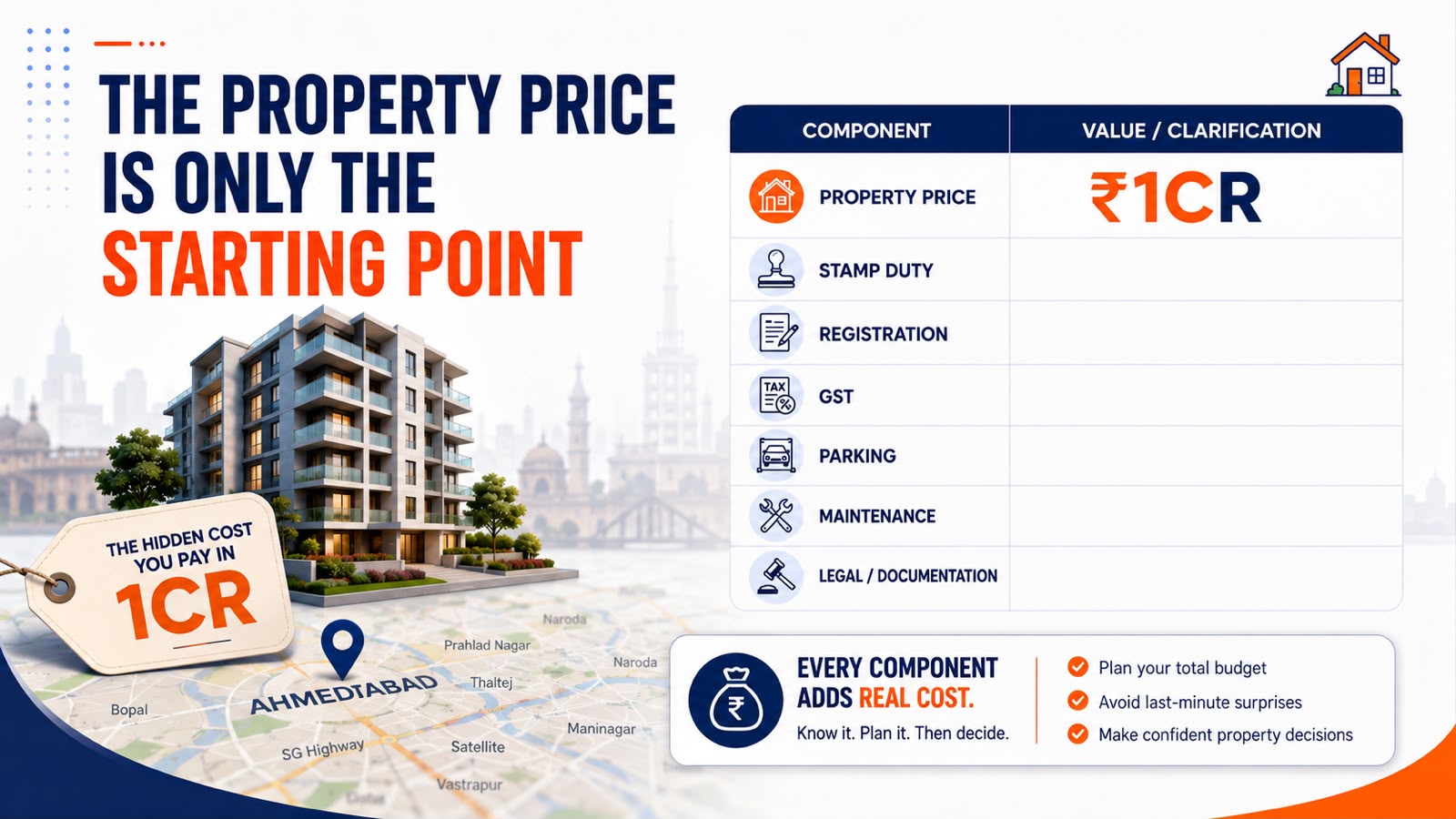
The Hidden Cost Guide: An Ahmedabad Case Study
Consider a common scenario in Ahmedabad's high-growth micro-markets, such as Shela or Gota. A buyer enters a premium sales lounge and is pitched a spacious apartment with a headline basic rate of ₹4,909 per sq. ft. For a 1,750 sq. ft. unit, the basic cost appears highly competitive on paper.
However, once you express serious intent and sit down for the final cost sheet negotiation, a series of essential, mandatory additions begins to surface:
| Cost Component | Pricing Details / Calculation | Running Total |
| Base Brochure Price | Basic Price (4909 * 1750) | ₹85,89,950 |
|
Floor-Rise Premium Preferential Location Charges (PLC) |
₹150 per sq. ft. for 14th floor (1750 - 1,800 sq. ft.) Garden-facing or corner unit premium |
+ ₹270,000 |
| Allotted Parking Space | Covered basement parking fee | + ₹100,000 |
| Goods & Services Tax (GST) | 5% on under-construction premium property (If Agreement goes after 45 L ) | + ₹2,25,000 |
| Stamp Duty & Registration | ~6% total (4.9% Stamp Duty + 1% Registration) | + ₹2,62,550 |
| Advance Maintenance & Deposit | 2 years upfront + basic fit-out charges | + ₹200,000 |
| AEC, AMC & AUDA Charges | Torrent Power setup + Ahmedabad Municipal Corp connection | + ₹3,00,000 |
| Running Maintenance | One-time contribution to the society's capital fund (30 Ruppes per Sq.Ft- Approx) | + ₹52,500 |
| Actual Net Payable | The true cost of ownership | ₹1,00,00,000 |
Disclaimer: This case study is presented by EXIO as an educational model for awareness purposes only. The base rate calculations, statutory check parameters (RERA/Index II), and development factors are based on regional market research in Ahmedabad and do not represent a commercial booking offer, a guaranteed ROI, or a legal certification of any specific real estate project.
What began as a ₹85.89 Lakh basic property price has rapidly scaled into a ₹1.00 Crore absolute liability, representing a hidden increase of roughly ₹806 per sq. ft. across the package. If you pay a non-refundable token amount based purely on the basic brochure price without uncovering these line items, you risk overextending your finances or losing your deposit.
If you wanted to know more about Property verification before you buy check out How to Verify Property Before Buying: 7 Essential Checklist
The Golden Rule: Never pay a token amount, sign a booking application, or hand over a cheque until you have systematically completed the property verification process.
What If the Property Is Registered in a Woman's Name?
Gujarat provides a registration-fee concession for eligible property registrations in a woman's name. The important point is that this concession relates to the registration fee, not the stamp duty.
For example, suppose a residential property is valued at ₹75 lakh for the applicable registration calculation. If the normal registration fee is 1%, that would be ₹75,000. If the buyer qualifies for the applicable female-buyer registration-fee waiver, this registration-fee amount may be waived.
| Regular applicable buyer | Eligible woman buyer | |
|---|---|---|
| Property value | ₹75 lakh | ₹75 lakh |
| Stamp duty at 4.9% | ₹3,67,500 | ₹3,67,500 |
| Registration fee at 1%* | ₹75,000 | ₹0* |
| Illustrative total of these two charges | ₹4,42,500 | ₹3,67,500 |
If the applicable registration fee waiver applies, the registration component may differ.
The female-buyer concession and applicable registration-fee treatment should be verified under the current Gujarat rules for the exact ownership structure before registration.
The key takeaway is simple: putting a woman's name on a property does not mean the stamp duty becomes lower. The relevant concession is on the registration fee, subject to the applicable conditions.
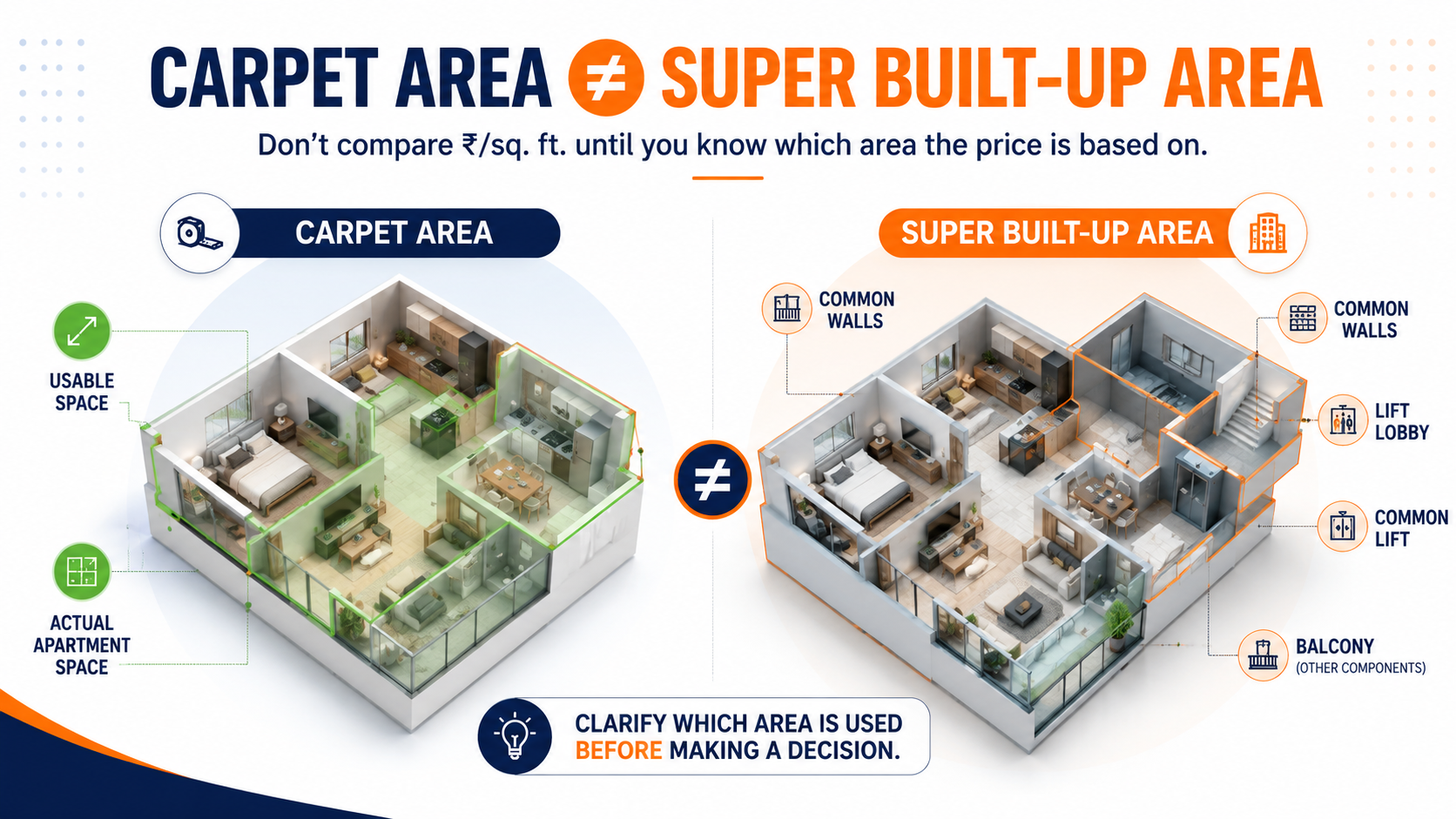
Carpet Area vs Super Built-Up Area: Which One Should You Use to Compare Property Prices?
One of the easiest ways to get confused while comparing two properties is to look only at the price per square foot. A project may advertise a flat at ₹6,000 per sq. ft., while another shows ₹6,500 per sq. ft. At first glance, the first property may appear cheaper.
But there is one important question to ask before comparing the two:
₹6,000 per sq. ft. of what?
The answer matters because property prices can be presented using different area measurements. For a homebuyer, two of the most commonly discussed measurements are carpet area and super built-up area.
What Is Carpet Area?
Under RERA, carpet area refers to the net usable floor area of an apartment, subject to the inclusions and exclusions specified under the law. In simple terms, it is much closer to the space available for actual use inside the apartment.
The statutory definition excludes areas such as external walls, service shafts and certain exclusive open areas, while the area covered by internal partition walls is included.
What Is Super Built-Up Area?
Super built-up area is a broader measurement commonly used in property marketing. Depending on the project and how the developer presents the property, it can include the apartment's built-up area along with an allocated share of common areas.
This is why two apartments can have a similar advertised price per square foot but provide different amounts of usable space.
A Simple Example
Suppose you are comparing two 2 BHK apartments in Ahmedabad.
| Property A | Property B | |
|---|---|---|
| Advertised price | ₹72 lakh | ₹75 lakh |
| Advertised area | 1,200 sq. ft. | 1,250 sq. ft. |
| Advertised rate | ₹6,000/sq. ft. | ₹6,000/sq. ft. |
| Carpet area | 800 sq. ft. | 900 sq. ft. |
At first glance, both appear to offer the same price per sq. ft.
But look at the carpet area.
Property A gives you:
₹72 lakh ÷ 800 sq. ft. = ₹9,000 per sq. ft. of carpet area
Property B gives you:
₹75 lakh ÷ 900 sq. ft. = ₹8,333 per sq. ft. of carpet area
So although Property B has the higher total price, it actually gives you more carpet area for the money.
That is why comparing only the advertised ₹/sq. ft. figure can lead to the wrong conclusion.
Which area should a buyer compare?
For apartment comparisons, carpet area should be one of the key numbers you look at, rather than relying only on the advertised super built-up or other marketing area.
A better comparison is:
Total property price ÷ carpet area = effective price per sq. ft. of carpet area
For example:
₹75,00,000 ÷ 900 sq. ft. = ₹8,333 per sq. ft. of carpet area
This gives you a more consistent basis for comparing the usable apartment space.
But don't stop at this calculation
A lower effective carpet-area price does not automatically mean the property is better.
You should also compare:
- Carpet area
- Apartment layout
- Natural light and ventilation
- Floor and orientation
- Parking
- Amenities
- Maintenance costs
- Developer track record
- RERA information
- Location and surrounding infrastructure
- Overall property price
EXIO's simple rule
When a property advertisement gives you a ₹/sq ft. number, don't immediately compare it with another project.
First ask, “Is this price calculated on carpet area, built-up area or another area measurement?”
IF you want to know more about this, check out 12 Things Home Buyers Miss During a Site Visit.
Where Buyers Most Often Under-Budget
These are some of the most common budgeting mistakes:
1. Planning only for the property price
A ₹75 lakh property does not necessarily mean ₹75 lakh is your complete cash requirement.
2. Ignoring the applicable government valuation
Don't assume your negotiated price automatically tells you the stamp-duty assessment.
Check the applicable Jantri/government valuation.
3. Treating GST as universal
GST treatment can depend on the property's construction/completion status and the applicable tax provisions.
4. Assuming parking is included
Get the parking cost and terms in writing.
5. Forgetting maintenance advances
An advance collected at possession or registration can affect the amount you need at the time of purchase.
6. Comparing properties using different area measurements
A cheaper ₹/sq-ft number isn't necessarily a better deal if the area basis is different.
7. Assuming every buyer gets the same registration treatment
Ownership structure can matter, particularly when considering the female-buyer registration concession.
8. Leaving no buffer
Even after calculating known charges, keep a reasonable financial buffer for transaction-specific expenses rather than planning to the last rupee.
Want to know the exact on-road legal cost for your flat in Ahmedabad/Gandhinagar? Visit Verified Properties in one place.
How to Calculate Your Own Property's Total Cost
You can use this simple process for almost any property purchase.
Step 1 - Start with the agreed property price
Write down the actual consideration agreed between buyer and seller/developer.
Step 2 - Check the applicable government valuation
Check the relevant Jantri/GARVI information and determine the valuation applicable to the property.
Step 3 - Determine the stamp-duty base
Use the applicable Gujarat rules to establish the value on which stamp duty is assessed.
Step 4 - Calculate stamp duty
Stamp duty = Applicable valuation × applicable rate
Step 5 - Calculate registration
Apply the current registration rule applicable to your ownership structure.
Step 6 - Check GST
If the property is under construction or otherwise falls within a taxable construction transaction, confirm the applicable GST treatment.
Step 7 - Add transaction-specific costs
Include:
- Parking
- Maintenance advance
- Legal/documentation
- Society/association charges
- Other applicable amounts
Step 8 - Calculate your estimated acquisition cost
Total acquisition cost = Property price + applicable government charges + applicable taxes + transaction-specific costs
This is the number you should use when deciding whether a property genuinely fits your budget.
Step-by-Step Online Payment Guide (GARVI 2.0 & e-Stamping)
A major search query cluster is "How to pay stamp duty online in Gujarat". Add a structured 4-step procedure:
-
GARVI 2.0 Portal Registration: Navigate to
garvi.gujarat.gov.inand select Public Data Entry / Stamp Duty Calculation. -
Jantri & Document Verification: Input the TP (Town Planning) scheme, final plot (FP) number, or survey number to verify the baseline ASR (Annual Statement of Rates) Jantri valuation.
To see how government base valuations affect your final property cost, read our complete guide on Jantri Rates in Ahmedabad (2026). -
Cyber Treasury Payment: Pay the statutory fees via Cyber Treasury net banking, UPI, or NEFT/RTGS to generate the e-Challan.
-
SHCIL e-Stamp & SRO Appointment: Generate the e-Stamp certificate through the Stock Holding Corporation of India (SHCIL) module and schedule biometric verification at your local Sub-Registrar’s Office (SRO).
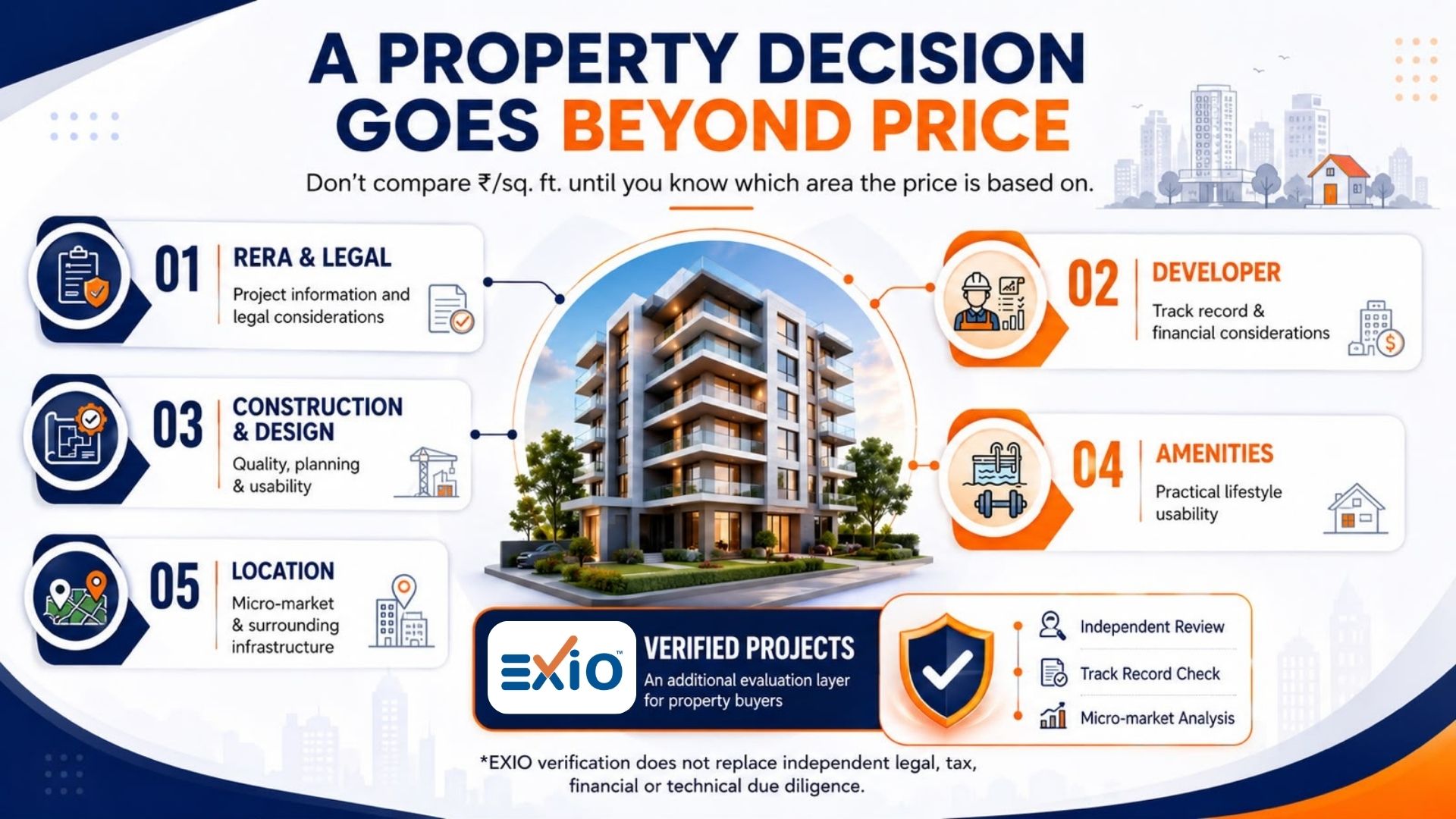
How EXIO Helps Buyers Look Beyond the Property Price
Knowing the total cost of a property is an important first step. But buying a property is not only a calculation exercise.
A buyer also needs to understand **what they are buying, who developed it, what has been officially disclosed, how the project compares with alternatives, and whether the property fits their long-term requirements.**
This is where EXIO's real estate advisory approach comes in.
EXIO is a real estate advisory platform focused on helping property buyers evaluate residential, commercial and land opportunities in Ahmedabad and Gandhinagar. Instead of focusing only on the advertised price, EXIO looks at the wider property decision.
What does EXIO evaluate?
EXIO evaluates projects across key areas such as:
- RERA and legal information
- Developer track record and financial stability
- Construction quality and project design
- Amenities and their practical usability
- Location, surrounding development and micro-market factors
Projects that meet EXIO's internal evaluation standards can be included among EXIO Verified Projects, giving buyers an additional information layer when comparing property options.
Why this matters to a buyer
Consider two properties with a similar price.
On paper, both may look attractive.
But the better question is: Which property makes more sense after looking beyond the price?
A proper comparison may involve:
- Developer delivery history
- RERA details and project disclosures
- Project specifications
- Construction and design considerations
- Location and surrounding infrastructure
- Usability of amenities
- Overall suitability for the buyer's requirements
EXIO's advisory approach is designed to help buyers compare these factors before making a property decision, rather than choosing a project based only on its brochure, price or promotional offer.
Conclusion
Buying a property is a major financial decision, and the price shown in a brochure is only the starting point. The real question is whether you understand the complete cost of buying the property and the property itself before committing. A clear cost sheet helps you know what the purchase may actually require, while proper property evaluation helps you understand whether the project deserves your money in the first place.
Don't just ask, “What is the property price?” Ask, “What will this property actually cost me, and is it worth buying?” That is the stronger ending because it doesn't repeat the article. It brings the entire argument back to one buyer decision.
Disclaimer:
This article is for general educational and informational purposes only and does not constitute legal, tax, financial or investment advice. Stamp duty, registration fees, Jantri values, GST provisions and other charges may change or vary by transaction, property and ownership structure; buyers should verify applicable charges through the official Gujarat Registration & Stamps/GARVI system and consult qualified professionals where required. EXIO's property evaluations are an additional information layer and do not replace independent legal, financial, tax or technical due diligence.

Frequently Asked Questions
In Gujarat, the standard stamp duty is 4.9% (composed of a 3.5% basic rate plus a 1.4% surcharge) for both male and female buyers. The registration fee is 1% of the property value. Consequently, a male buyer pays a combined statutory fee of 5.9%, whereas a sole female buyer pays 4.9% due to an exemption on registration fees.
In Gujarat, women do not receive a lower stamp duty rate—the stamp duty remains 4.9% for all buyers. Instead, the government offers a 100% waiver on the 1% registration fee exclusively for sole female property owners. If a property is purchased under joint ownership with a male co-buyer, the full 1% registration charge applies.
Stamp duty is always calculated on whichever is higher: the actual transaction value (Agreement Value) or the government-notified Annual Statement of Rates (Jantar rate). If you purchase a property for ₹60 Lakhs but the official Jantar valuation is ₹65 Lakhs, your 4.9% stamp duty will be assessed on the ₹65 Lakh figure.
Yes. Stamp duty and registration charges can be paid online via the GARVI Gujarat portal (garvi.gujarat.gov.in) under the Inspector General of Registration (IGR). Buyers can calculate their fees, pay through the integrated Cyber Treasury payment gateway (net banking/debit/e-challan), download receipt tokens, and book an appointment with the local Sub-Registrar's Office (SRO) for biometric verification.
Yes. Under Section 80C of the Income Tax Act, an individual buyer can claim a tax deduction of up to ₹1.5 Lakh on the total amount paid for stamp duty and registration charges. To qualify:
The deduction is valid only for a new residential property (not commercial property or vacant land).
The claim must be filed in the same financial year in which the charges were paid.
It applies to individuals opting for the Old Tax Regime, provided the overall Section 80C limit (₹1.5 Lakh) has not already been exhausted by other investments like PPF, ELSS, or EPF.


