
 Login
Login
 Investment Advisory
 Contact Us

“Jantri is going up. Should I buy now?” If you are buying a home in Ahmedabad or Gandhinagar, you may have already heard this. But there is a bigger question behind that advice: will a Jantri change actually increase the cost of your property? A proposed revision does not automatically mean the same rate applies to every property, or that the buyer will suddenly pay more.
The answer starts with one simple check: what Jantri value applies to the property, and how does it compare with the price being paid? This guide explains what is confirmed about the new Jantri rate in Gujarat 2026, what is still proposed, how to check the applicable value on GARVI, and where a change can affect stamp duty and the overall purchase cost. The real number to watch may be different from the headline.
What Is Jantri Rate in Gujarat? A Simple Explanation for Property Buyers
Jantri is the Gujarat government's minimum valuation benchmark for land and immovable property in a particular location and category. It helps determine the value considered for certain property-related charges, including stamp duty. It is not the same as the property's market price or the amount a buyer and seller agree to in a sale.
For example, a flat may be sold for ₹80 lakh while the applicable Jantri-based valuation is ₹70 lakh. In another case, the government valuation could be higher than the agreed price. That difference is where Jantri becomes important for a buyer. Jantri also does not have one fixed rate for an entire city. The applicable value can vary based on the property's location, land use, type and other relevant details. So, searching for the Jantri rate in Ahmedabad or the Jantri rate in Gandhinagar is only the starting point. The more useful question is: what Jantri value applies to this particular property? That number becomes important when calculating the transaction cost, and especially when the government valuation is higher than the price stated in the transaction.
Where the Gujarat Jantri Revision Stands in 2026
The important distinction for buyers is between the Jantri rates currently applicable and a proposed revision that has not yet been officially brought into force.
Gujarat's major Jantri revision was implemented in April 2023. A further revision was subsequently proposed, but its implementation was deferred after objections and feedback. Any future revision should be treated as proposed until the applicable government notification confirms its implementation.
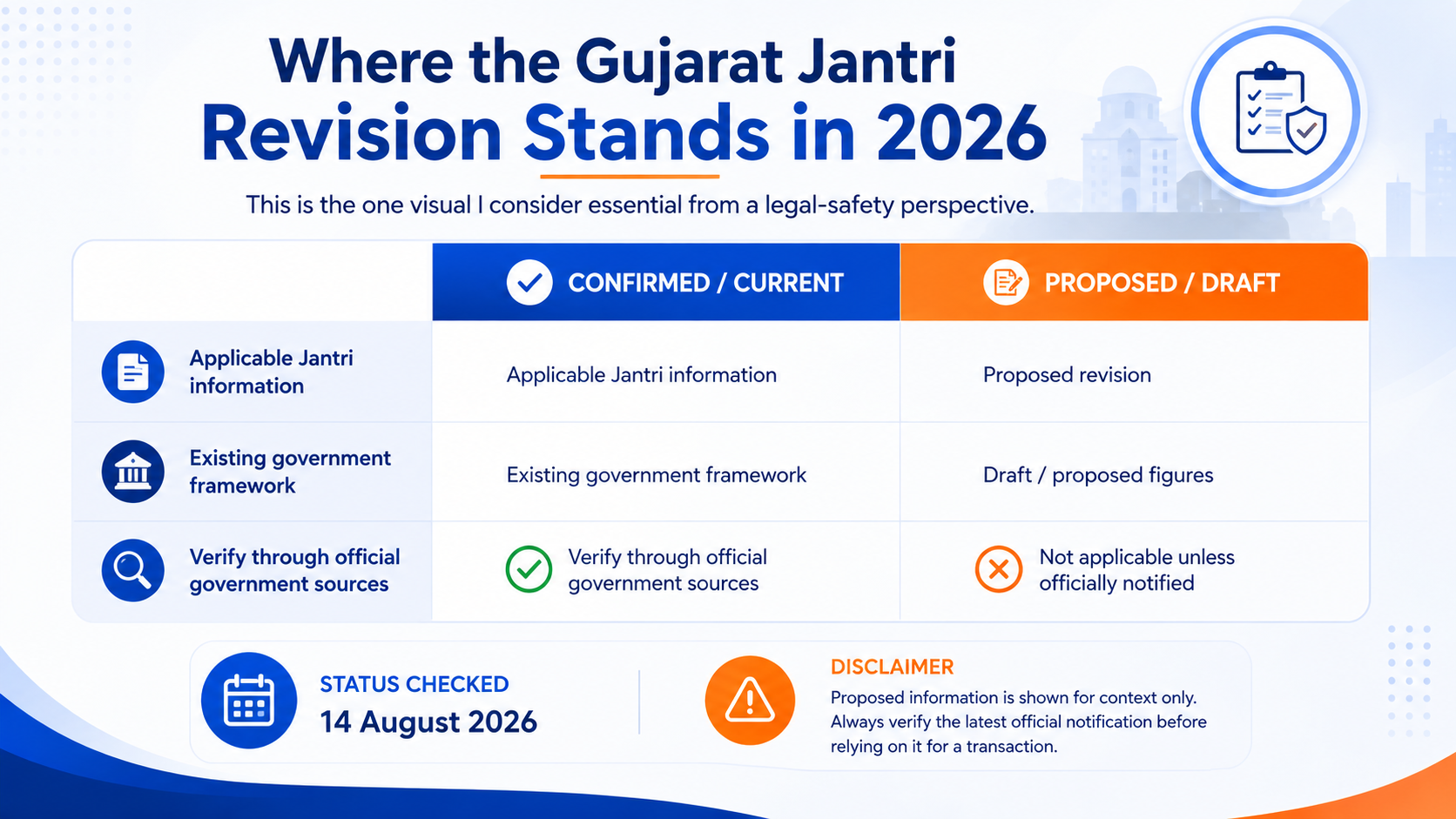
Confirmed vs Proposed - Checked 14 August 2026
| Confirmed | Proposed / Not to be assumed as current |
|---|---|
| The April 2023 Jantri revision is the established recent revision. | Draft or proposed revised values should not be treated as current rates. |
| Buyers should check the applicable Jantri value through the official Gujarat system. | A future implementation date should not be treated as confirmed without an official notification. |
| Stamp-duty calculations must follow the applicable government valuation rules. | Reported percentage increases should not be presented as the rate a buyer will definitely pay. |
Note: Proposed or draft Jantri figures are shown for context only. They should not be treated as applicable rates unless officially notified by the Gujarat government. Check the latest official value before using it for a property transaction.
How Jantri Value Can Affect Your Property Costs in Gujarat
A change in Jantri does not automatically mean the property's price has increased. The bigger question is whether the Jantri value exceeds the amount stated in the transaction. That is where the change can start affecting the buyer's registration cost.
For a simple example, suppose a flat is being purchased for ₹80 lakh, and the applicable Jantri value is ₹70 lakh. The agreed price is already higher, so a Jantri value of ₹70 lakh does not suddenly turn the property into a ₹70 lakh transaction. But if the applicable Jantri value were ₹90 lakh, the calculation would need to be examined differently because the government valuation is now above the agreed price. Buyers can verify the applicable Jantri value through Gujarat's official online system before using it in a property-cost calculation.” Gujarat Revenue Department, Jantri
Where Jantri Can Affect Your Property Costs
- Stamp duty: For the residential example used in this article, a 4.9% stamp-duty rate is used for illustration. The applicable rate and valuation basis should be verified for the specific transaction.
- Registration charges: A 1% registration charge is used for the illustration, subject to the applicable rules and any qualifying concession or exemption. The exact ownership structure should be checked before applying the concession.
- Your total purchase budget: A higher applicable valuation can increase statutory charges in some transactions. For a buyer, the important number is therefore not simply “Jantri increased by X%”, but “how many additional rupees does that change add to this transaction?”
- Income-tax implications in some below-value transactions: A transaction where the declared consideration is lower than the applicable stamp-duty value can also raise a separate question under Section 56(2)(x) of the Income-tax Act. That tax treatment should be assessed separately rather than being mixed up with Gujarat's stamp-duty calculation.
This is why checking the Jantri rate for the exact property matters more than looking at a city-wide headline. Once the applicable value is known, the impact can be calculated rather than guessed.
How to Check the Jantri Rate for Your Property on GARVI Gujarat
The Gujarat government's online Jantri service can be used to check the valuation applicable to a property or land parcel. The exact information required can vary depending on the property and the records available for that location.
1. Open the official Gujarat Jantri service
Start with the Gujarat Revenue Department's official Jantri service, rather than a third-party Jantri calculator.
Gujarat Revenue Department — Jantri
2. Select the relevant location
Enter or select the property's relevant location details as requested by the government system. Keep the district, taluka, village/locality and property identification details available before starting the search.
3. Use the property's land or property identifiers
Depending on the property and the available records, information such as a survey number, block number, city survey details or TP/Final Plot details may help identify the correct parcel or location.
These identifiers are part of Gujarat's official land-record framework.
4. View the applicable Jantri information
Once the relevant property/location information has been selected, use the Jantri service to view the applicable government valuation information.
Do not assume that a nearby property's Jantri value applies to the property being purchased.
5. Save the result and note the date
For a property transaction, save the result or relevant details and record the date on which the Jantri was checked.
Keeping the result and the date checked can help when the property is registered later, particularly if the applicable Jantri position changes in the meantime.
Important: The exact fields and navigation options on the government portal can change. For a live transaction, follow the fields currently displayed on the official Gujarat system rather than relying on a fixed screenshot or an old step-by-step guide.
How to Calculate Property Value Using the Jantri Rate in Gujarat
Once the Jantri rate for a property is found, the next step is to understand what that rate means in terms of the property's government value.
A simple way to understand it is:
Simple Jantri-based estimate = Applicable Jantri Rate × Relevant Area
For example, if the Jantri rate is ₹50,000 per sq. metre and the relevant area is 100 sq. metres, the Jantri-based value would be ₹50 lakh.
| Details | Example |
|---|---|
| Jantri rate | ₹50,000 per sq. metre |
| Relevant area | 100 sq. metres |
| Jantri-based value | ₹50 lakh |
This is a simple example to understand the calculation. For an actual property transaction, the relevant area and valuation method can depend on the property's type, location and applicable government rules.
Why Does This Number Matter?
The Jantri-based value gives a buyer an important government valuation benchmark to compare with the price agreed for the property. That comparison matters because the valuation used for stamp-duty purposes is governed by Gujarat's stamp laws and valuation rules.
If the agreed consideration and the applicable government valuation are different, the transaction may require a closer check before registration. The difference can affect the amount payable toward stamp duty, depending on the applicable valuation provisions. A separate income-tax question may also need to be considered under Section 56(2)(x) where its specific conditions are met.
So, before assuming that a lower negotiated price means lower registration costs, check these three things:
| Check | What it tells you |
|---|---|
| Agreed consideration | The price stated in the transaction |
| Applicable government valuation | The valuation relevant under the applicable stamp-duty rules |
| Difference between the two | Whether further stamp-duty or tax checks are required |
The exact treatment depends on the property, transaction, applicable valuation rules and relevant date. A Jantri calculation should therefore be used as a starting point for review, not as a substitute for the final valuation determined under the applicable government rules.
What Happens If Your Property Price Is Lower Than the Jantri Value in Gujarat?
A property can be agreed at one price while the government's valuation for that property is higher. That does not mean the buyer suddenly has to pay the difference to the seller, but it can change the calculation of stamp duty and may raise a separate tax question. This is where many buyers look only at the sale price and miss an important part of the registration cost.
The easiest way to understand what actually happens is to look at a simple property purchase and follow the numbers from
agreed price → Jantri value → stamp duty → possible tax implication.
The example below shows why the difference between these values matters—and what a buyer should check before registration.
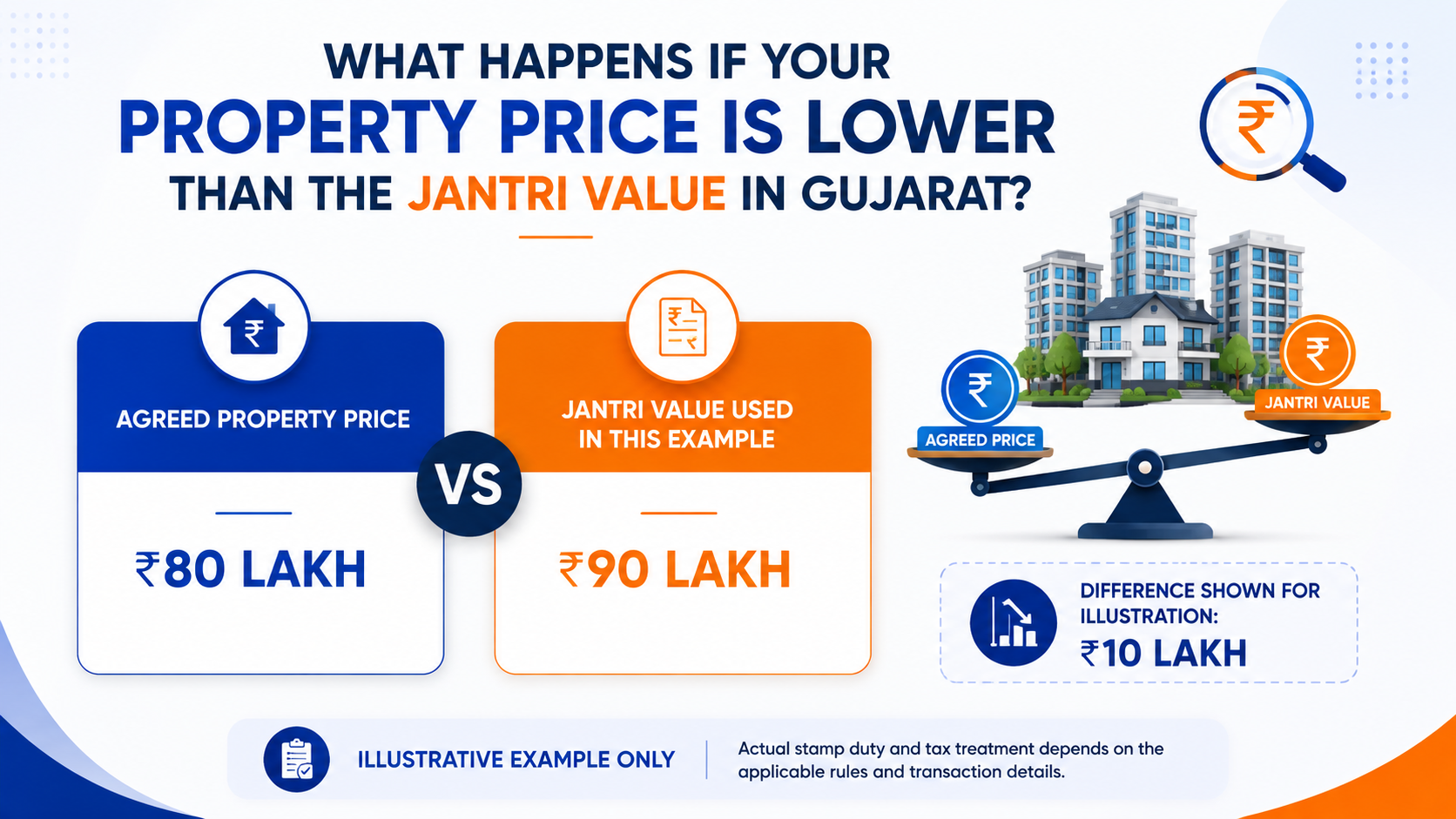
Case Study: When the Agreed Price Is Below the Jantri Value
Consider a buyer purchasing a residential property in Ahmedabad. The price agreed with the seller is lower than the applicable Jantri value for that property. At first glance, the lower purchase price may look like a better deal. But the registration calculation can tell a different story.
For this example, assume the property is agreed at ₹80 lakh, while the applicable Jantri value is ₹90 lakh. The buyer should not assume that every statutory charge is calculated only on the agreed price. Where the applicable government valuation is higher than the agreed consideration, that valuation can become relevant for stamp-duty purposes. The exact treatment depends on the applicable Gujarat valuation rules.
| Particular | Example |
|---|---|
| Agreed property price | ₹80 lakh |
| Applicable Jantri value | ₹90 lakh |
|
Value requiring consideration under the example |
₹90 lakh |
| Difference | ₹10 lakh |
| Illustrative stamp-duty calculation at 4.9%* | ₹4.41 lakh |
| Illustrative registration calculation at 1%* | ₹90,000 |
| Illustrative statutory cost | ₹5.31 lakh |
Important: Illustrative calculation using the rates specified for this Blog. Actual charges should be verified against the applicable Gujarat rules, property type, ownership structure and transaction details.
What does this example tell a buyer?
The ₹10 lakh difference does not mean the buyer pays ₹10 lakh extra to the seller. Instead, the higher government valuation can affect the statutory calculation around the transaction.
There can also be a separate income-tax question when immovable property is purchased below its stamp-duty value. Section 56(2)(x) has its own conditions and threshold, so that issue should be checked separately rather than treating the entire difference as automatically taxable.
What Should You Do If You Are Already Mid-Transaction?
If the property is already booked, the agreement is being prepared, or the agreement has been signed, do not treat a proposed Jantri revision as an automatic change to the transaction.
Check these points first:
- Agreement date
- Agreed property price
- Applicable Jantri value
- Expected registration date
- Latest government notification
- Agreement terms on statutory charges
- If the agreement is not yet signed
Ask for the current stamp-duty and registration calculation and confirm whether it uses an officially applicable Jantri value or only a proposed figure.
If the agreement is already signed
Keep the agreement, applicable valuation and latest government notification together. The relevant date and valuation rules can affect how the transaction is treated, so avoid assuming that a later proposal automatically changes an existing agreement.
The simple approach
Current applicable Jantri value = today's calculation.
Proposed revision = scenario to monitor.
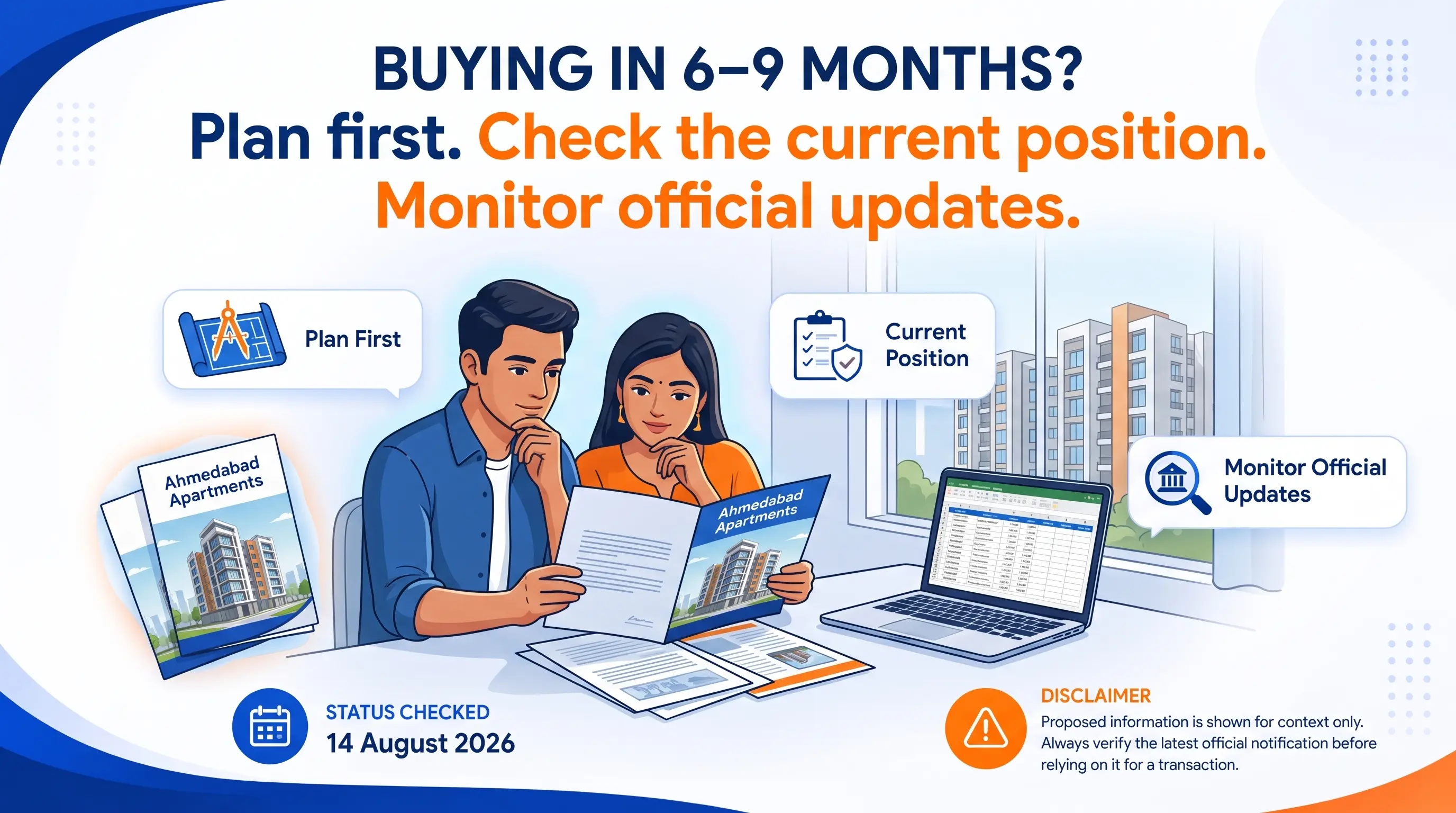
What If You Are Planning to Buy a Property 6–9 Months From Now
A buyer planning six to nine months has one advantage: there is time to understand the numbers before committing. There is also one uncertainty: the applicable Jantri position could be different by the time the property is registered.
That does not make waiting or buying automatically right or wrong. The better approach is to build the Jantri calculation into the purchase budget instead of making the entire decision around it.
| What to check | Why it matters |
|---|---|
| Property price | Shows what the seller or builder is actually asking |
| Current Jantri value | Shows the government valuation applicable today |
| Possible cost difference | Shows how a change in valuation could affect statutory charges |
| Available budget | Shows whether the additional cost would be manageable |
For example, if a property already makes financial sense at its current price, a possible Jantri revision can be treated as a cost scenario to monitor. It does not need to become the reason to book immediately.
On the other hand, if the purchase budget is already tight, even a relatively small change in statutory charges can matter. That number should be understood before signing rather than discovered during registration.
A simple rule for buyers
Do not buy because you are afraid Jantri may increase.
Buy when the property, price, location, legal position, construction quality and overall budget make sense—and then account for any Jantri-related cost separately.
What Should a Property Buyer Do About the 2026 Jantri Revision?
The safest approach is to treat the Jantri revision as something to check, not something to fear. A buyer does not need to predict exactly what the government may notify months from now. The more useful step is to understand the current applicable Jantri value, compare it with the property's agreed price, and calculate what the difference could mean for the overall purchase cost.
For buyers in Ahmedabad and Gandhinagar, four checks can make the decision much clearer:
| Check | What to find out |
|---|---|
| Current Jantri value | What value applies to the exact property today? |
| Agreed property price | Is the purchase price above or below that value? |
| Transaction impact | Could the difference change stamp duty, registration cost or create a separate tax consideration? |
| Future uncertainty | Is a proposed revision relevant to the expected registration date? |
The 2024 draft revision attracted 11,046 objections and suggestions, including 2,179 from Ahmedabad district, which itself shows why a proposed figure should not be treated as a final rate without an applicable government notification. Source: Times of India
A simple rule before making a decision
Do not buy a property only because someone says Jantri is going up.
Instead, check the property's current numbers first. If the property is suitable, the price is reasonable, the legal and technical checks are satisfactory, and the potential Jantri-related cost fits comfortably within the budget, the decision becomes much easier.
And if the numbers do not work, a Jantri deadline should not be the reason to ignore that problem.
How EXIO Helps Buyers Make a More Informed Property Decision
Understanding the Jantri impact is one part of buying a property. The bigger decision is whether the property itself makes sense after considering its price, location, builder, legal status, construction quality and overall cost.
This is where EXIO approaches property buying differently. As a real estate advisory firm in Ahmedabad, EXIO helps buyers discover and compare verified property options rather than simply presenting a list of projects. Each eligible project goes through a 50-point technical, legal and spatial audit, covering factors such as RERA and legal checks, construction and design, amenities, location and investment considerations.
For a buyer, the benefit is simple: the property can be evaluated before the decision is made. Whether the question is about Jantri, the builder, the location or the overall investment, the aim is to bring the important information together so the buyer can make a clearer decision.
What a buyer can review with EXIO
- Verified property and project information
- RERA and available legal details
- Builder track record
- Location and development factors
- Construction and project quality
- Price and overall property considerations
Looking for a property with more clarity and less guesswork?
Explore EXIO's verified property options and make a more informed decision.
Disclaimer: This article is for general informational purposes only and does not constitute legal, tax, financial or government advice. Jantri rates, stamp duty, registration charges, tax rules and government policies may change; proposed or draft revisions should not be treated as confirmed until officially notified. Examples and calculations are illustrative and may not apply to every property or transaction. EXIO does not guarantee that the information will remain current after the date of review. Always verify the latest information with official Gujarat government sources and seek appropriate professional advice before making a property or financial decision.

Frequently Asked Questions
Jantri is the government-determined valuation reference used for property and land in Gujarat. The applicable Jantri value depends on factors such as the property's location, category and relevant valuation details. It should not be confused with the property's actual market price.
The applicable Jantri information can be checked through the Gujarat government's official systems, including GARVI and the Gujarat Revenue Department. The property’s location and other relevant details may be required to identify the applicable valuation. Always use the latest official record when checking a property for a transaction.
A simple way to understand the calculation is to relate the applicable Jantri rate to the relevant property area. However, the actual government valuation may depend on the property's location, type, classification and applicable valuation method. Therefore, a simple rate × area calculation should be treated as an estimate, not a final statutory valuation.
A difference between the agreed property price and the applicable government valuation can have stamp-duty and tax implications, depending on the transaction and the rules that apply. Section 56(2)(x) may also become relevant in certain cases where immovable property is acquired for inadequate consideration. The difference should not be assumed to be automatically taxable; the specific conditions and applicable rules need to be checked.
A proposed or draft revision should not be treated as the applicable Jantri rate unless it has been officially notified and brought into effect by the competent government authority. Buyers should therefore distinguish between the Jantri value currently applicable to a property and any proposed future revision before making transaction or budgeting decisions.


