
 Login
Login
 Investment Advisory
 Contact Us

The Reserve Bank of India (RBI) has kept the policy repo rate unchanged at 5.25% in its August 2026 Monetary Policy Committee (MPC) meeting. For Ahmedabad homebuyers, this decision matters because the repo rate influences the broader cost of borrowing and can affect floating-rate loans over time. However, one important distinction should be clear from the beginning: the RBI repo rate is not the same as your home-loan interest rate.
Your actual home-loan rate depends on the applicable benchmark, the lender's spread, the loan product, your borrower profile and the terms of your loan. So, while the RBI has kept the repo rate unchanged, that does not automatically mean every homebuyer will pay 5.25% on a home loan or see an immediate change in their EMI.
For anyone planning to buy a property in Ahmedabad, the more useful question is not simply what the RBI did. It is what the decision means for your actual borrowing cost, EMI affordability and property-buying decision.
What the MPC actually decided
The RBI's Monetary Policy Committee kept the policy repo rate unchanged at 5.25% in its August 2026 meeting. The decision was announced on 5 August 2026, with the MPC retaining its neutral policy stance.
The decision means that there was no fresh repo-rate cut in August. For borrowers, this provides some near-term stability in the policy rate, but it does not guarantee that home-loan rates will remain unchanged indefinitely. Future changes will depend on subsequent RBI repo rate decisions and how lenders transmit changes through their applicable loan benchmarks and pricing structures.
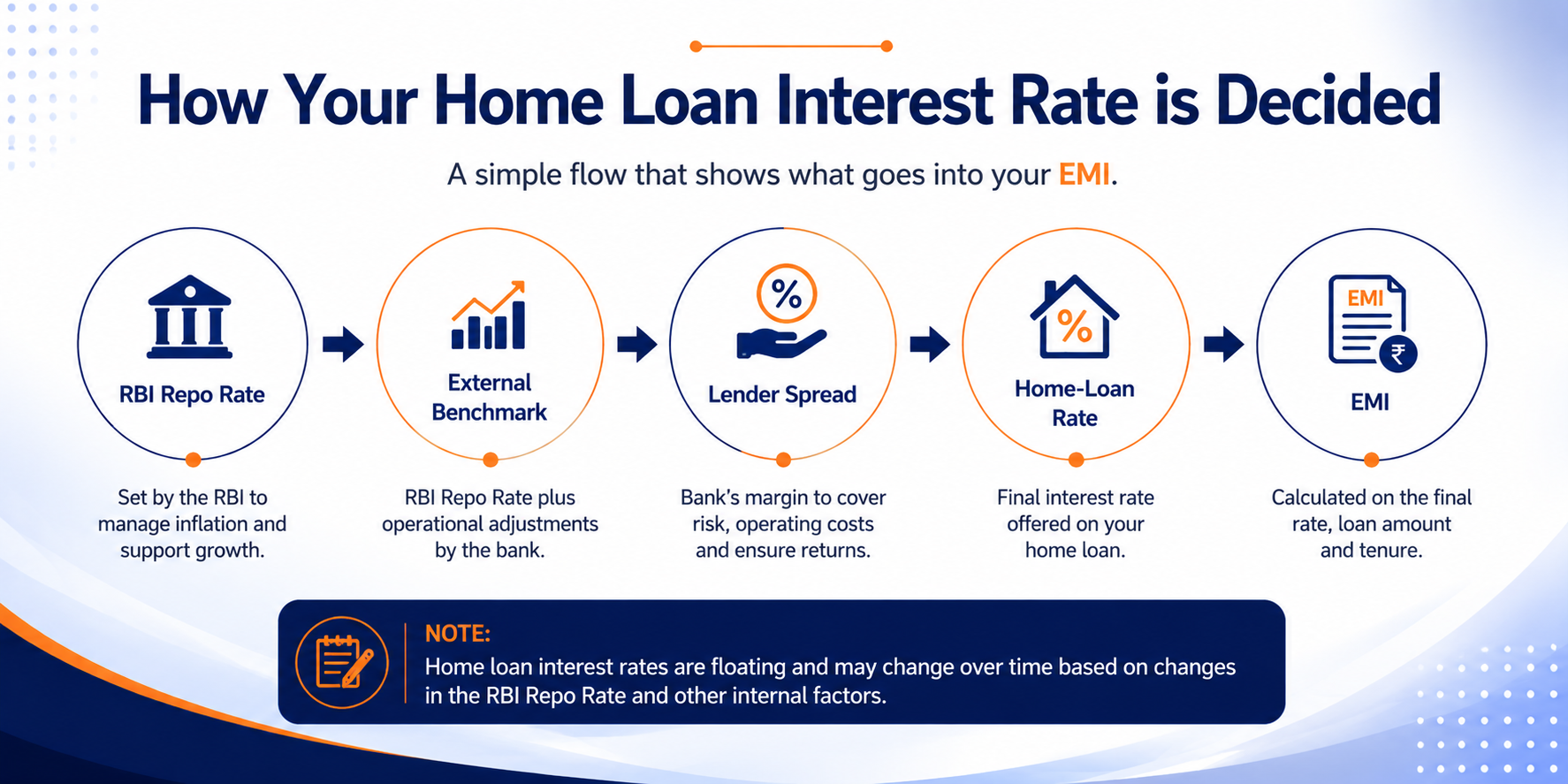
The repo rate is the rate at which the RBI lends to commercial banks against eligible securities. Because it influences the broader financial system, changes in the repo rate can eventually affect borrowing and lending conditions. However, the rate a homebuyer actually pays is determined through the lender's applicable pricing mechanism.
For Ahmedabad buyers, therefore, the August decision should be viewed as a stability signal rather than a direct EMI announcement. Your actual loan rate and the terms offered by your lender are still the numbers that matter when calculating your affordability.
What is the repo rate and how does it affect home loans?
The repo rate is the interest rate at which the Reserve Bank of India lends money to commercial banks against eligible securities. It is one of the RBI's key monetary-policy tools and is used to influence liquidity, borrowing conditions and economic activity.
When the RBI changes the repo rate, the impact does not automatically translate into the same change in every borrower's home-loan interest rate. The effect depends on how the loan is linked to its applicable benchmark, the lender's spread and the loan's reset mechanism.
For borrowers with eligible floating-rate loans linked to an external benchmark, changes in the benchmark can influence the lending rate when the loan resets. This can eventually affect the borrower's EMI, loan tenure or both, depending on the lender's applicable terms and the borrower's loan structure.
What happens when the repo rate changes?
| RBI action | Potential impact on borrowing | What a home-loan borrower should check |
|---|---|---|
| Repo rate increases | Borrowing conditions may become tighter | Whether your applicable benchmark and loan rate increase |
| Repo rate decreases | Borrowing conditions may become easier | Whether the lower benchmark is passed through at your reset |
| Repo rate remains unchanged | No new policy-rate change | Your current loan rate, spread and next reset date |
The important point is that a repo-rate change is not automatically equal to an identical change in your home-loan rate. The transmission depends on the applicable benchmark and terms of your loan.
For borrowers trying to understand how RBI policy affects their mortgage, the RBI's home-loan guidance for borrowers explains the importance of understanding the benchmark, spread, reset mechanism and other applicable loan terms.
Why the repo rate is not your home loan rate
One of the most common misconceptions around RBI policy announcements is that a repo rate of 5.25% means a homebuyer can get a home loan at 5.25%. That is not how home-loan pricing works.
For eligible floating-rate retail loans, banks use an external benchmark under the applicable RBI framework. The lender then applies its relevant spread and other applicable pricing terms. In simplified terms, the lending rate can be understood as the applicable benchmark plus the lender's applicable spread. The RBI also recommends that borrowers understand the benchmark, spread, reset mechanism and other terms applicable to their floating-rate home loan. RBI home-loan guidance for borrowers
For example, if a loan is linked to a benchmark of 5.25% and the applicable lender spread is 2.50%, the resulting lending rate would be 7.75%. This is only an illustration; the actual rate offered to a borrower can vary depending on the lender, loan product, borrower profile and other applicable conditions.
This distinction becomes particularly important when comparing home loans. Two lenders may be operating in the same interest-rate environment but offer different rates because their spreads, pricing policies, loan products and borrower eligibility criteria differ.
Therefore, instead of looking only at the RBI repo rate, a prospective borrower should check the actual rate offered, benchmark, spread, reset mechanism, fees and total repayment cost before choosing a lender.
The repo rate tells you something about the direction of monetary policy. Your loan agreement tells you what you actually pay.
The EMI on a real Ahmedabad ticket size, worked example
The easiest way to un
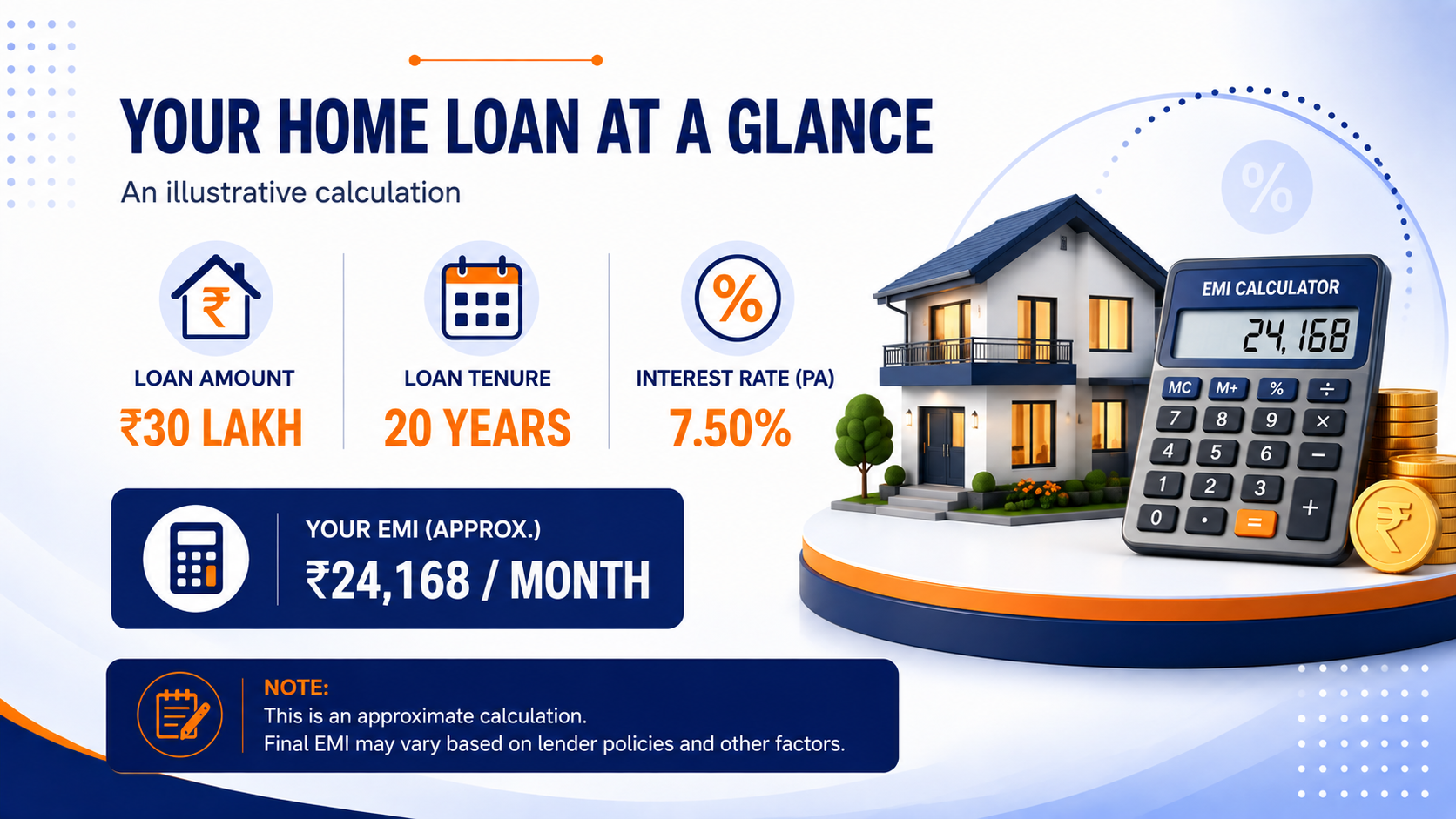
derstand the impact of interest rates is to convert the discussion into an actual home-buying example. Suppose an Ahmedabad buyer purchases a property for ₹40 lakh, makes a ₹10 lakh down payment and takes a ₹30 lakh home loan for 20 years. If the illustrative interest rate is 7.50%, the approximate monthly EMI would be ₹24,168.
Now consider how the same ₹30 lakh loan changes at different interest rates:
| Interest Rate | Loan Amount | Tenure | Approx. Monthly EMI |
|---|---|---|---|
| 7.25% | ₹30 lakh | 20 years | ₹23,711 |
| 7.50% | ₹30 lakh | 20 years | ₹24,168 |
| 7.75% | ₹30 lakh | 20 years | ₹24,635 |
| 8.00% | ₹30 lakh | 20 years | ₹25,093 |
These figures are illustrative and are intended to demonstrate how the EMI changes as the interest rate changes. The actual EMI offered to a borrower will depend on the lender's applicable interest rate, loan amount and tenure.
The difference may appear relatively small on a monthly basis, but a home loan is a long-term financial commitment. Even a modest change in the interest rate can affect the total amount paid over the life of the loan, particularly when the outstanding principal is large.
Consider a larger Ahmedabad purchase. If a buyer takes a ₹50 lakh home loan for 20 years at an illustrative 7.50% interest rate, the approximate EMI would be ₹40,280 per month. At this level, even a relatively small change in the interest rate deserves attention because the monthly obligation is already a significant part of a typical household budget.
This is why buyers should not make a property purchase based only on today's EMI. A more responsible approach is to calculate the EMI at the offered rate and then test the same loan at a somewhat higher rate. If the higher EMI would put substantial pressure on your monthly finances, the property or loan amount may be beyond your comfortable budget.
For example, the ₹30 lakh, 20-year loan would have an approximate EMI of ₹24,168 at 7.50%, compared with around ₹25,093 at 8.00%. This simple stress test can help a buyer understand whether there is enough financial room if borrowing costs become less favourable.
If you are already borrowing: the spread conversation to have with your bank
For existing floating-rate home-loan borrowers, an RBI policy announcement is a good reason to review the terms of the loan rather than simply waiting for the EMI to change.
The first thing to establish is which benchmark your loan is linked to and what your current interest rate is. You should also ask your lender about the applicable spread, your next reset date and how changes in the benchmark are transmitted to your loan.
This is important because the same benchmark does not necessarily result in the same final lending rate for every borrower. The lender's applicable spread is one of the components that determines the rate you actually pay.
When speaking with your bank, ask for a clear explanation of your current loan structure. In particular, find out whether your interest rate has changed, whether the change affects your EMI or remaining tenure, and when the next reset is scheduled.
You should also ask whether part-prepayment is available under your loan terms and whether refinancing or switching to another lender would provide a meaningful financial benefit. However, switching should not be based on the headline interest rate alone. Any potential interest saving should be compared against processing charges, administrative costs and other applicable expenses.
A useful way to think about it is:
Potential benefit from switching = Expected interest saving − applicable switching and other costs
If the saving is marginal, switching may not make sense. If the difference is significant and the borrower qualifies for better terms, it may deserve further evaluation.
Existing borrowers should also avoid assuming that a change in the benchmark automatically means their EMI will fall by the same amount. Depending on the loan structure and lender's mechanism, changes in the applicable interest rate can affect the EMI, the remaining tenure or both.
If you are about to borrow: what to lock, what to compare
For buyers who are still planning their home purchase, the August RBI decision is an opportunity to look at the complete cost of borrowing rather than focusing on the headline rate advertised by a lender.
A lender may advertise a home loan as being available "from" a particular interest rate. That starting rate does not necessarily mean every borrower will receive it. Your actual offer can depend on your credit profile, income, loan amount, property, loan product, benchmark and other eligibility factors.
Before finalising a home loan, compare the actual offer across several important factors.
| Factor | Why It Matters |
|---|---|
| Actual offered interest rate | Directly affects your EMI and interest cost |
| Benchmark | Shows what reference rate your floating loan follows |
| Lender spread | Helps determine the final lending rate |
| Reset mechanism | Determines how changes in the benchmark can affect the loan |
| Processing charges | Adds to the initial borrowing cost |
| Other applicable fees | Can increase the overall cost of the loan |
| Prepayment terms | Important if you expect to repay early |
| Loan tenure | Affects both EMI and total interest |
| Total repayment | Shows the long-term cost rather than just the monthly EMI |
A buyer should also avoid choosing a property based on an EMI that only works under the most favourable assumptions. Your monthly housing cost is not limited to the loan repayment. Maintenance, insurance, property taxes, utilities, interiors and unexpected expenses can all add to the cost of owning a home.
A sensible affordability test is therefore to calculate your EMI at the offered rate and then test it at a moderately higher rate. If the higher payment would seriously affect your ability to save, invest or manage other commitments, reconsider the loan amount or property budget.
More importantly, do not let the home loan become the only factor in your property decision. Before committing to a long-term loan, evaluate the property itself, including its RERA status, legal position, builder track record, construction quality, location, connectivity, pricing and long-term marketability.
A slightly lower interest rate can save money. Buying the wrong property can cost far more.
What this does and does not tell you about the next six months
The August 2026 RBI decision tells us where the policy repo rate stands today. It does not provide certainty about where home-loan rates will be six months from now.
The repo rate could remain unchanged, increase or decrease at a future MPC meeting depending on inflation, economic growth, global conditions, oil prices and other factors considered by the RBI. Even if the RBI changes the repo rate, the effect on individual home-loan borrowers will depend on the applicable benchmark, lender spread and reset mechanism.
This means buyers should be cautious about making decisions based on predictions such as "home-loan rates will definitely fall in the next six months." The opposite assumption, that rates definitely will not fall, would be equally difficult to justify.
For a property buyer, the better approach is to plan for different scenarios. First, check whether the property is affordable at today's offered rate. Then test whether the loan remains manageable if the rate becomes moderately higher. Finally, consider whether a future rate reduction would materially improve your finances or simply encourage you to take a larger loan.
This approach removes some of the uncertainty from the decision. You cannot control the RBI's next policy announcement, but you can control the amount you borrow, the property you select and the financial buffer you maintain..
Should you wait for a rate cut before buying in Ahmedabad?
There is no universal answer. If you have found a property that is appropriately priced, suits your requirements, has acceptable legal and project credentials and fits comfortably within your financial capacity, waiting solely for a possible rate cut may not necessarily result in a better purchase.
Property prices, project availability, payment plans and inventory can change while you wait. On the other hand, if the current EMI is already stretching your budget or the property appears overpriced, a possible future rate cut should not be used to justify buying it. The smarter decision is to evaluate the property price, loan cost, EMI affordability and long-term suitability together.
For Ahmedabad buyers, this is especially important because the city has a wide range of residential projects across different locations and price segments. The right decision depends on the specific property and the buyer's financial position, rather than on the RBI headline alone.
What should an Ahmedabad buyer take away from the August 2026 decision?
For Ahmedabad homebuyers, the most important takeaway from the August 2026 RBI decision is that 5.25% is the policy repo rate, not the rate you should use to calculate your home loan.
Your actual borrowing cost depends on your lender's rate and the structure of your loan. That is the number to use when calculating your EMI, testing affordability, and comparing different financing options. But the loan is only one side of the property decision. Before taking on a 15-, 20- or 25-year financial commitment, you also need to establish whether the property itself deserves that commitment. A good property decision therefore combines four things: the quality and suitability of the property, the price you are paying, the cost of financing and your ability to comfortably manage the resulting cash flow.
The key question is not simply, "Can I afford this EMI?" It is:
"Is this property worth taking this long-term financial commitment for?"
That question becomes particularly important in a market like Ahmedabad, where buyers can choose between different locations, project types, developers and price segments.
How EXIO can help you evaluate the property behind the EMI
A home loan is a long-term financial commitment, so the property you purchase with that loan deserves careful evaluation before you sign.
EXIO takes an advisory-led approach to property evaluation, helping buyers look beyond the advertised price and brochure. Our evaluation considers factors such as RERA and legal information, builder track record, project quality, location intelligence, pricing context, amenities and overall property suitability.
The objective is not simply to show you more properties. It is to help you develop better clarity about which properties deserve serious consideration before you commit your money and a long-term EMI.
If you are comparing residential properties in Ahmedabad or Gandhinagar, EXIO can help you assess the options more systematically and make a more informed property decision.
Don't choose a property only because the EMI fits. Choose one that deserves the EMI.
Disclaimer: This article is for general informational and educational purposes only and does not constitute financial, investment, banking, legal, tax, or property-buying advice. RBI policy, home-loan interest rates, lender terms, EMI calculations and property market conditions may change. The rates and EMI figures mentioned are illustrative and should not be considered an offer or guarantee. Readers should verify the latest information with the RBI, relevant lender and qualified professionals before making financial or property decisions. EXIO does not guarantee loan approval, future interest rates, property prices or investment returns.

Frequently Asked Questions
The RBI repo rate is 5.25% in August 2026. The Monetary Policy Committee (MPC) kept the repo rate unchanged at its August 2026 meeting and retained a neutral policy stance.
No. The repo rate is an RBI policy rate and does not directly equal a borrower's home-loan interest rate. For eligible floating-rate loans, the actual lending rate depends on the applicable benchmark, lender spread, loan product and other applicable terms.
A change in the repo rate can affect the applicable benchmark for eligible floating-rate home loans. When the loan resets, this can influence the interest rate and may affect the borrower's EMI, loan tenure or both, depending on the loan structure and lender's applicable terms.
There is no single home-loan rate applicable to every borrower in Ahmedabad. The actual rate depends on the lender, loan product, borrower profile, applicable benchmark, lender spread and other terms. Buyers should compare the rate actually offered to them rather than relying only on an advertised starting rate.
Not necessarily. A future rate cut cannot be predicted with certainty, while property prices, project availability and payment plans can change. Buyers should evaluate the property price, loan cost, EMI affordability and long-term suitability together rather than timing a purchase only around a possible rate cut.


