
 Login
Login
 Investment Advisory
 Contact Us

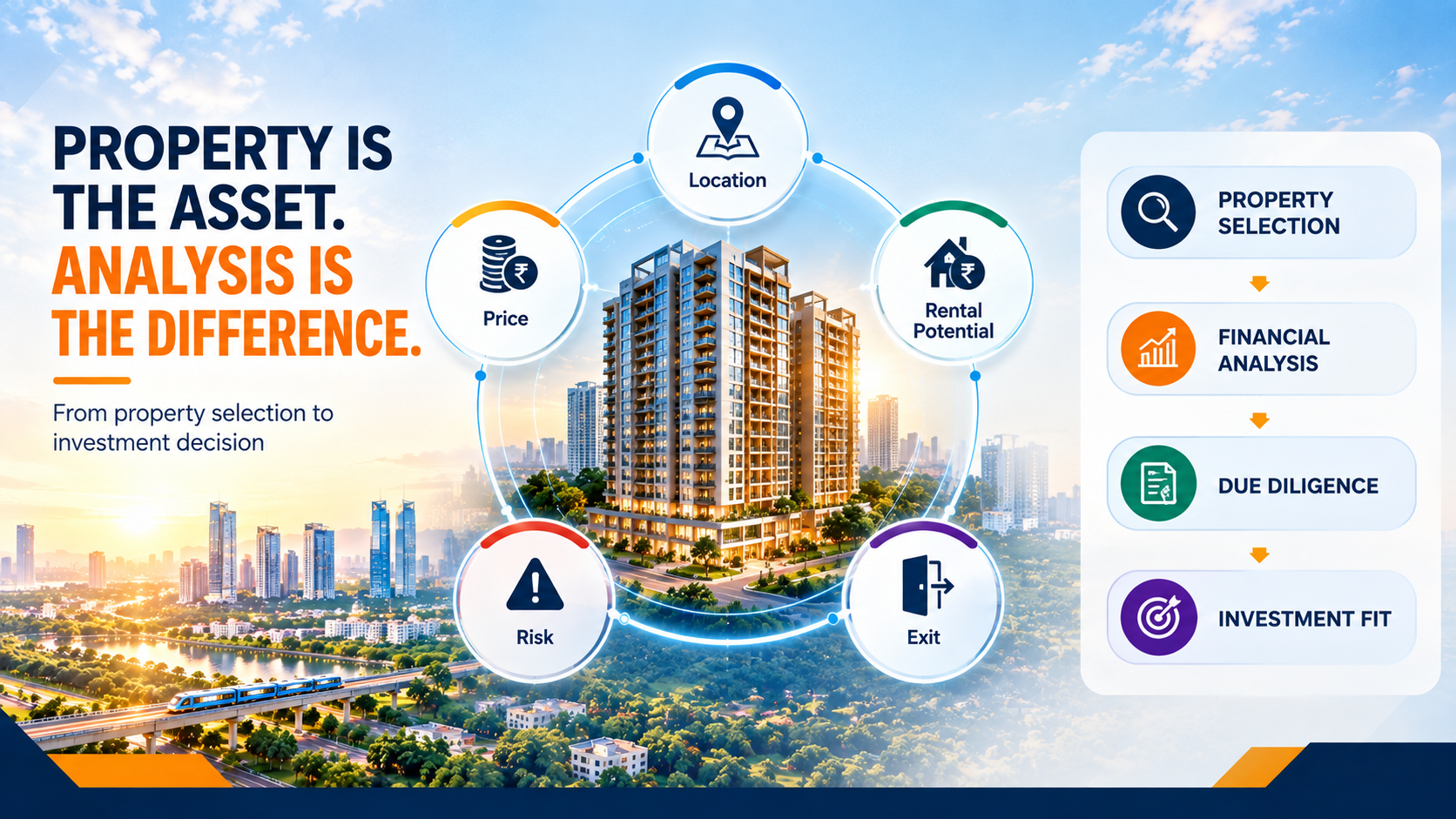
Buying property is a transaction. Investing in property is a strategy. The real difference lies in what happens before you buy, how the property is evaluated, what the numbers show, what risks exist, and whether the asset fits your investment goals.
This is where a real estate investment company in Ahmedabad can add value. This guide explains what a property investment company does, how to evaluate one, and what to consider before investing across Ahmedabad, Gandhinagar and GIFT City.
What Does a Real Estate Investment Company Do (And Why It Replaces the Broker)?
A real estate investment company in Ahmedabad analyses, underwrites, and manages income-generating property portfolios. Unlike transactional brokers who earn one-off sales commissions, an investment firm operates as a fiduciary, modeling net internal rate of return (IRR), verifying GujRERA records, and handling corporate leasing and portfolio exits
Advisory vs. Transactional Selling: Understanding the Incentive Gap
A traditional property transaction usually centres on one immediate outcome: completing the deal. The focus may therefore be on available inventory, pricing, project features and the buyer’s decision timeline.
A real estate investment company approaches the same decision from a broader investment perspective. Instead of looking only at whether a property can be purchased, the analysis can consider total acquisition cost, rental potential, vacancy risk, capital appreciation, liquidity, holding period and exit potential.
The difference is simple: transactional selling focuses on the purchase; investment advisory focuses on what the purchase is expected to achieve.
| Operating Metric | Traditional Real Estate Broker | Real Estate Investment Company |
| Core Incentive | One-off transaction commission (typically 1%–2%) | Retainer advisory, asset performance, or ongoing management fees |
| Valuation Metric | Speculative claims on future market appreciation | Formal underwriting: Net IRR, cash-on-cash yield, and cap rates |
| Due Diligence | Relies on marketing brochures and builder claims | Independent 30-year title searches, GujRERA audits, and zoning verification |
| Post-Purchase Scope | Relationship ends immediately upon deed registration | Corporate tenant leasing, rent escalation oversight, and exit liquidity |
| Asset Strategy | Disconnected, single-property transactions | Balanced asset allocation (Commercial, Pre-leased, Plotted, Mixed-use) |
Instead of assessing whether an office space on Sindhu Bhavan Road or an apartment in Shela "looks premium," an investment firm calculates the net financial yield. This means modelling cash flows after deducting statutory stamp duty (based on revised Jantri valuations), AMC/AUDA property taxes, routine maintenance outlays, and realistic tenant vacancy buffers.
💡 EXIO's Valuation & Due Diligence Guide:
Wondering how government circle rates determine your stamp duty and minimum taxable transaction value? Read our complete analysis: Jantri Rate Ahmedabad: What It Means for Property Buyers.
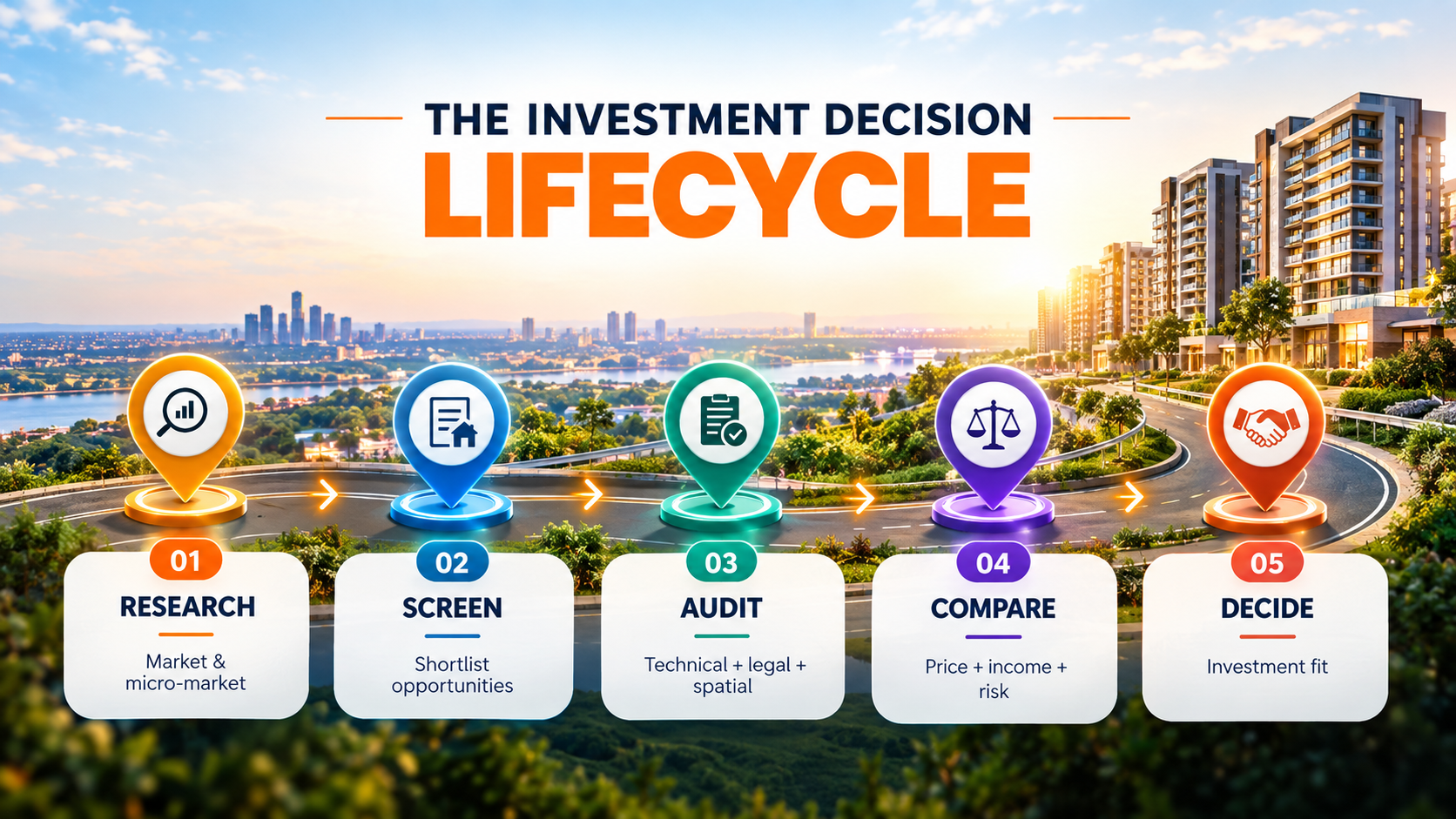
From Property Selection to Portfolio Management: The 4-Stage Lifecycle
Acquiring a property is simply the first milestone of capital deployment. Generating consistent risk-adjusted returns requires continuous operational oversight across four distinct phases:
-
1. Sourcing & Financial Underwriting: Evaluating off-market opportunities, pre-leased corporate assets, and early-phase township plots. Every deal is stress-tested against interest-rate shifts, tenant absorption cycles, and localised micro-market supply pipelines.
-
2. Independent Statutory Audits: Auditing developer filings on the GujRERA portal (
gujrera.gujarat.gov.in), verifying that 70% of project funds are ring-fenced in designated escrow accounts, confirming non-agricultural (NA) land permissions, and checking Building Use (BU) approvals. -
3. Corporate Tenant Acquisition & Lease Structuring: Negotiating long-term commercial lease agreements with corporate and institutional tenants. This includes establishing enforceable lock-in clauses, structured security deposit reserves, and standard rental escalations (typically 4% to 5% annually or 15% every 3 years).
-
4. Portfolio Rebalancing & Exit Execution: Actively tracking capital appreciation cycles to execute planned exits, whether that involves liquidating an appreciated residential unit to redeploy into high-yield commercial assets or managing secondary sales for NRI investors
How to Verify a Property Investment Company in Ahmedabad & Gandhinagar
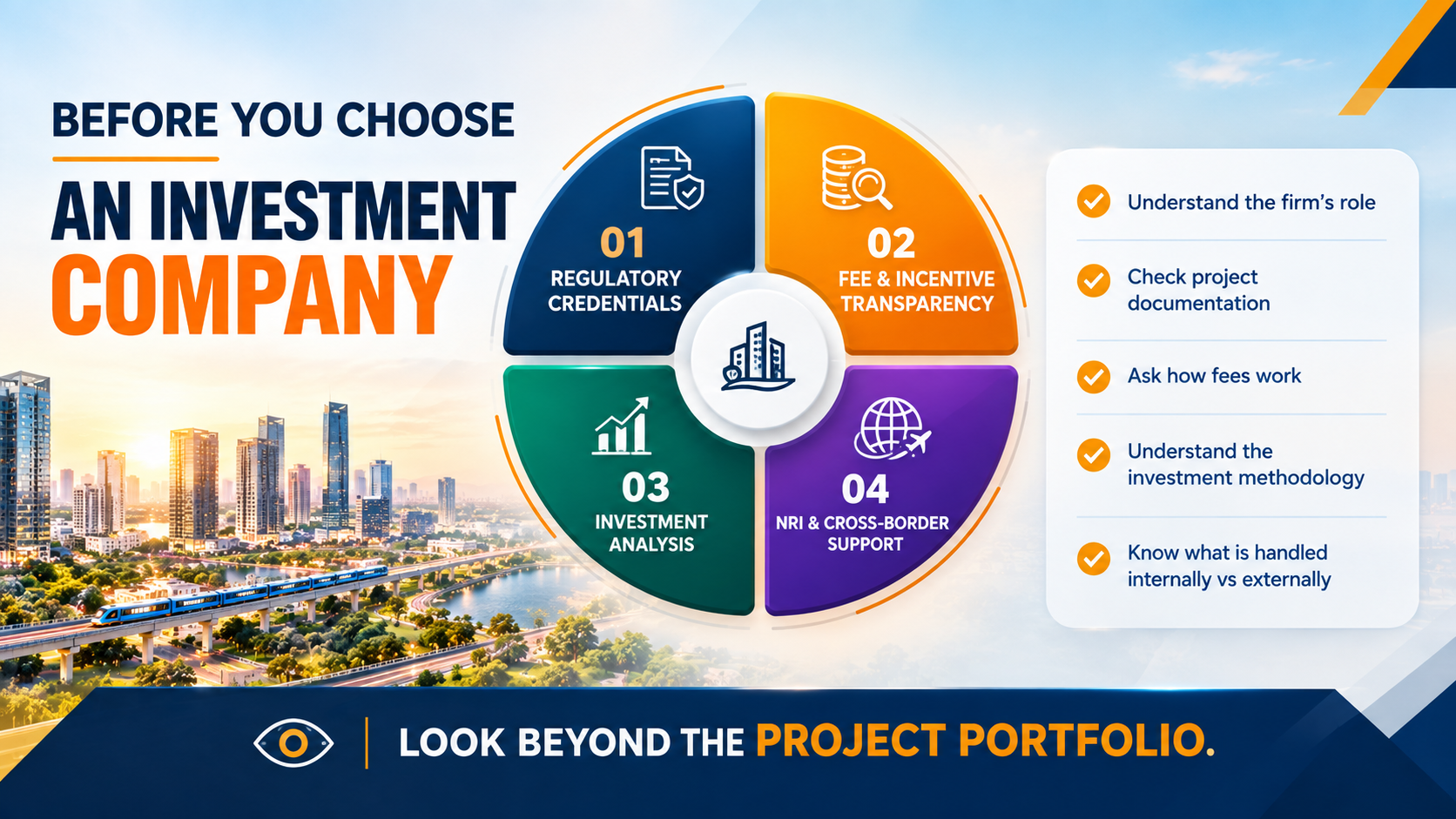
To evaluate a property investment company in Ahmedabad and Gandhinagar, verify four pillars: active GujRERA registration (Section 9), fee model transparency (separating fiduciary advisory from developer sales commissions), micro-market yield modelling (accounting for revised Jantri and vacancy risk), and end-to-end statutory cross-border compliance for NRI capital.
Choosing a property investment company requires examining structural credentials, fee transparency, analytical methodology, and due-diligence protocols rather than relying on glossy project brochures or marketing claims.
For investors allocating capital across Ahmedabad, Gandhinagar, and GIFT City, four specific evaluation areas determine whether an advisory firm can protect and grow your capital.
1. Regulatory Credentials & Statutory Project Due Diligence
Start by determining the firm's legal standing and confirming whether its activities require formal state licensing. Under Section 9 of the Real Estate (Regulation and Development) Act, 2016, any real estate agent or advisory firm facilitating the sale or purchase of units in a registered project must hold an active registration certificate with the regulatory authority.
Beyond the advisor’s credentials, examine how rigorously the firm audits the underlying asset:
-
GujRERA Records: Cross-verify the project’s registration status on the official public portal (
gujrera.gujarat.gov.in). Review Quarterly Progress Reports (QPRs), promoter track records, approved layout modifications, and regulatory disclosures. Confirm that 70% of buyer collections are held in designated project escrow accounts. -
Statutory Project Documentation: Verify sanctioned Town Planning (TP) scheme integration, Non-Agricultural (NA) land permissions, and valid Building Use (BU) permissions issued by local urban authorities (AMC or AUDA).
-
Timeline vs. Construction Progress: Compare marketing promises against actual on-ground milestones and official phase-wise completion filings.
-
Independent Legal Scrutiny: Ensure the firm facilitates an independent 30-year title verification, encumbrance check, and formal legal search report via an independent advocate rather than accepting developer-provided documentation.
2. Fee Structure & Incentive Transparency
How an investment company gets paid directly shapes the objectivity of its advice. Clear commercial disclosures separate true fiduciary consulting from commission-driven sales.
Essential Questions for Vetting Firm Compensation:
-
Does the firm operate on a fee-only advisory mandate or retainer?
-
Does it collect sales commissions, success fees, or marketing retainers from developers?
-
Are channel-partner agreements and referral fee arrangements disclosed in writing before capital commitment?
-
Does the firm maintain a documented record of recommending that investors walk away from non-viable projects?
A professional property investment company clearly distinguishes research-backed investment underwriting from promotional builder marketing.
3. Investment Analysis & Micro-Market Research
Broad claims such as "property prices always double" substitute speculation for investment analysis. Real estate returns vary drastically across asset classes, micro-locations, tenant profiles, and holding horizons.
A disciplined evaluation requires mathematical precision across five metrics:
| Analytical Parameter | Focus Areas for Ahmedabad & Gandhinagar |
| Net Rental Yield | Models actual net income by subtracting property taxes, common area maintenance (CAM), and realistic vacancy buffers from gross collections. |
| Total Acquisition Cost | Factors in base property price, statutory stamp duty (4.9%), registration fees (1%), revised government Jantri valuations, GST on under-construction assets, and legal outlays. |
| Micro-Market Fundamentals | Audits inventory overhang, upcoming commercial supply, and corporate absorption rates across distinct corridors (e.g., SBR Grade-A offices vs. GIFT City DTA units vs. SP Ring Road suburban residential). |
| Liquidity & Exit Risk | Analyses the historical depth of secondary resale and leasing markets to avoid illiquid capital lock-ins. |
| Asset-Specific Risks | Stress-tests portfolios against tenant concentration risk, lease lock-in expiries, construction delays, and changing infrastructure timelines. |
💡 EXIO Cost Breakdown:
In Gujarat, statutory acquisition friction typically adds 4.9% to 5.9% to your baseline capital outlay. Review the full schedule of state levies, female buyer fee exemptions, and municipal charges in our Gujarat property registration charges and stamp duty guide.
4. NRI Investment & Cross-Border Compliance
For Non-Resident Indians (NRIs) and Overseas Citizens of India (OCIs), an advisory firm must navigate Foreign Exchange Management Act (FEMA) and Reserve Bank of India (RBI) rules to protect capital:
-
Banking Channels: Funds must be routed strictly via normal banking channels using NRE, FCNR(B), or NRO accounts; cash transactions are prohibited.
-
Remote Execution (PoA): End-to-end management of Power of Attorney drafting, Indian consular attestation abroad, and local adjudication with the Sub-Registrar.
-
Taxation & Withholding: Coordinating proper Section 195 Tax Deducted at Source (TDS) and lower deduction certificates to prevent penalties.
-
Capital Repatriation: Structuring transaction audit trails, maintaining Foreign Inward Remittance Certificates (FIRCs), filing Form 15CA/15CB, and managing the $1M per financial year NRO remittance threshold.
💡 EXIO Market Intelligence:
Unsure whether to allocate capital into Ahmedabad's mature business corridors or Gandhinagar's GIFT City growth belt? Explore our data-backed analysis: Ahmedabad vs Gandhinagar: Which City Offers Better Real Estate ROI?

Where Are Investors Looking Across Ahmedabad & Gandhinagar?
Capital allocation across Ahmedabad and Gandhinagar focuses on four corridors: Grade-A commercial spaces on SG Highway and Sindhu Bhavan Road yielding 7% to 8.5%, institutional tech and finance hubs in GIFT City (SEZ vs. DTA), high-liquidity residential corridors along SP Ring Road (Shela, Vaishnodevi), and long-horizon industrial land banking in Sanand and Dholera SIR.
1. SG Highway & Sindhu Bhavan Road (SBR)
-
Target Asset: Pre-leased Grade-A office plates, standalone corporate floors, and vetted commercial real estate projects in Sindhu Bhavan Road and SG Highway.
-
Yield Benchmark: 7.0% to 8.5% net annual rental yield, supported by institutional 9-to-15-year leases and standard 15% escalations every 3 years.
-
Primary Risk: High capital entry barriers (₹2 Cr to ₹10+ Cr) and sudden vacancy friction if floor-plate efficiency or parking ratios fall below corporate Grade-A benchmarks.
2. GIFT City & Gandhinagar Link
-
Target Asset: Commercial office plates in SEZ/DTA towers and vetted commercial real estate projects in Gandhinagar and GIFT City.
-
Yield Benchmark: 6.2% to 7.5% gross yield, offset by institutional tenant covenants and long-term capital appreciation driven by tech, BFSI, and GCC expansion.
-
Primary Risk: Regulatory misalignment between SEZ and DTA units; non-SEZ entities cannot legally lease inside processing zones, which directly restricts tenant liquidity.
3. SP Ring Road & Emerging Growth Nodes (Shela, Vaishnodevi, Gota)
-
Target Asset: 3 & 4 BHK apartments in gated societies and high-street neighbourhood retail centres. Browse our vetted residential properties along SP Ring Road and Shela to evaluate floor-plate efficiencies and builder delivery track records.
-
Yield Benchmark: 2.5% to 3.8% gross rental yield, balanced by higher transaction liquidity and steady 8% to 12% annual capital appreciation during infrastructure expansion.
-
Primary Risk: Localised inventory oversupply and execution delay; buyers must verify valid AUDA/AMC Town Planning (TP) approvals and promoter delivery records on GujRERA.
Shela is no longer just an extension of South Bopal." Read our tactical market breakdown on infrastructure scaling, live inventory absorption, and price discovery in this corridor: View the Shela Market Dispatch on LinkedIn.
4. Dholera SIR & Industrial Belts (Sanand)
-
Target Asset: Industrial logistics plots, warehousing land, and commercial land-banking parcels along expressway nodes.
-
Yield Benchmark: Long-horizon capital appreciation (7-to-10+ year holding period); not an immediate cash-flow or rental-yield asset.
-
Primary Risk: Speculative land-pooling schemes and delayed civic trunk infrastructure; requires strict verification of Non-Agricultural (NA-Industrial) status and clear, unencumbered individual titles.
7 Questions to Ask Before Choosing a Property Investment Company
Before partnering with a real estate investment company in Ahmedabad, ask targeted questions covering their underwriting methodology, empirical return data, vacancy stress-testing, GujRERA due diligence, fee transparency, risk-management protocols, and liquidity exit horizons.
Interviewing a prospective property investment firm should focus on uncovering their data sources, legal safeguards, and commercial incentives. Use these seven practical questions to assess whether an advisory partner operates with institutional discipline.
1. "How do you evaluate an investment opportunity?"
-
Why it matters: Eliminates firms that rely on builder marketing claims rather than financial fundamentals.
-
What to listen for: The firm should explain a structured screening process, filtering deals by micro-market absorption rates, developer execution history, zoning validity, and asset-class fit (commercial pre-leased vs. residential appreciation) rather than just "project popularity."
2. "What data supports the expected returns?"
-
Why it matters: Gross rental yields and speculative appreciation figures often mask real ownership costs.
-
What to listen for: Look for a comprehensive financial model showing net returns. The calculations must factor in revised government Jantri valuations, stamp duty (4.9%), registration fees (1%), GST for under-construction assets, local property taxes, common area maintenance (CAM), and realistic annual escalation rates.
3. "How do you assess vacancy and liquidity risk?"
-
Why it matters: An asset that looks profitable on paper can drain cash flow if it sits vacant for six months.
-
What to listen for: A disciplined firm models a realistic vacancy buffer (e.g., 1–2 months between corporate tenants) and tracks competing office or residential supply in the specific sub-market (such as SBR, SG Highway, or GIFT City) to evaluate secondary resale liquidity.
4. "What project-level due diligence do you perform?"
-
Why it matters: Title flaws, pending litigation, or unapproved layouts can freeze your capital indefinitely.
-
What to listen for: The advisor should detail how they verify promoter filings on the official GujRERA portal (
gujrera.gujarat.gov.in), confirm that 70% of buyer collections remain in designated escrow accounts, check Building Use (BU) permissions, and facilitate independent 30-year title searches via a legal advocate.
5. "How are your fees and commissions structured?"
-
Why it matters: Uncovers potential conflicts of interest before you commit capital.
-
What to listen for: Transparent disclosure of whether the firm charges an investor advisory retainer, a performance fee, or collects commissions from developers. If developer payouts are involved, they must disclose whether they can independently recommend walking away from an unviable asset.
6. "What happens if the investment doesn't perform as expected?"
-
Why it matters: Tests the firm’s risk management and post-purchase accountability.
-
What to listen for: Check if they assist with active lease renegotiation, tenant replacements, secondary market repositioning, or portfolio rebalancing. Transactional brokers disappear after registration; asset managers monitor performance through cyclical shifts.
7. "What is the potential exit strategy?"
-
Why it matters: Buying real estate is straightforward; exiting at target valuations requires advance planning.
-
What to listen for: A clear definition of the target holding horizon (e.g., 3–5 years for capital appreciation vs. 7–10 years for pre-leased cash flow), identifying the probable end-buyer profile (retail buyer, HNI, or institutional fund), and planning for secondary market liquidity.
Critical Red Flags to Avoid in Gujarat Real Estate
-
Unrealistic Guaranteed Yields (>10%–12%): Prime commercial assets in Ahmedabad yield 7.0%–8.5% net. Offers promising 12%+ typically inflate the upfront purchase price to subsidise short-term returns.
-
Pre-RERA "Soft Launches": Marketing or taking deposits for any project without an active GujRERA registration number violates Section 3 of RERA and carries severe legal and completion risks.
-
Unapproved Agricultural/Weekend Villa Plots: Buying undivided shares in agricultural land around Sanand or Dholera without Non-Agricultural (NA) permissions leaves buyers without individual sale deeds, utility lines, or clear exit liquidity.
-
"Free" Advisory Services: Firms that charge investors zero fees often rely on 3%–6% developer sales commissions, prioritising inventory turnover over objective due diligence.
How EXIO Approaches Real Estate Investment Advisory
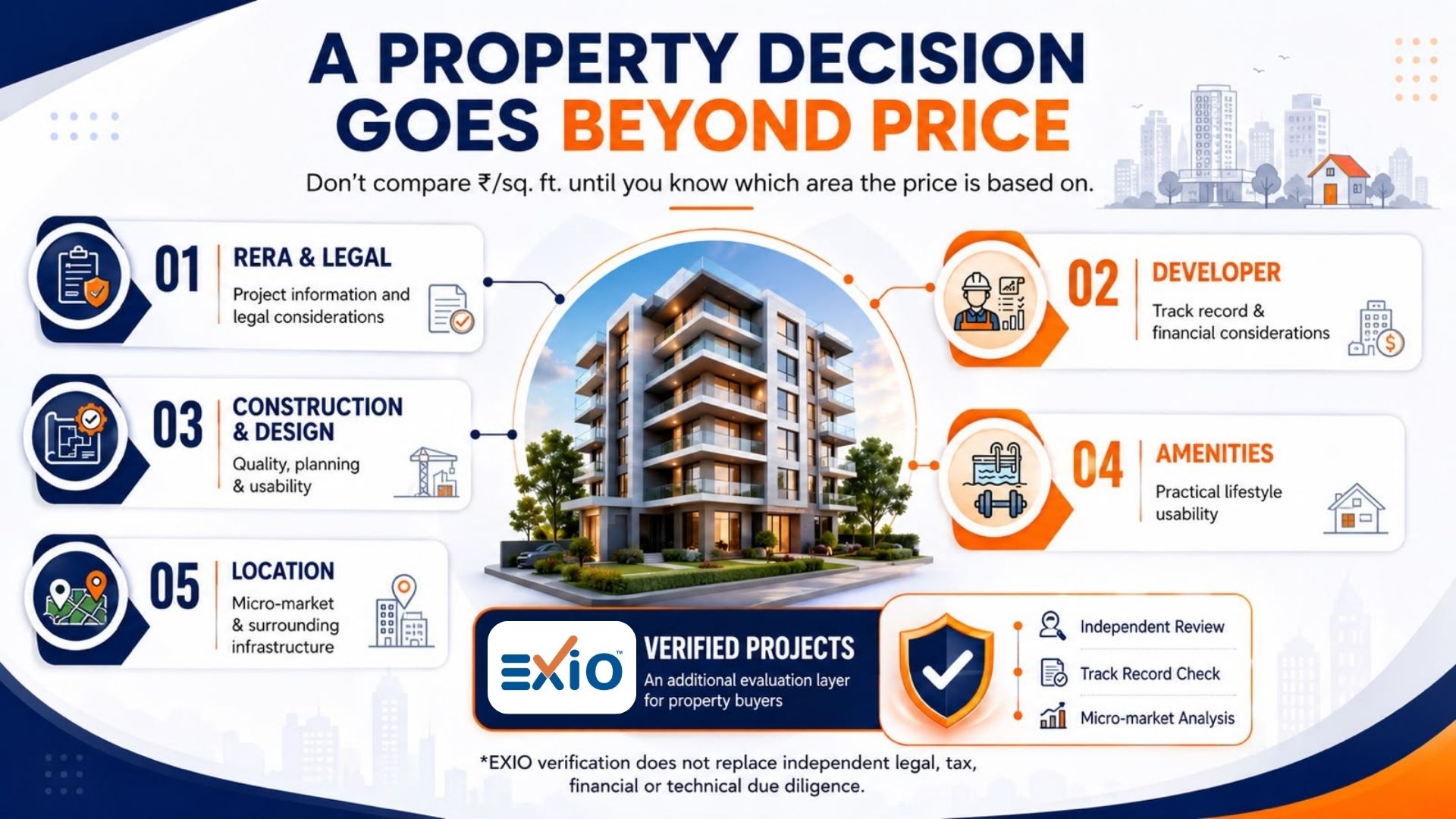
EXIO operates as an independent, research-driven real estate advisory firm in Ahmedabad and Gandhinagar. Rather than distributing builder inventory for commissions, EXIO applies a 6-stage underwriting framework, anchored by a proprietary 50-point audit, to evaluate asset viability, title security, and net yield alignment before client capital is deployed.
The 6-Stage Advisory Framework
EXIO follows a structured process to help investors research, evaluate and compare property opportunities before making an investment decision.
1. Market Research: We study Ahmedabad, Gandhinagar and GIFT City across key micro-markets, tracking location fundamentals, infrastructure, supply, demand and emerging investment trends.
2. Project Screening: We narrow down opportunities based on location, project stage, developer profile, property type, pricing and other relevant investment factors.
3. 50-Point Project Audit : Shortlisted projects go through EXIO's structured 50-point technical, legal and spatial audit, covering areas such as RERA records, project documentation, construction, developer track record, location and usability.
4. Project Comparison: We compare shortlisted properties on pricing, total acquisition cost, rental potential, market demand, liquidity, project quality and other factors relevant to the investment case.
5. Investment Fit: The shortlisted opportunities are assessed against the investor's budget, objectives, preferred property type, investment horizon and risk considerations.
6. Decision Support : EXIO helps investors move from research to a more informed property decision through structured comparisons, project insights and ongoing coordination. For NRIs, the NRI Concierge Protocol provides additional remote support, including virtual site intelligence and pre-handover inspection coordination.
Already have a flat or office in mind?
Get an Independent Project Audit
Before you hand over token money or sign anything, let us run a ground check on it.
-
We calculate your actual usable carpet area (so you don’t pay for wasted corridors).
-
We check GujRERA records, land titles, and past builder delays.
-
We tell you honestly if the price is fair or inflated for that area.
(Send us the project name or brochure for an honest review)
Not sure where to invest your budget?
Book a Free 1-on-1 Consultation
Whether your budget is ₹50 Lakh or ₹2 Crore+, talk directly with our research team before you start visiting sites.
-
Find the right area for your goal (steady monthly rent vs. long-term appreciation).
-
Compare residential flats vs. commercial offices without sales pressure.
-
See only pre-verified, RERA-approved properties that pass our safety checks.
(No sales pitch. Just ground-level facts and numbers)
Disclaimer
The figures, rental yields, and financial estimates in this article are for informational purposes only and do not constitute formal investment or legal advice. Real estate returns, prevailing market rates, government Jantri valuations, taxes, and statutory rules fluctuate over time and are not guaranteed. Investors must conduct independent due diligence, verify current records on gujrera.gujarat.gov.in, and consult qualified professionals before committing capital.

Frequently Asked Questions
A traditional property broker works on a one-off transactional commission (typically 1% to 2%) paid at closing, incentivizing them to move whatever inventory is on their desk. A real estate investment company functions as a fiduciary asset manager. It analyzes acquisitions using financial metrics (such as IRR, net capitalization rates, and vacancy sensitivity models), conducts independent 30-year legal title audits, and handles post-acquisition operations including tenant onboarding, corporate lease structuring, and asset liquidation.
Check the official Gujarat RERA portal (gujrera.gujarat.gov.in). Search the project’s RERA registration number to review quarterly construction progress reports (QPRs), verify that 70% of collections sit in project escrow accounts, and check for promoter litigation or delay orders.
Yes. Non-Resident Indians (NRIs) can legally purchase residential and commercial real estate under FEMA regulations using funds from NRE/NRO accounts. Agricultural land and farmhouses remain restricted. Investment firms coordinate remote paperwork, consular Power of Attorney (PoA), and tenant management.
Buyers must pay stamp duty (4.9% based on transaction or government Jantri value, whichever is higher) plus a 1% registration fee (waived for sole female buyers). Under-construction units attract Goods and Services Tax (GST), while completed properties with an Occupancy Certificate (BU permission) are exempt.
Investors must secure a certified 30-year title clearance report from an independent advocate, verify local municipal building approvals (AUDA/AMC), review corporate lease lock-in periods, and confirm clear structural and fire safety certificates.


