
 Login
Login
 Check & match property
 Investment Advisory
 List Your Project
 Contact Us

Finding a property is easy. Finding someone you can trust to help you choose the right one is much harder.
In Ahmedabad and Gandhinagar, buyers have hundreds of projects, developers, listings, and property options to consider. More choice, however, does not always mean a better decision. Which project is actually worth considering? Is the quoted price reasonable? Has the developer delivered similar projects? And is the recommendation based on your requirements, or simply on what someone wants to sell?
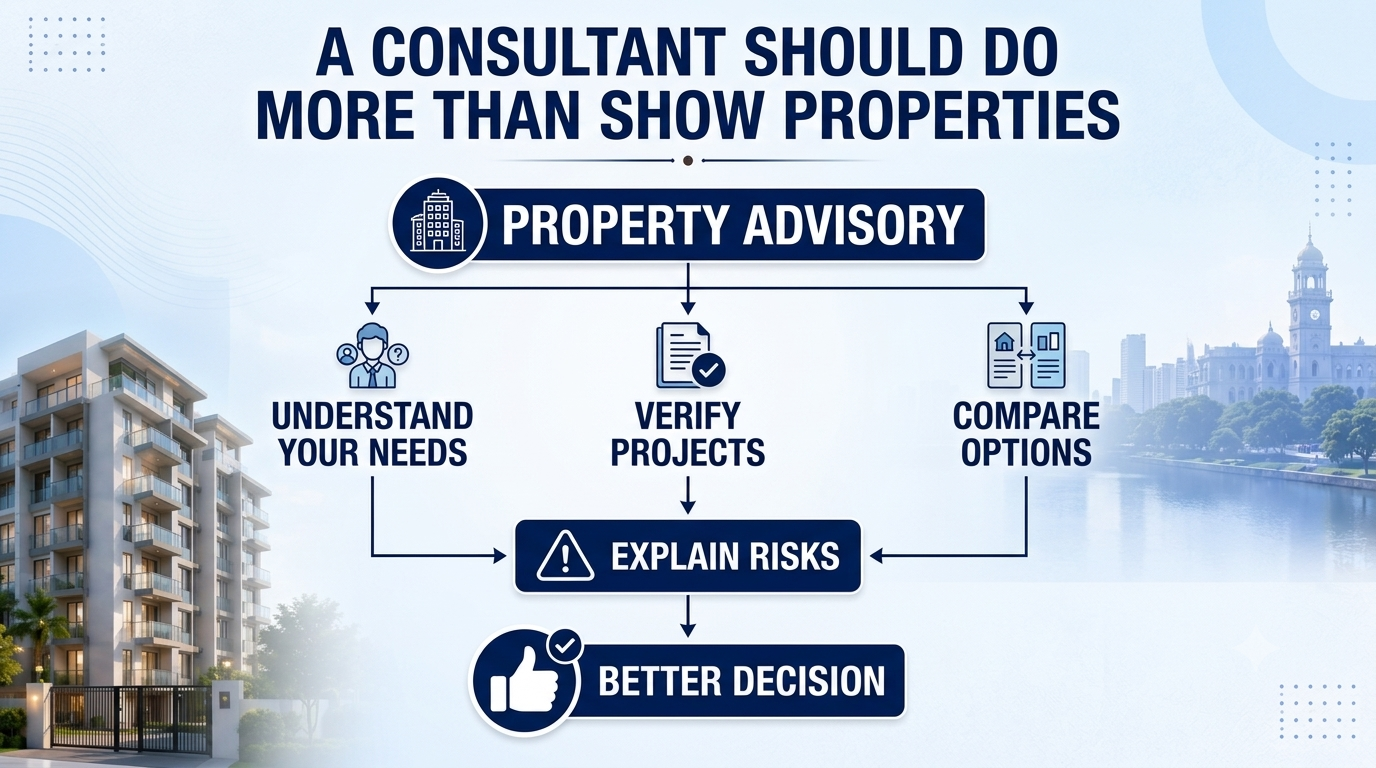
A good real estate consultant should do more than show properties. The right advisor should help you compare projects, verify important details, understand the risks, assess the location and pricing, and make a decision based on your requirements. This becomes particularly important in a market shaped by the growth of GIFT City, commercial corridors such as SG Highway and Sindhubhavan Road (SBR), and rapid residential development across the Sardar Patel Ring Road.
This guide explains what to look for when choosing a real estate consultant in Ahmedabad and Gandhinagar, from project verification and developer track record to location analysis, pricing transparency, and the questions you should ask before relying on any property recommendation.
What Should a Good Real Estate Consultant Actually Do?
A good real estate consultant does far more than arrange property visits or forward builder brochures. The real value of an advisor lies in helping a buyer filter options, verify documentation, compare alternatives, and evaluate potential risks before making a financial commitment.
In dynamic property markets like Ahmedabad and Gandhinagar, where buyers must choose between hundreds of residential and commercial launches, the real challenge is not merely finding a property. It is identifying which properties deserve serious consideration in the first place.
A professional property advisor should add measurable value across five key areas:
1. Understanding the Buyer's Exact Requirements
Before shortlisting any project, a consultant must analyse the buyer's underlying profile and constraints:
-
Overall budget and total capital deployment capacity
-
Preferred micro-markets, connectivity nodes, and transit corridors
-
Property type, carpet area configurations, and layout utility
-
Primary objective: self-use living versus long-term capital appreciation
-
Expected purchase timeline and preferred construction stage
-
Target investment horizon, projected cash flows, and risk appetite
A property that appears attractive on paper may still be fundamentally unsuitable if it fails to match your core financial and operational objectives.
2. Shortlisting Options Instead of Showing Everything
Unrestricted access to hundreds of listings rarely leads to better decisions. A skilled consultant narrows down the market exclusively to properties that meet your pre-vetted criteria.
-
The objective is fewer, highly relevant options, not endless site visits.
-
A useful shortlist clearly outlines why each specific project was selected and how it outperforms competing alternatives in the same micro-market.
3. Verifying Critical Project Information
A consultant should never rely on marketing claims or sales collateral. Depending on the asset class, essential checks include:
-
GujRERA registration status, sanctioned completion dates, and escrow account details
-
Sanctioned master layout plans and municipal approvals (AUDA/GUDA/AMC)
-
Developer's historic delivery track record and past construction quality
-
On-ground project milestone status versus promised possession timelines
-
Building material specifications, usable carpet efficiency, and structural safety
-
Infrastructure feasibility and surrounding micro-market town planning (TP) schemes
Note: While a property consultant does not replace a licensed advocate or structural engineer, their role is to identify operational red flags and legal discrepancies early in the evaluation process.
4. Calculating the True On-Road Acquisition Cost
The base price quoted in an advertisement or brochure is rarely the final amount you will pay. A consultant must provide a complete cost sheet covering:
-
Base sale price and floor-rise / preferred location charges (PLC)
-
Statutory government charges (4.9% stamp duty and 1% registration fees in Gujarat)
-
Applicable Goods and Services Tax (GST) on under-construction assets
-
Long-term maintenance deposits, IFMS, and clubhouse/amenity charges
-
Sub-metered electrification, legal documentation fees, and loan processing charges
A lower headline price per square foot does not automatically indicate better value once all ancillary costs are factored into the purchase price.
5. Providing a Balanced Perspective on Opportunities and Risks
The primary responsibility of an independent advisor is to offer objective, unbiased analysis:
-
A project may have excellent highway connectivity but lack basic municipal stormwater drainage today.
-
Another project may offer premium club amenities but carry an inflated premium compared to adjacent grade-A developments.
-
An established developer may demonstrate a reliable delivery record, while a newer market entrant may require deeper legal and financial due diligence.
A professional consultant should be equally transparent about why a property is suitable, and why it may be completely wrong for you.
Property Search vs Property Advisory
| Evaluation Metric | Basic Property Search / Portals | Professional Property Advisory |
| Project Selection | Displays all available projects indiscriminately | Filters projects based strictly on verified requirements |
| Pricing Guidance | Quotes base advertised rates | Maps out the complete, all-inclusive acquisition cost |
| Feature Analysis | Repeats developer sales features | Evaluates actual layout usability and carpet efficiency |
| Developer Vetting | Shares promotional builder overviews | Analyses past delivery timelines and construction track records |
| Location Insight | General geographical descriptions | Conducts hyper-local micro-market yield and infrastructure analysis |
| Site Engagements | Maximises property visits | Evaluates and compares shortlisted options |
| Primary Objective | Focuses on closing a sale | Focuses on making an informed investment decision |
The right consultant reduces uncertainty rather than simply increasing the number of properties you visit. Choosing your real estate advisory partner requires the same diligence as selecting the property itself.
Traditional Brokers vs. Generic Classified Portals vs. Advisory Platforms
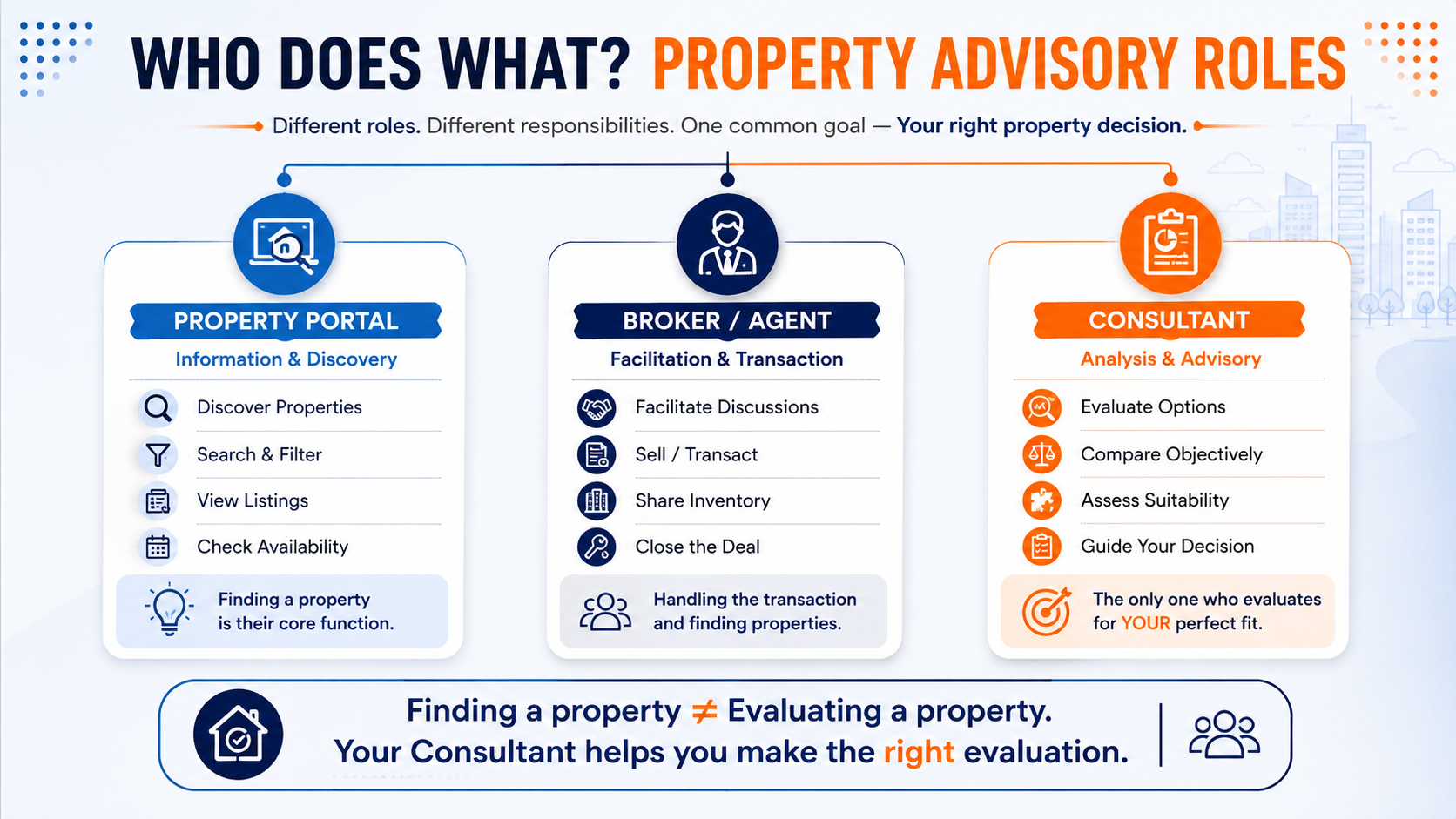
Before scheduling site visits or reviewing project brochures, please understand the structural differences among market intermediaries.
| Property Portal | Broker / Agent | Real Estate Consultant | |
|---|---|---|---|
| Primary role | Property discovery | Transaction facilitation | Property decision support |
| Main focus | Listings & availability | Buyer-seller/developer transaction | Suitability & evaluation |
| Shortlisting | Filters/search tools | Based on available inventory | Based on buyer requirements |
| Project comparison | Limited | Varies | Core part of the process |
| Developer evaluation | Usually limited | May vary | Should be part of due diligence |
| Pricing analysis | Displays quoted prices | Negotiates/deals | Helps assess overall value |
| Legal/project checks | Usually not advisory-led | Varies | Should identify what needs verification |
| Commercial transparency | Platform-dependent | Commission-based models vary | Should clearly disclose compensation |
| Main question | “What properties are available?” | “Can this transaction happen?” | “Is this property right for you?” |
A property portal helps you discover options. A broker may help facilitate a transaction. A consultant should help you evaluate whether the option is worth considering.
How EXIO approaches property advisory
EXIO follows a structured evaluation process covering RERA and legal checks, builder track record, construction and design, amenities, location, and investment potential. Projects are assessed through a 50-point technical, legal, and spatial audit before being recommended.
7 Things to Check Before Choosing a Real Estate Consultant
Choosing a property advisor is as consequential as choosing the property itself. Instead of relying on gut feeling or smooth sales talk, use this structured framework, built around What to Check, Why It Matters, and the exact Question to Ask, to evaluate any consultant in Ahmedabad and Gandhinagar.
1. Check How They Select and Filter Properties
-
What to Check: Does the consultant follow a structured qualification process based on your budget, property purpose (end-use vs. investment), layout configuration, possession timeline, and risk appetite, or do they dump an unfiltered list of projects on you?
-
Why It Matters: Access to more listings does not lead to a better decision; better filtering does. A consultant who forwards dozens of brochures is acting as a directory, not an advisor. The objective is fewer, highly relevant options tailored to your constraints.
Question to Ask:
"What specific criteria did you use to eliminate other projects in this micro-market before shortlisting these three for me?"
2. Ask What They Verify Before Recommending a Project
-
What to Check: Find out whether the consultant conducts preliminary checks on GujRERA registrations, AUDA/GUDA/AMC layout approvals, construction stage milestones, and title history before presenting an asset.
-
Why It Matters: Marketing brochures highlight architectural renders, not regulatory clearances. While a consultant does not replace an advocate, an advisory team should filter out legally ambiguous or stalled projects before you waste time on site visits.
Question to Ask:
"Have you verified this project’s active GujRERA filings, approved layout sanction, and designated escrow account details?"
3. Examine Their Knowledge of the Developer's Track Record
-
What to Check: Can the consultant discuss the builder's past delivery record, structural quality, and historical delays, beyond reading from the developer's corporate presentation?
-
Why It Matters: A developer’s past performance in a specific asset class (e.g., affordable housing vs. luxury high-rises) predicts future execution. A knowledgeable advisor knows which builders deliver on time and which ones routinely face delivery lag or quality complaints.
Question to Ask:
"How many projects has this developer completed in Gujarat on time, and what common post-handover issues have buyers reported in their previous schemes?"
🔗Related Guide: How to Check a Builder's Track Record in 10 Minutes
4. See Whether They Understand the Micro-Market Dynamics
-
What to Check: Does the consultant demonstrate deep, hyper-local understanding of specific corridors,
-
Why It Matters: Each micro-market across Ahmedabad and Gandhinagar functions with distinct dynamics:
-
Shela & South Bopal: Rapidly expanding residential hubs driven by modern amenities and retail growth.
-
Gota & Jagatpur: High-absorption corridors catering to urban professionals needing connectivity to SG Highway and Chandkheda.
-
Sindhubhavan Road & Iscon-Ambli: Premium commercial and luxury residential epicentres with high capital values.
-
GIFT City & PDPU Road & More: Commercial finance hubs driven by corporate tenant migration and steady rental yields.
-
Question to Ask:
"How do rental yields, infrastructure milestones, and upcoming inventory supply differ between these two adjacent micro-markets over the next 24 to 36 months?"
5. Check Whether They Explain the Total Acquisition Cost
-
What to Check: Does the consultant provide a transparent, all-inclusive financial breakdown, or do they only quote an attractive "starting base price"?
-
Why It Matters: A ₹75 Lakh quoted price is never the final amount you spend. In Gujarat, the true acquisition cost must factor in:
Example: Property Base Price = ₹75,00,000
₹75,00,000
Base Property Price
+
Applicable GST
+
Stamp Duty
+
Registration Fee
+
Applicable Project Charges
+
Other Applicable Costs
↓
━━━━━━━━━━━━━━━━━━━━
FINAL PROPERTY ACQUISITION COSTA lower quoted base rate per square foot can become more expensive once excessive loading or hidden ancillary charges are factored in.
🔗 Related Guide: Stamp Duty and Property Registration Charges in Gujarat (Complete Guide)
6. Ask How the Consultant Makes Money (Commercial Transparency)
-
What to Check: Is the consultant transparent about their revenue model, developer partnerships, and commission structures?
-
Why It Matters: Commercial incentives influence project recommendations. When an intermediary receives higher compensation from a specific builder, they may prioritise that project over a superior alternative. Transparency about commercial relationships helps buyers understand the context behind every recommendation.
Question to Ask:
"Do you receive developer-side compensation for this project, and does your firm charge any advisory or brokerage fees to me as the buyer?"
What Should a Good Consultant Verify Before Recommending a Property?
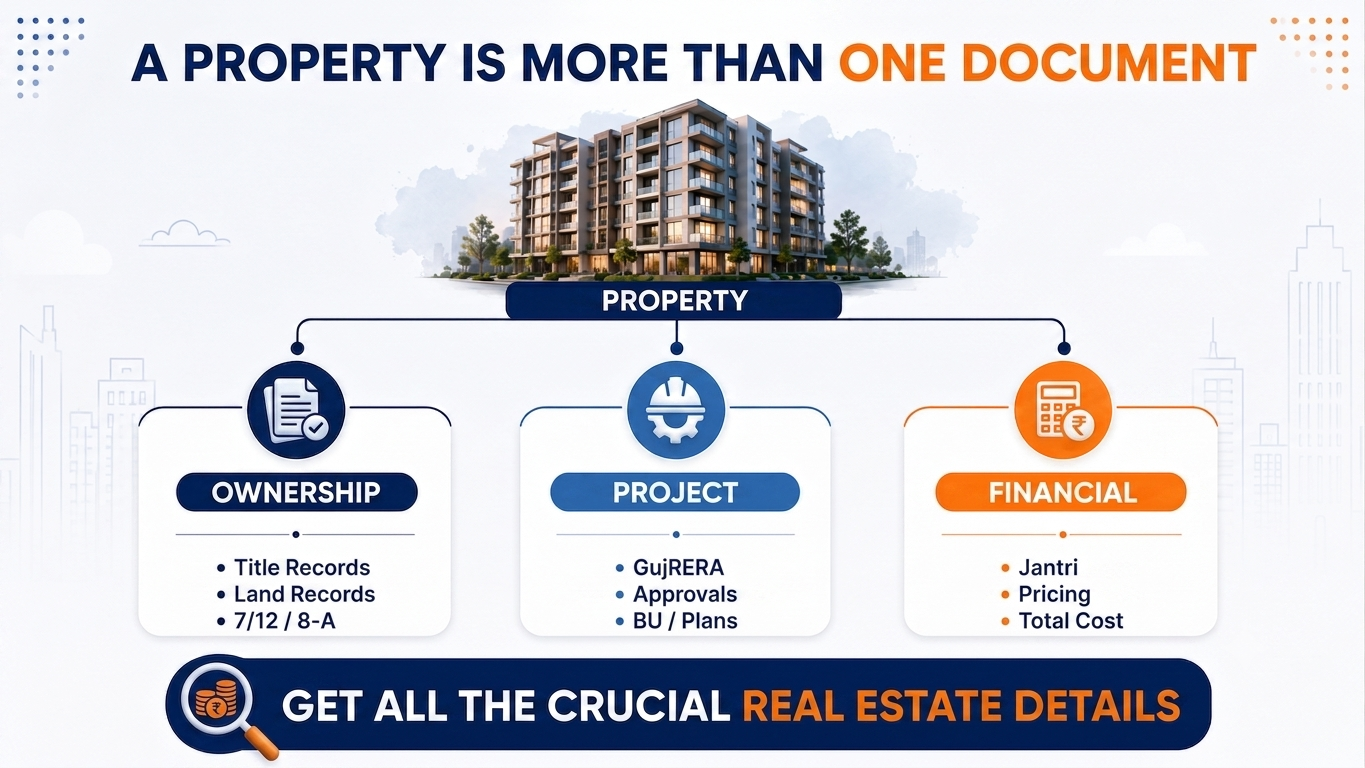
A professional real estate investment company or property advisor must go beyond marketing brochures and conduct thorough statutory due diligence through government registries. Before signing an Expression of Interest (EOI) or transferring booking tokens, require proof across these seven legal pillars:
1. Land Ownership Verification: 7/12 (Saat-Baaro) & 8-A Records
All urban land parcels in Gujarat originate from agricultural classifications. A qualified consultant verifies records via the state AnyRoR Gujarat Portal:
-
Form 7/12 (Village Form VII-XII): Verifies the registered landowner, survey numbers, and historic ownership transitions.
-
Form 6 (Hakk Patrak - Mutation Entries): Identifies previous ownership transfers to verify that no pending succession disputes or tenancy (Ganot) claims exist.
-
Form 8-A: Confirms the complete landholding details and municipal revenue records.
2. Non-Agricultural (NA) Order & Zoning Compliance
Land must possess a valid NA-Residential or NA-Commercial order issued by the District Collector. Your advisor must verify that the underlying survey numbers comply with the master zoning plans governed by the Ahmedabad Urban Development Authority (AUDA) or the Gandhinagar Urban Development Authority (GUDA).
3. Sanctioned Master Layouts vs. On-Site Construction
Ensure that the architectural blueprints match approved municipal drawings:
-
Verify the approved Floor Space Index (FSI) and chargeable paid FSI limits.
-
Ensure common amenities (visitor parking, refuge areas, clubhouses, green belts) have not been unlawfully converted into saleable residential or commercial units.
-
Verify Town Planning (TP) scheme alignments to confirm that future road widening will not infringe on the property boundaries.
4. GujRERA Registration & Escrow Ring-Fencing
Cross-examine the official Gujarat RERA Portal (GujRERA):
-
Active RERA Number: Avoid unapproved "pre-launch" or "soft-launch" projects lacking active RERA registration.
-
Dedicated Escrow Account: Confirm that transaction payments are routed exclusively to the project's RERA-mandated escrow bank account, where 70% of funds are legally reserved for construction.
-
Sanctioned Timelines: Check quarterly project progress filings against promised handover dates.
5. Building Use (BU) Permission & Fire NOC
For ready-to-move-in assets, verify that the local municipal corporation (Ahmedabad Municipal Corporation - AMC or Gandhinagar Municipal Corporation - GMC) has issued an official Building Use (BU) Permission.
Legal Notice: Occupying or registering a property without an authorised BU permission leaves the building vulnerable to municipal sealing, demolition notices, and utility disconnections.
6. Jantri Rates (ASR) & Statutory Cost Structuring
In Gujarat, registration charges are assessed on the higher of the declared transaction value or the government Jantri Rate (Annual Statement of Rates):
-
Base Stamp Duty: 3.5% + Surcharge: 1.4% = 4.9% Total Stamp Duty.
-
Registration Charge: 1.0% (Waived for female buyers in Gujarat).
-
Tax Penalty (Section 56(2)(x)): Purchasing property below the official Jantri value creates severe income tax liabilities, as the difference is taxed as direct income under Indian tax laws.
🔗Related Guide: Jantri Rate Ahmedabad 2026: What Does It Mean for Buyers?
7. 30-Year Title Clearance Certificate
Requires an independent Title Clearance Certificate issued by an advocate who has published a public notice in leading regional and national newspapers, confirming that the land is free from active litigation, banking liens, or third-party claims.
Technical Audits: Evaluating Build Quality Beyond the Brochure
A trusted property advisor near me must inspect structural and engineering specifications rather than relying on decorative sample flats:
-
Carpet Area vs. Super Built-Up Loading: Insist on a clear breakdown of the Real Estate Regulatory Authority (RERA) carpet area versus super built-up loading percentages, ensuring you do not overpay for common circulation spaces.
-
Structural Specifications: Independent inspection of concrete grades, structural design vetting against seismic zone guidelines, and MEP (mechanical, electrical, plumbing) layouts.
-
Monsoon & Drainage Auditing: On-ground assessment of local stormwater infrastructure to prevent waterlogging during monsoon seasons, particularly along low-lying feeder roads.
-
Future-Proof Amenities: Confirming the operational feasibility of basement EV charging stations, dedicated visitor parking bays, and pressurised fire suppression systems.

Hyper-Local Micro-Market Breakdown (Ahmedabad & Gandhinagar)
A quality consultant or property investment company must demonstrate comprehensive analytical depth across Gujarat's key micro-markets:
SG Highway & Sindhubhavan Road (SBR) - Commercial Hub
-
Core Drivers: Grade-A corporate office absorption, luxury automotive showrooms, and multinational retail spaces.
-
Advisory Focus: Analysing tenant covenants, lock-in periods, Common Area Maintenance (CAM) charges, and rental yields (averaging 7.0% – 8.2%).
North-West Growth Corridor (Vaishno Devi, Jagatpur, Gota)
-
Core Drivers: High-density 2, 3, and 4 BHK residential apartments with modern amenities.
-
Advisory Focus: Evaluating AUDA road expansion plans, school/hospital accessibility, and water supply infrastructure.
Prime Luxury Corridors (Iscon-Ambli Road, Bodakdev, Satellite)
-
Core Drivers: Ultra-luxury high-rises, sky villas, and legacy residential properties.
-
Advisory Focus: Low-density floor layouts, multi-car basement allocations, and developer delivery track records.
GIFT City & Gandhinagar Knowledge Corridor (Kudasan, Raysan, Sargasan)
-
Core Drivers: Financial institutions, technology companies, and global service centres driving sustained tenant migration.
-
Advisory Focus: Evaluating high-occupancy corporate leases and capital appreciation across key transit corridors.
Ahmedabad and Gandhinagar are not uniform real estate markets; what applies to a residential development in South Bopal behaves completely differently from commercial office spaces along SG Highway or emerging residential pockets along the Gandhinagar corridor.
A knowledgeable consultant should clearly articulate the pricing drivers, absorption timelines, and upcoming infrastructure catalysts across distinct pockets:
-
SG Highway & Sindhu Bhavan Road (SBR): The established commercial and high-end residential lifeline, where capital values are driven by corporate relocations, premium retail density, and rapid connectivity to expanding outer bypass networks like the Ahmedabad 3rd Ring Road corridor.
-
GIFT City & PDPU Road / Raysan: An international financial and tech hub characterised by specialized SEZ/non-SEZ zoning, strong corporate tenant demand, and massive government-backed transit investments. To understand the long-term appreciation curve of this belt, review our in-depth analysis on how the 2030 Commonwealth Games and Olympic vision will transform Ahmedabad-Gandhinagar real estate.
-
Shela, South Bopal & Vaishno Devi / Gota: High-demand residential corridors fueled by middle-to-upper-tier end-user demand, integrated township amenities, and direct access to the SP Ring Road.
Red Flags When Evaluating a Real Estate Consultant
Choosing a property consultant in Ahmedabad or Gandhinagar requires more than checking the number of projects they can show you. Watch for these warning signs before relying on a recommendation.
1. Creates Pressure to Book Immediately
Be cautious of repeated claims such as “the price increases tomorrow,” “only two units are left,” or “pay the token amount now.” If the advisor suggests you take a few reasonable days to review the properties, whether it is commercial or residentials understand the price, verify important documents, and compare alternatives before committing money.
2. Recommends Properties Without Understanding Your Needs
A consultant should first understand your budget, purpose, preferred location, property configuration, and possession timeline. If projects are being recommended before these factors are discussed, the advice may be based more on available inventory than on your requirements.
3. Recommends the Same Developer Again and Again
A single project or developer may genuinely be the right fit, but the recommendation should have a clear reason behind it. Ask which comparable projects in Ahmedabad or Gandhinagar were considered and why they were not shortlisted.
4. Highlights Benefits but Avoids the Drawbacks
Every property has trade-offs. These could include higher loading, lower carpet efficiency, surrounding development constraints, infrastructure gaps, pricing concerns, or competing project supply. A reliable consultant should be able to explain both the advantages and limitations of a property.
5. Is Not Transparent About Commercial Relationships
Before accepting property advice, ask how the consultant is compensated and whether the consultant has any commercial arrangement with the developer. Understanding the compensation structure helps buyers evaluate recommendations with the right context.
6. Avoids Sharing Important Project or Legal Information
A consultant should be able to direct you toward information that can be independently verified, including the project's GujRERA registration details, approved project information, sanctioned plans where applicable, and relevant land or title records. If basic verification questions are repeatedly avoided or dismissed, treat that as a warning sign.
Golden Rule: If a property consultant makes it difficult to ask questions, verify information, compare alternatives, or understand the total cost before booking, slow down and verify before transferring any money.
10 Questions to Ask Before Choosing a Real Estate Consultant
Before choosing a property consultant in Ahmedabad or Gandhinagar, ask questions that reveal their experience, local knowledge, recommendation process, transparency, and approach to property verification.
1. How do I choose the right real estate consultant for my needs?
Start by checking whether the consultant understands your budget, property purpose, preferred locations, property type, and purchase timeline rather than simply presenting available projects.
2. How much experience do you have in Ahmedabad and Gandhinagar?
Ask about their experience in the specific locations and property segment you are considering. Local market knowledge can be more useful than general experience alone.
3. Which areas and property types do you specialise in?
A consultant familiar with Shela, South Bopal, Gota, SBR, Gandhinagar, or GIFT City should be able to explain how these micro-markets differ in pricing, development, connectivity, and buyer demand.
4. How do you select and shortlist properties?
Ask what criteria are used before a project is recommended. A good process should consider your requirements, project quality, developer track record, location, pricing, and relevant risks.
5. Which other projects did you compare before recommending this one?
This reveals whether the recommendation is based on an actual comparison or simply on available inventory. Ask why competing projects were shortlisted or rejected.
6. How do you verify a property before recommending it?
Ask whether the consultant reviews relevant GujRERA information, project approvals, developer history, pricing, and other important property details before recommending a project.
7. How much does a real estate consultant charge, and how are you compensated?
Ask whether the consultant charges the buyer directly, receives developer-side compensation, or follows another commercial model. Clear compensation terms help you understand the context behind recommendations.
8. Can you explain the total cost of buying this property?
The quoted property price may not represent the complete acquisition cost. Ask for a breakdown of applicable GST, stamp duty, registration, maintenance/IFMS, project charges, and other applicable costs.
9. What are the risks or disadvantages of the property you are recommending?
A reliable consultant should be able to explain the strengths, limitations, and potential risks of a project instead of presenting every recommendation as the “best” option.
10. When would you advise me not to buy a property?
This is one of the most revealing questions you can ask. A consultant providing genuine advisory support should be comfortable explaining when a property does not match your requirements or when its risks outweigh its benefits.
A good consultant should be able to explain not only what to buy, but also why, how it was evaluated, what it will really cost, and when you should walk away.
Partner with Gujarat's Trusted Real Estate Advisory Firm
Acquiring real estate across Ahmedabad and Gandhinagar requires structural research, independent legal verification, and direct developer connectivity.
At EXIO, our engineering and advisory teams conduct comprehensive 50+ factor technical, legal, and structural audits on every listed project.
-
For Homebuyers & Investors: Explore Legally Audited Properties on EXIO.in
-
For Developers & Builders: Submit Your Project for Technical Verification & Onboarding
Disclaimer
Disclaimer: All content, data projections, and legal frameworks presented in this article are intended strictly for educational and informational purposes. Real estate investments are subject to micro-market risks, regulatory amendments, and statutory updates by AUDA, GUDA, and GujRERA. Readers, buyers, and developers are advised to conduct independent title verification and legal due diligence with a qualified advocate or certified property advisor before executing financial commitments or signing registered instruments.

Frequently Asked Questions
A real estate consultant helps buyers evaluate property options based on factors such as budget, location, project quality, developer track record, documentation, pricing and intended use. Unlike a simple property listing service, the value of advisory lies in helping the buyer compare options and understand the reasoning behind a recommendation.
A broker generally focuses on facilitating a property transaction between the buyer and seller or developer. A real estate consultant may take a broader advisory approach, helping the buyer compare projects, evaluate risks, understand pricing, and make a more informed property decision.
Check how transparently the consultant explains its services, recommendations, pricing, and business relationship with developers. Also look for evidence of project verification, knowledge of the local market, independent property research, and clear answers to questions about RERA, documentation, pricing, and developer history.
EXIO evaluates projects through a structured 50-point technical, legal, and spatial audit covering areas such as RERA and legal considerations, builder track record, construction and design, amenities, and location and investment potential. The purpose is to help buyers make decisions based on more than just a property's advertised features.
No responsible consultant should guarantee a specific return on a property investment. Property values and rental income depend on market conditions, location, supply and demand, infrastructure, project quality, and other factors. Any investment recommendation should clearly distinguish between analysis, expectations, and guarantees.


