
 Login
Login
 Check & match property
 Investment Advisory
 List Your Project
 Contact Us

The Sardar Patel Ring Road (SP Ring Road) has become one of the key connectors around Ahmedabad, linking major residential, commercial and industrial growth corridors. But as the city has expanded outward, rising traffic volumes and development along the Ring Road have increased pressure on its existing road capacity.
The proposed 6-laning project aims to improve this connectivity and reduce friction across important junctions and surrounding corridors. For real estate, that matters because better accessibility can influence where new development, commercial activity and residential demand emerge.
But the impact is unlikely to be uniform across the entire Ring Road.
The real question is: which micro-markets could benefit most from this infrastructure upgrade by 2027–28?
To understand that, we need to look beyond proximity to the road and examine connectivity, upcoming infrastructure, development activity, employment centres and underlying property demand across Ahmedabad’s growth corridors.
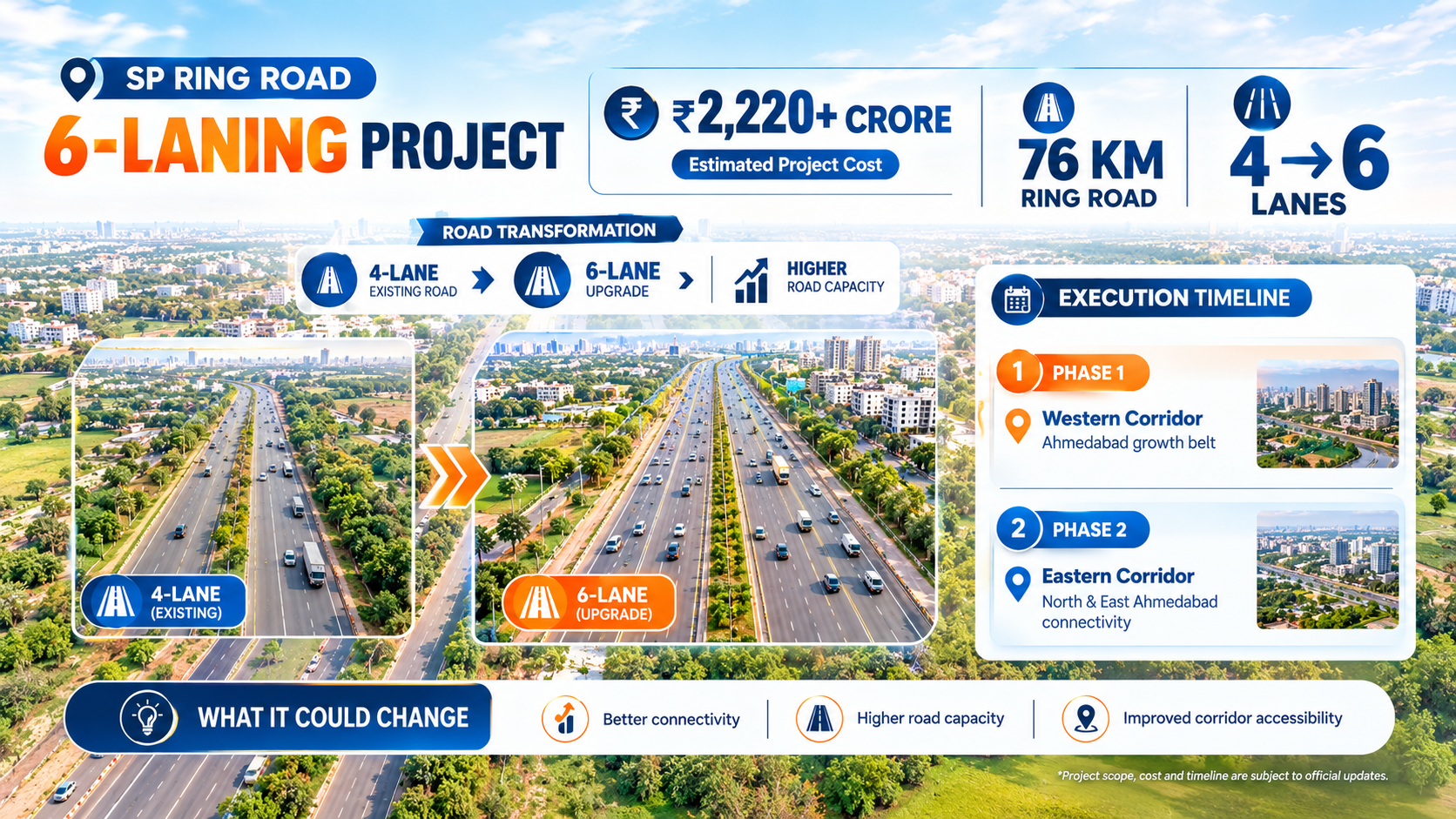
1. The ₹2,220+ Cr SP Ring Road Upgrade: AUDA’s 6-Laning Scope & Execution Timeline
The 76.25 km Sardar Patel (SP) Ring Road operates as the peripheral spine of Ahmedabad’s urban structure. Originally constructed with a 60-meter Right of Way (RoW) and a 4-lane main carriageway, the corridor has absorbed intense vehicle volume over the last decade, functioning simultaneously as an inter-state logistics freight bypass and a daily intra-city commuter arterial.
To eliminate systemic congestion, the Ahmedabad Urban Development Authority (AUDA) structured a comprehensive ₹2,220 crore infrastructure overhaul divided into two engineering packages:
AUDA SP Ring Road 6-Laning: Package Breakdown
| Project Scope | Package 1 (Eastern Stretch) | Package 2 (Western Stretch) |
| Total Distance | 37 km | 39.25 km |
| Stretch Covered | Km 8 to Km 45 (Bhat/Naroda to Aslali/Kamod) | Km 0 to Km 8 & Km 45 to Km 76 (Kamod to Vaishnodevi & Bhat) |
| Key Areas & Junctions | Naroda, Nikol, Odhav, Vastral, Ramol, Hathijan | Vaishnodevi, Ognaj, Shilaj, Bopal, Sanathal, Kamod |
| Main Carriageway | Widening from 4 to 6 lanes | Widening from 4 to 6 lanes |
| Service Roads | Dedicated 4-lane local service corridors | Up to 4-lane separated service corridors |
| Primary Economic Link | Industrial GIDCs & Ahmedabad–Vadodara Expressway | GIFT City, SG Highway & Dholera SIR Expressway |
| Project Mode | Hybrid Annuity Mode (HAM) | Hybrid Annuity Mode (HAM) |
| Delivery Target | 2027–2028 | 2026–2028 (Phase-wise junctions first) |
EXIO Summary
-
Package 1 (East – 37 km): Focuses on heavy industrial corridors, freight transit, and mid-segment residential pockets connecting to the Vadodara Expressway.
-
Package 2 (West – 39.25 km): Focuses on high-value residential and corporate corridors (Shilaj, Bopal, Vaishnodevi) and links directly to the Dholera Expressway and GIFT City.
The Engineering Blueprint: Segregating Freight from Local Living
The critical shift in AUDA's design is the expansion of peripheral service roads:
-
49 km of Service Road Upgradation: AUDA is converting 34 km of two-lane service roads into 4 lanes, alongside widening 15 km of three-lane service tracks into 4-lane access corridors.
-
Grade-Separated Isolation: This creates a composite 10-to-14-lane cross-section. Long-distance freight moving between Kandla/Mundra ports and Mumbai/Delhi is confined to the central 6-lane access-controlled carriageway, insulating local township traffic from heavy vehicles.
-
Junction Interventions & River Bridges: Upgraded 6-lane flyovers, vehicular underpasses (VUPs), and pedestrian underpasses are being integrated at high-friction nodes, including Tragad, Sanathal, and Bhat, alongside twin 3-lane parallel bridges across the Sabarmati River at Kamod and Bhat.
Civil Milestones & Phased Completion Horizons
-
Civil Execution: Work across both packages operates under the Hybrid Annuity Mode (HAM), incentivising contractors to hit strict engineering timelines.
-
Target Delivery Window (2026–2028): Critical western grade separators and priority stretches (Vaishnodevi to Shilaj, and Sanathal Junction) reach early completion milestones, while synchronised full-corridor operations and final service-lane integration are slated for delivery across 2027 to 2028.
2. The Infrastructure Ripple Effect: Why 6-Laning Unlocks Property Value
In real estate economics, capital value appreciation rarely happens solely because road surface expands. It occurs when the friction of distance collapses: the operational cost, time, and physical resistance of travelling between residential communities and primary employment clusters.
The 6-laning of the Sardar Patel Ring Road, paired with dedicated multi-lane service roads, fundamentally alters urban dynamics across Ahmedabad in three measurable ways:
A. Commute Time Compression & Radius Expansion
Before AUDA initiated the 6-laning and grade-separation works, roundabouts at Vaishnodevi, Shilaj, Sanathal, and Bhat suffered from severe peak-hour bottlenecks. Commuters crossing from residential enclaves like South Bopal or Shela to Gandhinagar, GIFT City, or the northern commercial clusters routinely faced 45-to-60-minute travel windows.
-
Travel Time Reduction: Widening the main carriageway to 6 signal-free lanes and introducing multi-level flyovers cuts intersection transit times by 30% to 45%.
-
Livability Threshold: When an outer suburban micro-market moves within a reliable 20-to-25-minute commute of primary corporate districts (SG Highway, Sindhu Bhavan Road, GIFT City), end-user absorption surges, transitioning the pocket from speculative holding into high-demand primary residential housing.
B. Segregated Service Roads: Unlocking Commercial Curb Usability
A major structural limitation of traditional 4-lane bypass corridors is curb conflict: slow-moving local traffic exiting retail shops or township gates directly confronts fast-moving heavy trucks on the main carriageway.
AUDA’s implementation of dedicated 3-lane and 4-lane grade-separated service corridors resolves this:
-
Pedestrian & Retail Safety: Local vehicles access commercial high streets, retail showrooms, hospitals, and residential township gates without merging into high-speed transit lanes.
-
Grade-A Office Spillover: National retail brands, auto showrooms, and Grade-A commercial developers require organised, legal deceleration lanes and frontage visibility. The expanded service network provides low-friction access, turning raw frontage into high-value commercial ribbon corridors.
C. Commercial & Luxury Migration from Saturated Corridors
Land pricing on core western arterials has reached rational commercial ceilings:
-
Prime plots on Sindhu Bhavan Road (SBR) and Ambli Road frequently trade between ₹2.5 lakh and ₹4.5+ lakh per square yard.
-
With land costs consuming up to 55%–65% of total project capital in core areas, Grade-A developers cannot price apartments affordably for mid-to-upper-tier buyers.
-
The expanded 6-lane SP Ring Road offers developers the scale to build master-planned, amenity-rich gated communities and large-format office parks at lower land acquisition bases, passing structural value to investors while capturing superior early-phase yield.
3. Micro-Market Appreciation Index: Projected Price Growth by 2027–2028
Capital value growth along the SP Ring Road will not distribute uniformly. Pockets adjacent to major multimodal infrastructure junctions, corporate arterial extensions, and Grade-A service lanes will capture the largest share of capital inflow.
The quantitative index below outlines current capital valuations, forecast 2-year compounding annual growth rates (CAGR), rental yield baselines, and primary demand catalysts across the five key peripheral corridors:
| Micro-Market Pocket | Primary Real Estate Asset Class | Baseline Capital Rate (2026 Avg) | Projected 2-Year Appreciation (CAGR) | Projected Gross Rental Yield | Key Infrastructure Trigger |
| Sanathal – Shantipura | Grade-A Offices, Plotted Developments, Warehousing | ₹4,200 – ₹6,200 / sq. ft. | 15% – 19% | 4.8% – 6.5% | Dholera SIR Expressway interchange; Sanand semiconductor & auto hub expansion. |
| Vaishnodevi – Tragad | 3 & 4 BHK High-Rises, Retail Showrooms | ₹5,800 – ₹6,500 / sq. ft. | 14% – 18% | 4.2% – 4.9% | SG Highway junction overhaul; seamless transit to GIFT City & Gandhinagar. |
| Bhat – Koteshwar Circle | Executive Suites, High-Density 2 & 3 BHKs | ₹6,000 – ₹8,500 / sq. ft. | 13% – 17% | 4.5% – 5.2% | Sabarmati Riverfront Phase-2 extension; twin 3-lane bridges; SVPI Airport bypass. |
| Shilaj – Shela West | Luxury 4/5 BHK Apartments, Gated Villas | ₹4,000 – ₹4,500 / sq. ft. | 12% – 16% | 3.5% – 4.2% | Sindhu Bhavan Road extension de-bottlenecking; continuous service road access. |
| Nikol – Vastral (East) | Mid-Segment 2/3 BHK Units, Industrial Logistics | ₹3,400 – ₹4,600 / sq. ft. | 9% – 12% | 3.8% – 4.4% | Package-1 6-laning completion; direct feeder link to Ahmedabad–Vadodara Expressway. |
Exio Summary
-
Capital Appreciation Leader (Sanathal – Shantipura): Projected at 15% to 19% CAGR, driven by its dual function as an industrial logistics core (Sanand GIDC) and the direct terminus for the high-speed Dholera Expressway (NH-751).
-
Rental Yield Outperformer (Bhat & Vaishnodevi): Commanding gross rental yields between 4.2% and 5.2%, heavily insulated by executive demand from tech, finance, and banking talent commuting to GIFT City and the northern corporate corridor.
-
Luxury End-User Magnet (Shilaj & Shela West): While rental yields are lower (3.5% to 4.2%), end-user capital absorption remains high as Sindhu Bhavan Road's luxury market expands westward into gated, high-amenity residential towers.
4. In-Depth Analysis: The 4 High-Growth Corridors to Watch
A. Vaishnodevi, Tragad & Zundal: SP Ring Road Impact on North Ahmedabad
Situated at the intersection of SG Highway and the northern arc of SP Ring Road, the Vaishnodevi, Tragad node functions as the primary bridgehead connecting Ahmedabad to Gandhinagar and GIFT City.
-
Infrastructure Impact: The grade-separated underpass at Tragad, combined with 6-lane main carriageway widening, eliminates chronic peak-hour gridlock. Commuters can reach GIFT City in under 20–25 minutes without navigating municipal bottleneck points.
-
Target Asset Class: Master-planned, amenity-driven high-rise communities featuring large-format 3 & 4 BHK apartments.
-
Buyer Profile: Corporate executives, financial professionals from GIFT City, and doctors/professors affiliated with nearby educational and healthcare campuses (Nirma University, Adani Shantigram).
-
Vaishnodevi Circle: Recognised as the gateway to the twin cities, this prime node commands top demand among buyers looking for the best residential property in Ahmedabad due to its signal-free link to GIFT City and premium township developments.
-
Tragad: With the new Tragad underpass streamlining local daily transit, this neighbourhood has become an ideal micro-market for families planning to balance affordability, gated amenities, and rapid capital appreciation.
-
Zundal: Positioned directly along the Gandhinagar border, Zundal is witnessing surging demand for spacious 2 & 3 BHK apartments in Ahmedabad among professionals seeking peaceful living with direct access to major transit highways.
B. Shilaj, Shela & Ghuma: SP Ring Road Impact on West Ahmedabad
As commercial and land acquisition costs along Sindhu Bhavan Road (SBR) and Ambli crossed rational ceilings, developer capital naturally shifted across the SP Ring Road perimeter into Shilaj and Shela West.
-
Infrastructure Impact: Widened 4-lane service corridors isolate local township traffic from heavy transit, providing seamless curb access into gated luxury high-rises. Grade-separated flyovers at Bopal, Ghuma, and Shilaj cross-sections eliminate long signal delays for city-bound commuters.
-
Target Asset Class: Ultra-luxury high-rises, sky villas (priced at ₹1.5 Cr to ₹3.5+ Cr), and private gated villa layouts.
-
Buyer Profile: Business owners, second-generation HNIs moving out of congested western localities (Satellite, Bodakdev), and senior corporate leadership.
-
Shilaj: Functions as the epicentre of western luxury housing, drawing strong interest from HNIs and business leaders seeking expansive 4 & 5 BHK high-rises with direct access to the Sindhu Bhavan Extension.
-
Shela: Has evolved into a self-sustaining residential township, favoured by buyers looking for modern gated communities equipped with lifestyle clubhouses, top schools, and retail high streets.
-
Ghuma: Serves as an accessible entry point in the western corridor, attracting homebuyers looking for well-planned mid-segment developments that offer quick connectivity to Bopal and the SG Highway corporate strip.
C. Sanathal & Shantipura: SP Ring Road Impact on Industrial & Logistics Growth
Positioned in the southwestern quadrant, Sanathal has transitioned from a sleepy bypass crossing into one of Gujarat’s most vital commercial multi-modal nodes.
-
Infrastructure Impact: Sanathal is the direct convergence point between SP Ring Road, the Ahmedabad–Dholera Special Investment Region (SIR) Expressway (NH-751), and the industrial corridor feeding into Sanand GIDC (the automotive and semiconductor cluster anchored by Tata and Micron).
-
Target Asset Class: Pre-leased warehousing assets, commercial office towers, logistics parks, and organised plotted villa schemes situated just off the main ring road.
-
Buyer Profile: Institutional funds, logistics operators, manufacturing leadership, and long-term capital allocators targeting infrastructure-led upside.
D. Bhat & Koteshwar Circle: SP Ring Road Impact on Airport-Connected Areas
Bhat Circle sits on the northeastern riverbank, directly bridging Gandhinagar, GIFT City, and Sardar Vallabhbhai Patel International (SVPI) Airport.
-
Infrastructure Impact: The extension of the Sabarmati Riverfront Phase-2 up to SP Ring Road at Bhat, paired with the construction of twin 3-lane parallel river bridges, transforms this corridor from a transit route into a high-visibility waterfront boulevard.
-
Target Asset Class: Compact executive apartments (2 & 3 BHKs), serviced suites, and boutique commercial office complexes.
-
Buyer Profile: Frequent flyers, corporate consultants, expatriates, and investors seeking hands-off, managed rental yields.
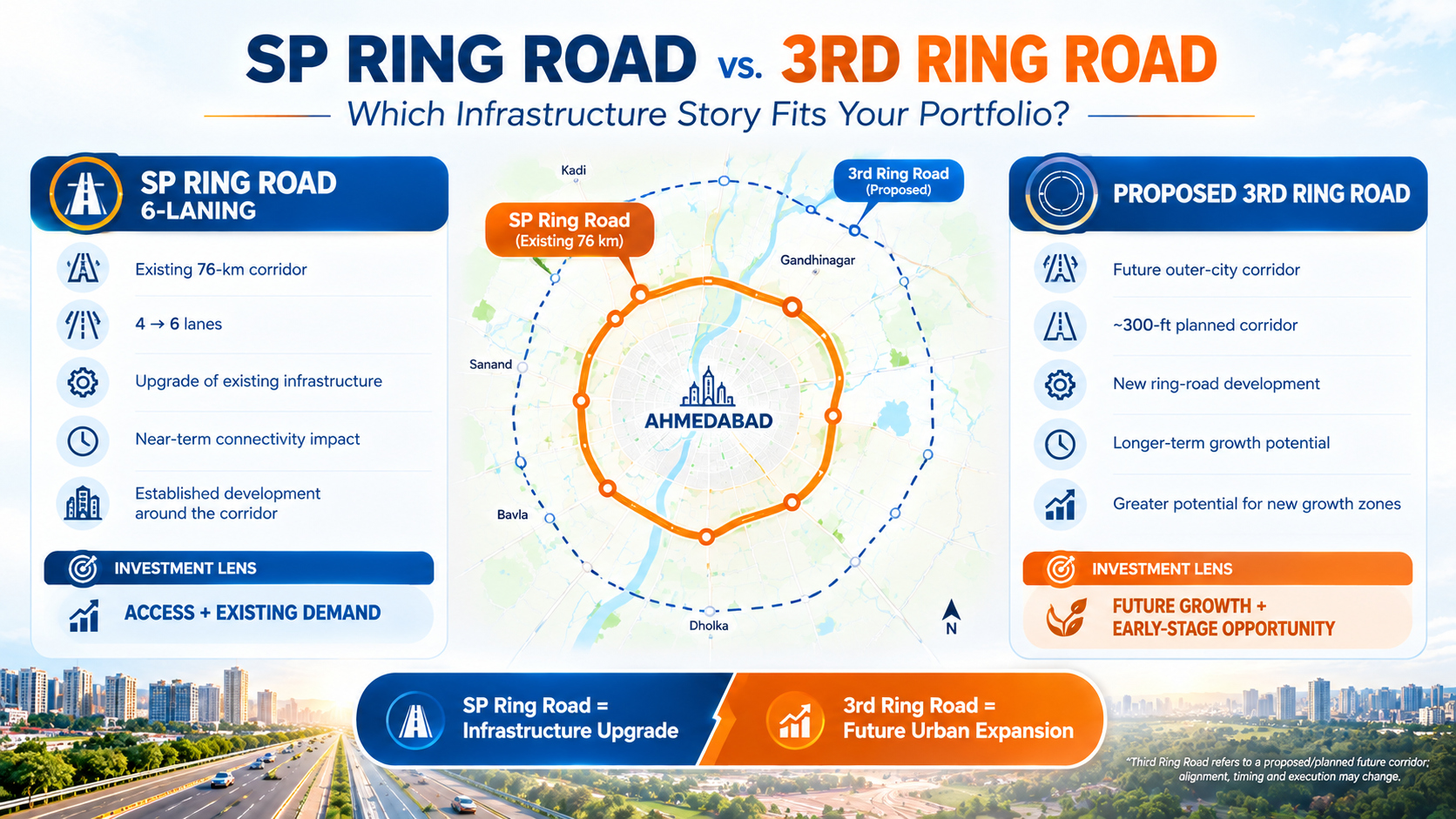
5. SP Ring Road (Widening) vs. Upcoming 3rd Ring Road: Which Fits Your Portfolio?
Investors frequently ask whether they should allocate capital to properties along the 6-lane SP Ring Road or acquire land on the proposed 3rd Ring Road (300-ft Outer Loop). The answer depends on your investment horizon, risk appetite, and liquidity needs.
The two projects serve fundamentally different functions in Ahmedabad’s urban growth model:
| Comparison Metric | SP Ring Road 6-Laning (2nd Ring Road) | Upcoming 3rd Ring Road (Outer Loop) |
| Corridor Profile | Existing 76.25 km / 200-ft ring upgraded from 4 to 6 lanes + service corridors. | Greenfield ~100 km / 300-ft arterial loop. |
| Investment Horizon | Near-to-Mid Term (2026–2028). | Long Term (5–8+ Years). |
| Asset Class Focus | Ready & under-construction high-rises, commercial retail, Grade-A offices. | Raw agricultural land, TP-scheme non-agricultural plots, plotted communities. |
| Key Target Nodes | Vaishnodevi, Shilaj, Shela, Sanathal, Bhat Circle. | Godhavi, Palsana, Khatraj, Dhanaj, Moraiya, Sargasan. |
| Primary Value Engine | Congestion relief, livability gains, and commercial service-lane access. | Early-stage land banking, DP/TP zoning, and agricultural-to-urban conversion. |
| Gross Yield Profile | 3.5% – 5.2% steady rental yield + capital appreciation. | Near 0% cash flow; entirely driven by land multiple exits. |
| Execution Risk | Low-to-Moderate; civic contracts awarded under HAM with visible execution. | Moderate-to-High; long-cycle land acquisition, DP notifications, and TP finalizations. |
Strategic Portfolio Allocation: How to Deploy Capital
-
Choose the SP Ring Road 6-Lane Corridor If: You want immediate residential livability, steady rental cash flows from corporate and expatriate tenants, and a liquid real estate asset backed by Grade-A developers and RERA protection. It suits salaried executives, business owners upgrading their residences, and yield-focused investors seeking predictable 12% to 18% capital appreciation by 2027–2028.
-
Choose the 3rd Ring Road If: You have patient, non-leveraged capital and are looking for 3x to 5x land multiples over a 7-to-10-year window. This strategy requires extensive land title due diligence, understanding AUDA Town Planning (TP) scheme deductions, and the ability to hold illiquid assets through municipal zoning cycles.
💡 Related Strategic Reading:
If your portfolio strategy prioritises early-stage peripheral land banking over immediate rental yields, explore our comprehensive ground report:
👉 Ahmedabad’s 3rd Ring Road: The Next Wealth Corridor Where Smart HNIs Are Quietly Building Fortunes.
6. Checklist Before Buying Property on SP Ring Road: 3 Red Flags to Avoid
An infrastructure project of ₹2,220+ crore creates immense marketing buzz, but smart capital never buys on announcements alone. Real estate along a major, access-controlled transit corridor behaves very differently from interior neighbourhood plots.
Before committing equity to any residential or commercial project fronting the SP Ring Road, run every prospective asset through three non-negotiable checks:
Check 1: Dedicated Curb-Cut Access to the Multi-Lane Service Road
The core feature of the new 6-lane design is controlled high-speed transit.
-
The Operational Hazard: Direct vehicle entry or exit cuts onto the central 6-lane carriageway are strictly barred under AUDA and NHAI safety guidelines. All vehicular access must filter through the designated 3-lane or 4-lane service corridors.
-
The Due Diligence Test: Verify whether the property has an approved, legally sanctioned curb-cut directly connecting to the active service lane. If a project directly abuts the high-speed main carriageway without an open, sanctioned service road buffer, residents and commercial patrons will face hazardous deceleration issues, physical barricades, or lengthy U-turn loops to reach the site.
Check 2: Flyover Elevation & Visual Blindspot Audits
While elevated flyovers and vehicular underpasses (VUPs) solve commuter traffic, they can quietly destroy ground-level commercial value.
-
The Retail Risk: If you are purchasing ground-floor retail showrooms or second-floor commercial office space, inspect AUDA’s engineering cross-sections for nearby flyover ramps. Properties located directly behind high, elevated concrete retaining walls lose street-level line-of-sight visibility, pedestrian footfall, and easy drive-in access.
-
The Residential Risk: For residential buyers, units situated on lower levels (floors 1 through 4) that sit parallel to elevated flyover ramps suffer from persistent tyre rumble, acoustic reflection, and particulate exhaust pollution. Ensure residential towers are either set back behind substantial landscaped buffer zones or purchase units above the flyover parapet line (typically 6th floor and higher).
Check 3: Final Plot (FP) Status & Town Planning (TP) Deductions
Peripheral micro-markets undergoing rapid arterial widening are frequently caught in evolving Town Planning (TP) schemes.
-
The Land Area Risk: In draft TP schemes, agricultural parcels and original plots (OP) face statutory land deductions, often ranging between 30% and 40%, handed over to the development authority for road expansions, green reservations, and civic amenities before a Final Plot (FP) certificate is issued.
-
The Due Diligence Test: When evaluating plotted schemes, villas, or raw land parcels near ring road junctions, request the AUDA-sanctioned Form F (Allotment of Final Plot) and the zoning demarcation certificate. Ensure the developer's promised carpet area or plot boundary accounts for the full 60-meter Ring Road right-of-way plus any statutory service lane setbacks, eliminating the risk of future municipal demolition or boundary recalculations.

How EXIO Helps You Invest With Real Clarity
Choosing the right property means looking beyond sales brochures and staged sample flats. EXIO is an independent, research-first real estate advisory platform in Ahmedabad. We don't push developer inventory or sell on commission; we evaluate properties through technical inspections, legal background checks, and ground-level market data so you don't overpay.
What EXIO Audits Before You Pay Token Money
-
50+ Point Technical Inspection: Rigorous checks across structural build quality, materials, and everyday layout usability.
-
Ground-Level Locality Data: Micro-market comparisons based on verified tenant demand, actual commute times, and future supply pipelines.
-
Builder Track Record: Objective background checks on historical delivery timelines, GujRERA records, and financial stability.
-
All-Inclusive Net Yield Modelling: Transparent ROI projections factoring in stamp duty, GST, maintenance, property taxes, and realistic vacancy periods.
-
Pre-Screened Inventory: Access to a curated list of strictly vetted, legally clear, and RERA-compliant projects.
How to Get Started
1. Have a Flat or Office in Mind?
Get an Independent Project Audit
Before signing an allotment letter or handing over a token, let our research team run a check:
-
Calculate your exact usable carpet area and price-per-square-foot efficiency.
-
Verify title deeds, sanctioned plans, and past developer delays on GujRERA.
-
Audit the developer's quote against actual registered transaction values in the area.
👉 Request an Independent Project Audit
(Share the project name or brochure for an honest review)
2. Still Deciding Where to Invest?
Book a Free 1-on-1 Consultation
Whether your budget is ₹50 Lakh or ₹2 Crore+, speak directly with our advisory team before you begin site visits:
-
Match the right Ahmedabad micro-market to your goal (rental yields vs. capital appreciation).
-
Objectively compare residential high-rises vs. commercial spaces.
-
Browse only pre-screened properties that pass our safety filters.
(Zero sales pitch. No broker pressure. Just data.)
Disclaimer
Exio authored this report strictly for market awareness, research analysis, and educational evaluation of urban infrastructure and regional real estate trends. All capital appreciation projections, rental yield ranges, and timeline milestones are based on civic development plans published by the Ahmedabad Urban Development Authority (AUDA), publicly available infrastructure tenders, and historical transaction indices across Ahmedabad’s micro-markets. These estimates do not constitute direct financial advice, guaranteed return forecasts, or an offer of investment. Property values, Town Planning (TP) scheme boundaries, road deductions, and RERA registration statuses are subject to change by municipal authorities, market supply-demand cycles, and developer execution. Investors, buyers, and allocators are strongly advised to conduct independent legal title verification, physical site inspections, and review project-level RERA disclosures before entering into any binding real estate contract.

Frequently Asked Questions
The Ahmedabad Urban Development Authority (AUDA) has commissioned approximately ₹2,220 crore across two civil execution packages under the Hybrid Annuity Mode (HAM). The project expands the existing 76.25 km 4-lane main carriageway to 6 high-speed lanes (with 12.5-meter lane widths) while upgrading up to 49 km of peripheral service roads into dedicated 3-lane and 4-lane corridors to separate local township vehicles from heavy inter-state freight.
Priority grade separators, underpasses, and flyovers across high-density western nodes (such as Vaishnodevi, Tragad, and Sanathal) are targeting key civil milestones through 2026–2027. Full synchronized commissioning of the 6-lane carriageway, parallel river bridges, and integrated service lanes across all 76 km is scheduled between late 2027 and 2028.
The SP Ring Road 6-laning project aims to upgrade Ahmedabad's existing four-lane Sardar Patel Ring Road to six lanes, improving road capacity and connectivity across the city's major peripheral growth corridors. The project covers approximately 76 km of the Ring Road.
SP Ring Road (2nd Ring Road): A near- to mid-term investment (2026–2028) focused on ready or under-construction apartments, gated-community villas, and Grade-A retail with immediate livability, verified civic infrastructure, and ongoing rental income.
3rd Ring Road (~100 km, 300-ft Outer Loop): A long-term wealth play (5–8+ years) focused on raw agricultural land banking, TP-scheme non-agricultural (NA) plots, and plotted schemes in emerging peripheral belts like Godhavi, Khatraj, and Moraiya.
Areas with strong connections to the SP Ring Road could benefit from improved accessibility and infrastructure capacity. Key micro-markets to watch include Vaishnodevi, Tragad, Zundal, Shilaj, Shela, Ghuma, Sanathal, Shantipura, Bhat and Koteshwar. However, the impact is likely to vary depending on local connectivity, development activity and property demand.
Micro-markets that combine SP Ring Road connectivity with strong residential or commercial development, improving infrastructure and sustained demand could have better potential through 2027–28. Areas such as Vaishnodevi–Tragad–Zundal, Shilaj–Shela–Ghuma, Sanathal–Shantipura and Bhat–Koteshwar deserve closer evaluation, but actual appreciation will depend on market conditions and project-level factors.
