
 Login
Login
 Investment Advisory
 Contact Us

Booked your flat? You’ve made the decision. But have you completed the process?
For most buyers, the booking feels like the moment everything is finally settled. The property is chosen, the amount is paid, and the allotment letter arrives.
But this is where another important phase begins.
The first few weeks after booking can involve decisions and documents that are easy to overlook, especially when you’re simply following the process given by the developer.
What should you check? What should you ask before signing? And what needs to be in place before the agreement is registered?
This guide takes you through the first 30 days after booking, step by step, so you know what deserves your attention at each stage, and can move from “booked” to “properly documented” with confidence.
The 30-Day Post-Booking Roadmap at a Glance
The transition from paying a booking token to executing a registered Agreement for Sale carries the highest financial and legal risk. Use this operational roadmap to track statutory deadlines and protect your capital:
| Timeline | Phase / Action Item | Statutory Reference / Document | Primary Deliverable |
| Days 1–3 | Secure & Scrutinise Allotment Letter | Official Developer Seal & Sign | Confirmed unit number, RERA carpet area, and payment plan. |
| Days 4–7 | Enforce the 10% Advance Cap | RERA Section 13(1) | Prevent payments exceeding 10% before registration. |
| Days 8–11 | Verify Project Escrow & Approvals | RERA Section 4(2)(l)(D) | Confirm 70% project escrow bank account and sanctioned layout. |
| Days 12–17 | Bridge the Loan Disbursal Gap | APF Code & Tripartite Agreement | Pre-approve mortgage and link disbursals strictly to slab stages. |
| Days 18–22 | Audit the Draft Agreement for Sale | State Model Agreement Rules | Eliminate unilateral penalty clauses and verify RERA possession date. |
| Days 23–25 | Tax Compliance (GST & Section 194-IA) | Income Tax Act & GST Framework | Verify 1% vs. 5% GST and set up 1% TDS deduction via Form 26QB. |
| Days 26–30 | Sub-Registrar Office Registration | e-Challan, Index II & Biometrics | Execute statutory transfer and secure the original Index II. |
1. Days 1–3: Secure Your Formal Allotment Letter
A payment receipt or booking swipe slip merely confirms the transfer of funds; it provides zero statutory protection regarding which property you secured. Within 72 hours of paying your token amount, demand an official Allotment Letter printed on the promoter's registered corporate letterhead.
What is an Allotment Letter? (Legal Meaning & Scope)
An Allotment Letter is an official legal document issued by a real estate developer or housing authority confirming that a specific property unit (apartment, plot, or commercial space) has been formally allocated to a buyer after receiving the initial booking amount. While it creates a legally binding contractual relationship establishing you as an "Allottee" under Section 2(d) of RERA, an allotment letter is not a title deed and does not transfer property ownership. Ownership transfers only when the final Sale Deed / Conveyance Deed is registered at the Sub-Registrar Office.
Why the Allotment Letter is Critical:
-
Mortgage Approval: Banks mandate the signed allotment letter to verify property cost, confirm developer credentials, and initiate home loan processing.
-
Price Lock & Layout Protection: Prevents the promoter from unilaterally escalating the base price, altering unit boundaries, or reallocating your unit to another buyer.
-
Evidence in RERA Disputes: Under Section 18 of RERA, if a project stalls or plans change without statutory consent, the allotment letter serves as primary evidence to claim delay compensation or full refunds.
Document Comparison: Know the Difference
| Document | Issued By | Primary Legal Purpose | Ownership Transferred? |
| Allotment Letter | Developer / Authority | Confirms allocation of a specific unit & payment terms | No (Contractual allocation only) |
| Agreement for Sale (ATS) | Buyer & Builder | Detailed, registered contract governing construction & obligations | No (Promise to sell in future) |
| Sale Deed / Conveyance | Sub-Registrar | Final registered deed transferring legal title & possession | Yes (Absolute legal ownership) |
The Non-Negotiable Allotment Checklist
-
Specific Unit Allocation: Exact tower/wing, floor number, and apartment unit number. Avoid vague commitments such as "Allocation subject to tower launch."
-
Standardised Carpet Area: Measurement defined strictly in RERA Carpet Area (the net usable floor area of an apartment, excluding external walls, service shafts, and common corridors), provided in both square meters and square feet.
-
Undivided Share of Land (UDS): The exact proportionate undivided land share attributed to the unit.
-
Demarcated Parking Bay: Specific allocation of covered basement or stilt parking with an assigned identification number. Promoters cannot sell open parking spaces or issue ambiguous "subject to availability" letters under RERA Section 2(n).
-
Itemised Payment Schedule: A stage-wise, construction-linked payment milestone chart rather than arbitrary calendar deadlines.
Standardized Carpet Area: Measurement defined strictly in RERA Carpet Area (the net usable floor area inside internal walls, excluding common corridors and service ducts). For a visual breakdown of how loading calculations distort actual livable space, see our detailed guide on RERA Carpet Area vs. Super Built-Up Area and Loading Factors.
2. Days 4–7: The 10% Advance Cap Under RERA Section 13
A frequent developer practice is demanding 15% to 20% of the total property value as a "second booking instalment" or "allotment confirmation" before providing the agreement draft.
Statutory Protection Under Section 13(1)
Under Section 13(1) of the Real Estate (Regulation and Development) Act, 2016:
"A promoter shall not accept a sum more than ten per cent of the cost of the apartment, plot, or building as the case may be, as an advance payment or an application fee, from a person without first entering into a written agreement for sale with such person and register the said agreement for sale."
If an apartment has an agreed total cost of ₹80,00,000, your cumulative financial outflow before registration cannot legally exceed ₹8,00,000. If the builder issues a demand note exceeding this threshold, issue a written response citing Section 13(1) and request the draft Agreement for Sale along with a scheduled registration appointment before releasing additional capital.
3. Days 8–11: The RERA 70% Escrow Account & Sanctioned Plan Audit
Before releasing funds to meet the 10% threshold, verify where your money is actually deposited. RERA safeguards buyer capital through statutory escrow ring-fencing.
1. The 70% Escrow Mandate (Section 4(2)(l)(D))
RERA 70% Escrow Account Verification: Where is Your Money Going? Before releasing funds to meet the 10% advance cap, verify the project escrow account under RERA Section 4(2)(l)(D). Check your demand note: the beneficiary bank account name must explicitly read: [Developer Entity] - [Project Name] - RERA Dedicated Separate Account. Never transfer booking tranches to a builder’s generic operational or marketing current account, preventing fund diversion to other projects.
2. Sanctioned Architectural Layout Cross-Check
Log in to your state RERA web portal (e.g., GujRERA, MahaRERA, UP-RERA) and enter the project registration number:
-
Download the approved Sanctioned Building Plan.
-
Cross-check your brochure floor plan against the portal layout to ensure the builder has not converted common refuge areas, fire ducts, or amenity zones into unauthorised saleable units.
-
Verify that your specific wing and floor have an active Commencement Certificate (CC).
4. Days 12–17: Loan Sanction to Disbursement: The Gap Nobody Plans For
Holding a home loan "Sanction Letter" does not mean your lender will automatically clear builder demand notes. A sanction letter only evaluates your personal borrowing capacity; it does not validate the project's legal clearances.
Navigating the Disbursal Gap
-
APF (Approved Project Financial) Code Verification: Ask the developer for their APF code for your specific bank. An active APF confirms that the bank's legal panel has reviewed the title chain, municipal approvals, and non-encumbrance records.
-
The Tripartite Agreement: For under-construction purchases, banks mandate a tripartite agreement executed between the buyer, the promoter, and the lending institution. This binds the promoter to direct any cancellation or default refunds directly to the bank loan account.
-
Preventing Premature Disbursals: Instruct your bank in writing that no construction-linked tranche should be disbursed based solely on a developer's demand letter. The bank must obtain an Architect/Engineer Progress Certificate verifying that the specific floor slab or masonry stage has been cast on-site.
5. Days 18–22: The Agreement for Sale: Critical Clauses to Read Before Signing
Do not sign an Agreement for Sale (ATS) at the sales lounge under artificial urgency. While state regulations specify a standardized model agreement, developers often insert restrictive conditions into schedules and annexures.
Essential Clauses to Inspect
-
Possession Date Alignment: Check the possession date printed in the agreement against the statutory date listed on the RERA portal. Sales teams often promise delivery in "2 years," while their RERA registration grants a 4-year delivery buffer. The date in your agreement must be aligned with the RERA schedule.
-
Symmetry in Delay Compensation: Review penalty clauses for payment delays. If the agreement stipulates that a buyer must pay 12% to 18% penal interest on delayed instalments, ensure the builder is bound by the identical interest rate for project delivery defaults. Under RERA model rules, this rate is standardised to the State Bank of India (SBI) highest Marginal Cost of Funds Based Lending Rate (MCLR) + 2%.
-
The 3% Carpet Area Variation Limit: Verify that the agreement specifies the statutory 3% carpet area adjustment rule. If the final delivered carpet area decreases, the developer must immediately refund the differential value with interest.
-
5-Year Structural Defect Liability (Section 14(3)): Ensure the agreement includes the statutory 5-year warranty period. Any structural, design, or workmanship defects identified within 5 years of possession must be rectified by the promoter at their own cost within 30 days of written notification.
6. Days 23–25: Tax Compliance & Statutory Pass-Throughs (GST & Section 194-IA)
Property transactions involve two statutory tax mechanisms that buyers must execute to avoid penalties from the Income Tax Department and GST authorities.
| Property Classification | Criteria / Status | Effective GST Rate (Without ITC) |
| Affordable Housing | Carpet area up to 60 sq.m. (metros) / 90 sq.m. (non-metros) AND total cost $\le$ ₹45 Lakh | 1% |
| Non-Affordable Residential | Cost > ₹45 Lakh or carpet area exceeding affordable limits | 5% |
| Commercial Showrooms & Offices | Commercial real estate units | 12% (with ITC) |
| Completed Units (BU/OC Issued) | Project has received a valid Building Use / Occupancy Certificate | 0% (Exempt) |
Never pay GST on a ready-to-move property where the Occupancy Certificate (OC) or Building Use (BU) permission was issued before the sale agreement was executed.
2. Mandatory 1% TDS on Properties Above ₹50 Lakh (Section 194-IA)
Under Section 194-IA of the Income Tax Act, if the total property value is ₹50,00,000 or more, the buyer, not the builder, is legally responsible for deducting 1% TDS from every milestone payment.
-
Total Consideration Rule: The ₹50 Lakh ceiling includes all ancillary charges bundled into the contract (car parking, club membership, advance maintenance, and preferential location charges).
-
Payment via Form 26QB: Deduct 1% from every payment tranche and deposit it online via Form 26QB on the Income Tax e-filing portal within 30 days from the end of the month in which the deduction was made.
-
Form 16B Issuance: Download the official Form 16B TDS certificate from TRACES (typically available within 4–7 days of filing Form 26QB) and submit it to the developer as proof of tax payment. Late filing attracts a statutory fine of ₹200 per day under Section 234E.
7. Days 26–30: Sub-Registrar Registration: Costs & Presence
Executing your agreement without registering it at the Sub-Registrar Office (SRO) provides zero statutory standing under RERA Section 13.
1. Document & Fee Clearances
-
Stamp Duty: Clear the statutory stamp duty payment (typically 4% to 7% of consideration value, depending on state regulations and local municipal council surcharges) via authorised government e-challan or approved franking portals.
-
Registration Fee: Pay the standard state registration fee (commonly 1%, subject to specific concessions, such as zero registration fees for women sole owners in select states).
2. Who Must Be Present at the Sub-Registrar Office
-
All Named Allottees: Every co-buyer listed in the allotment letter must appear in person with their original PAN card, Aadhaar card, and passport-size photographs for biometric fingerprint scanning and digital photography.
-
Promoter’s Authorised Representative: An authorised signatory carrying a valid registered Power of Attorney (PoA) or certified Board Resolution authorising them to execute deeds for the project.
-
Two Independent Witnesses: Two adult witnesses carrying original government photo identity cards and residential address proofs.
The Post-Registration Paper Trail: What to File & Safeguard
Upon completing biometric registration, collect your documentation and organise both physical and secure digital files:
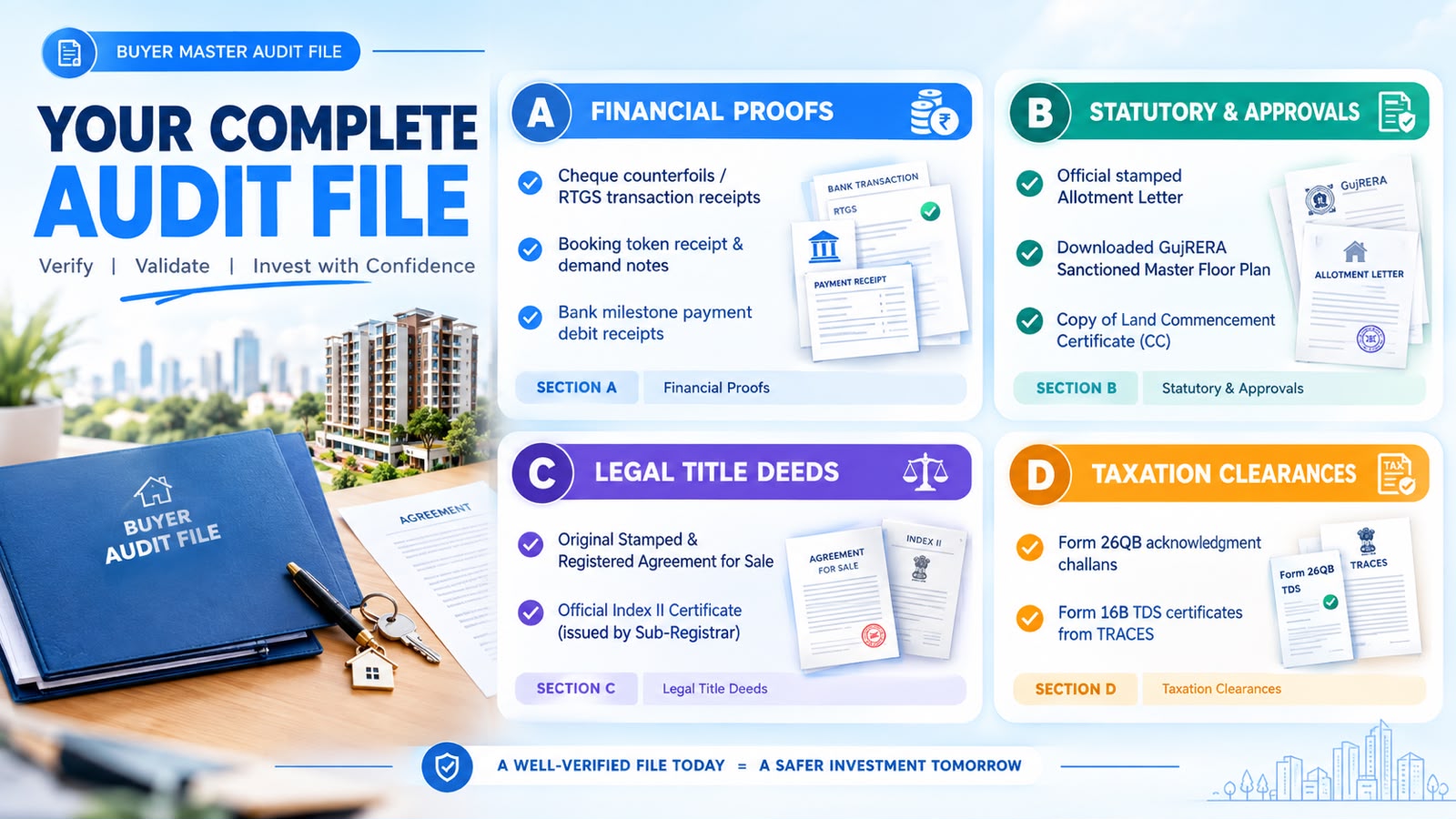
- Index II (The Public Record Certificate): Ensure you collect Index II from the Sub-Registrar Office. This document serves as the formal extract of the registration record, providing public evidence of your legal right, unit identification, and execution value.
Read Exio’s latest LinkedIn article on what Index-2 actually reveals about a project's real prices:
https://www.linkedin.com/pulse/what-index-2-actually-tells-you-projects-real-pprgf
What Can Safely Wait Until Later (And What Cannot)
Prioritise your efforts during the first month by focusing only on statutory and financial milestones:
Must Be Finalised Within 30 Days (Cannot Wait)
-
Reconciling sanctioned architectural drawings with the booking layout.
-
Checking the developer’s dedicated 70% RERA escrow bank account.
-
Executing the registered Agreement for Sale before crossing the 10% payment threshold.
-
Deducting and filing 1% TDS (Form 26QB) for payments made within the month.
What Can Safely Wait for Later Construction Stages
-
Interior & Architectural Contracting: Detailed false ceiling, electrical point modifications, and modular joinery planning can wait until brickwork and internal plastering are completed.
-
Utility Meter Name Transfers: Shifting electricity meters (e.g., Torrent Power, UGVCL, BESCOM) and municipal water connections occurs after final Building Use (BU) / Occupancy Certificate (OC) issuance.
-
Resident Association (RWA) Formalities: Society formation, payment of maintenance sinking funds, and facility handovers take place after the project reaches substantial completion.
Cancellation & Token Refund Rules Under RERA
If personal circumstances change, or if due diligence uncovers title defects, your refund rights depend on statutory milestones:
Scenario A: Cancellation Before Signing the Agreement for Sale
If you choose to withdraw before executing the Agreement for Sale, the promoter cannot forfeit arbitrary sums like 10% or 20% of the entire property value. Promoters are legally permitted to deduct only a reasonable administrative fee (typically ₹10,000 to ₹25,000 or up to 1–2% of the booking token) and must refund the remaining capital within 30 to 45 days.
Scenario B: Cancellation Due to Builder Default or Unapproved Plan Changes
If the promoter attempts to alter sanctioned layouts, reduces the promised carpet area, or fails to start construction within agreed timelines:
-
You have the absolute right to cancel the booking under RERA Section 18.
-
The developer is legally obligated to return 100% of the money received along with statutory interest at the SBI MCLR + 2% rate from the date of payment receipt to the date of refund, with zero forfeiture.
How EXIO Helps You Invest With Real Clarity
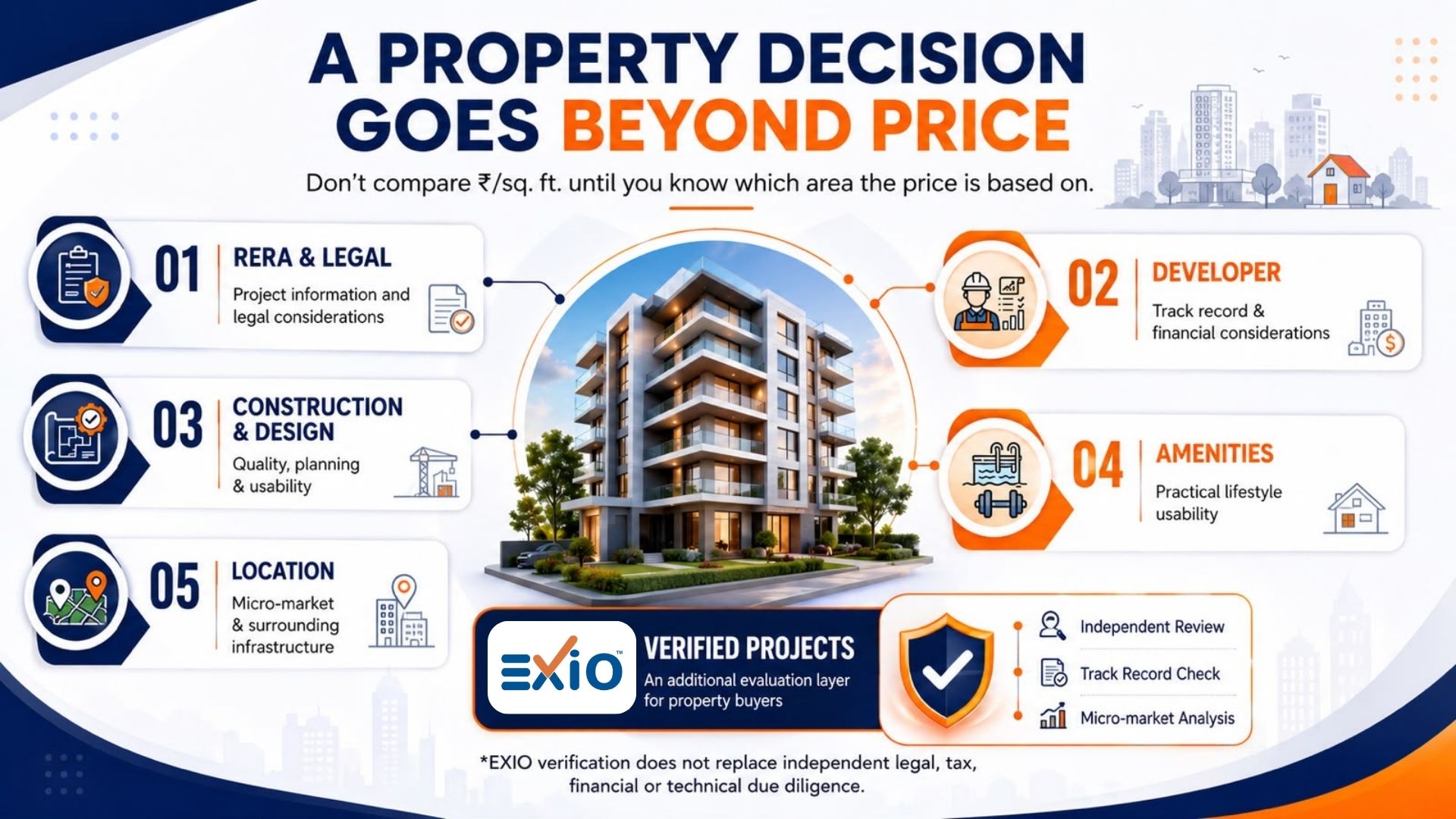
Choosing the right property means looking far beyond sales brochures and sample flats. EXIO is an independent real estate advisory firm that helps buyers evaluate properties through technical inspections, legal background checks, ground-level neighbourhood research, and project comparisons. Instead of simply pushing inventory, EXIO checks whether a specific apartment or commercial space actually matches your financial goals.
What EXIO Checks Before You Put Money Down
-
50+ Point Property Inspection: Every project is checked across structural build quality, true usable room sizes, legal titles, government approvals, and practical daily liveability.
-
Ground-Level Neighbourhood Research: Compare Ahmedabad areas based on real tenant demand, actual highway and metro access, and future supply pipelines, not just advertised growth claims.
-
Builder Background Verification: Look past big brand names to check whether the developer delivers projects on time, uses durable construction materials, and maintains healthy finances.
-
True Usable Space Analysis: Compare properties by their actual living area (RERA carpet area) so you never overpay for wasted common corridors or inflated super built-up claims.
-
Net Return Calculations: Get realistic profit projections that factor in government stamp duty, society maintenance bills, local property taxes, and expected vacancy periods.
-
Pre-Screened Projects: Access a curated list of legally clear, RERA-compliant projects so you do not waste time visiting problematic or delayed sites.
Already have a flat or office in mind?
Get an Independent Project Audit
Before you hand over token money or sign anything, let us run a ground check on it.
-
We calculate your actual usable carpet area (so you don’t pay for wasted corridors).
-
We check GujRERA records, land titles, and past builder delays.
-
We tell you honestly if the price is fair or inflated for that area.
(Send us the project name or brochure for an honest review)
Not sure where to invest your budget?
Book a Free 1-on-1 Consultation
Whether your budget is ₹50 Lakh or ₹2 Crore+, talk directly with our research team before you start visiting sites.
-
Find the right area for your goal (steady monthly rent vs. long-term appreciation).
-
Compare residential flats vs. commercial offices without sales pressure.
-
See only pre-verified, RERA-approved properties that pass our safety checks.
(No sales pitch. Just ground-level facts and numbers)
Disclaimer
This guide is published solely for educational and informational purposes and does not substitute for formal legal, taxation, or financial due diligence. Statutory rules under RERA, the Income Tax Act, and local municipal authorities are subject to project-specific nuances and periodic updates. Always verify project sanction documents on the official RERA portal and consult an independent legal counsel or chartered accountant before executing agreements or transferring funds. Exio assumes no legal or financial liability for decisions taken based on this content.

Frequently Asked Questions
If your home loan application is rejected by the lending institution, your refund depends on whether your booking form includes a "finance contingency clause." Reputable developers include a clause refunding the initial token minus an administrative fee (typically ₹10,000 to ₹25,000) upon presentation of the bank’s official loan rejection letter. Always demand this clause in writing before transferring initial booking funds.
No. A promoter cannot unilaterally cancel a booking without following due process. Under RERA model rules, the promoter must issue a formal 30-day written notice specifying the grounds for cancellation. Use this window to communicate contract concerns in writing, referencing state RERA model agreement rules.
Yes. Under Section 14 of RERA, developers cannot make major additions or alterations to sanctioned project plans without the prior written consent of at least two-thirds of the allottees. If the developer modifies your unit layout, structural column locations, or building floor plan without your written consent, you are legally entitled to cancel the booking and receive a full refund with interest.
No. Under Section 2(n) of RERA, open parking spaces are common property and cannot be sold. Covered or basement parking slots must be clearly demarcated and priced in the initial allotment documentation. Demanding additional payments for parking post-booking violates statutory transparency mandates.
In registration offices utilizing digital workflows, the Sub-Registrar issues the original stamped agreement along with the digitally signed Index II on the same day or within 2 to 3 working days following biometric verification.


