
 Login
Login
 Investment Advisory
 Contact Us

Buying a property is not only about finding the right location, floor, view or price. Before paying a booking amount, the buyer also needs to understand what the property documents are saying. This is where many buyers get stuck. A file may contain a sale deed, 7/12, 8A, NA order, GujRERA details, approved plans and several other papers, but simply having all these documents does not mean the buyer knows what they prove.
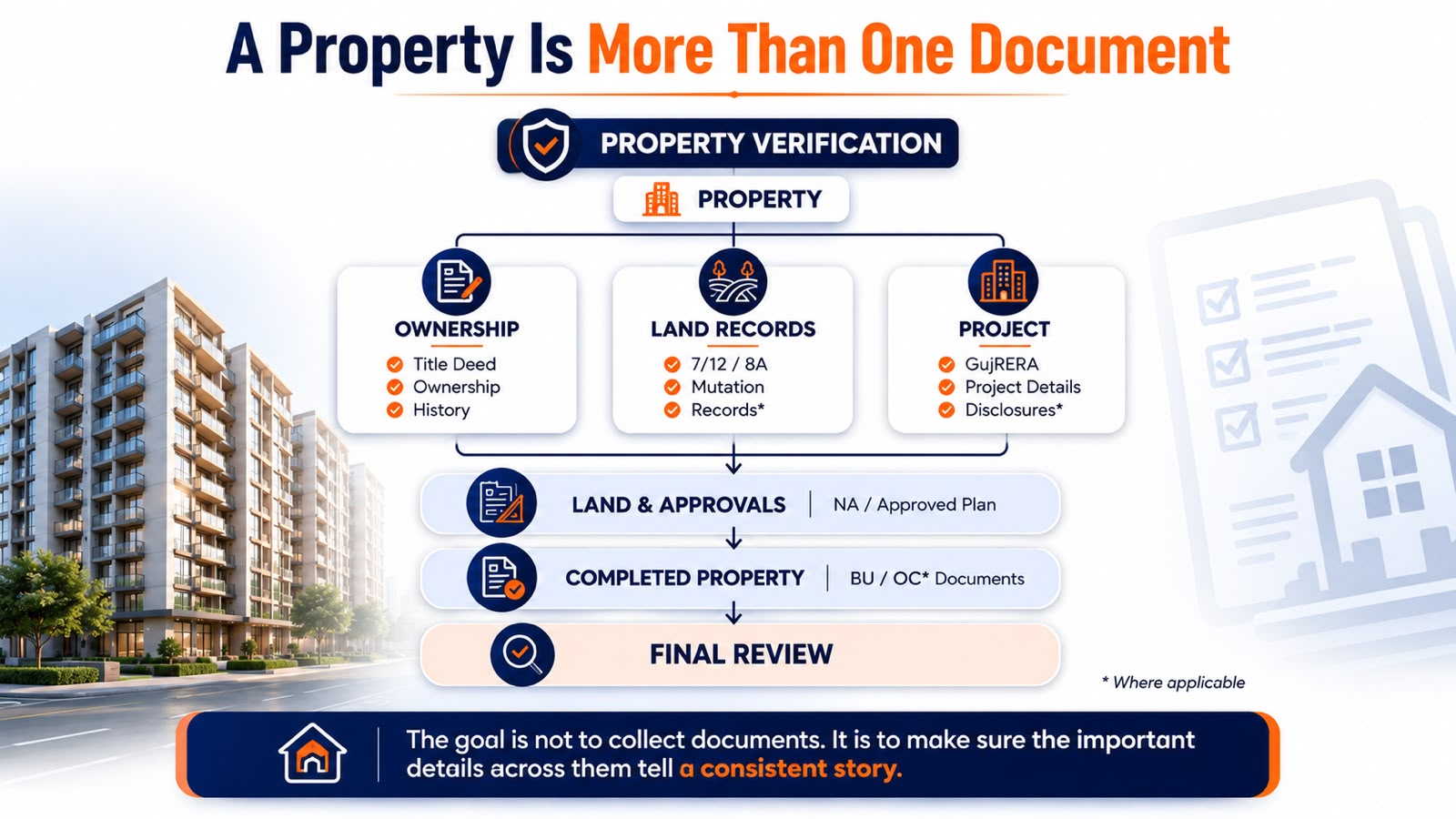
The easier way to approach property documents is to stop treating them as paperwork that has to be collected and start treating them as answers to different questions. One document may help you understand ownership. Another may tell you about the land record. Another may explain the permitted use of the land. Another may show what construction was approved. When these documents are read together, the buyer gets a much clearer picture of the property.
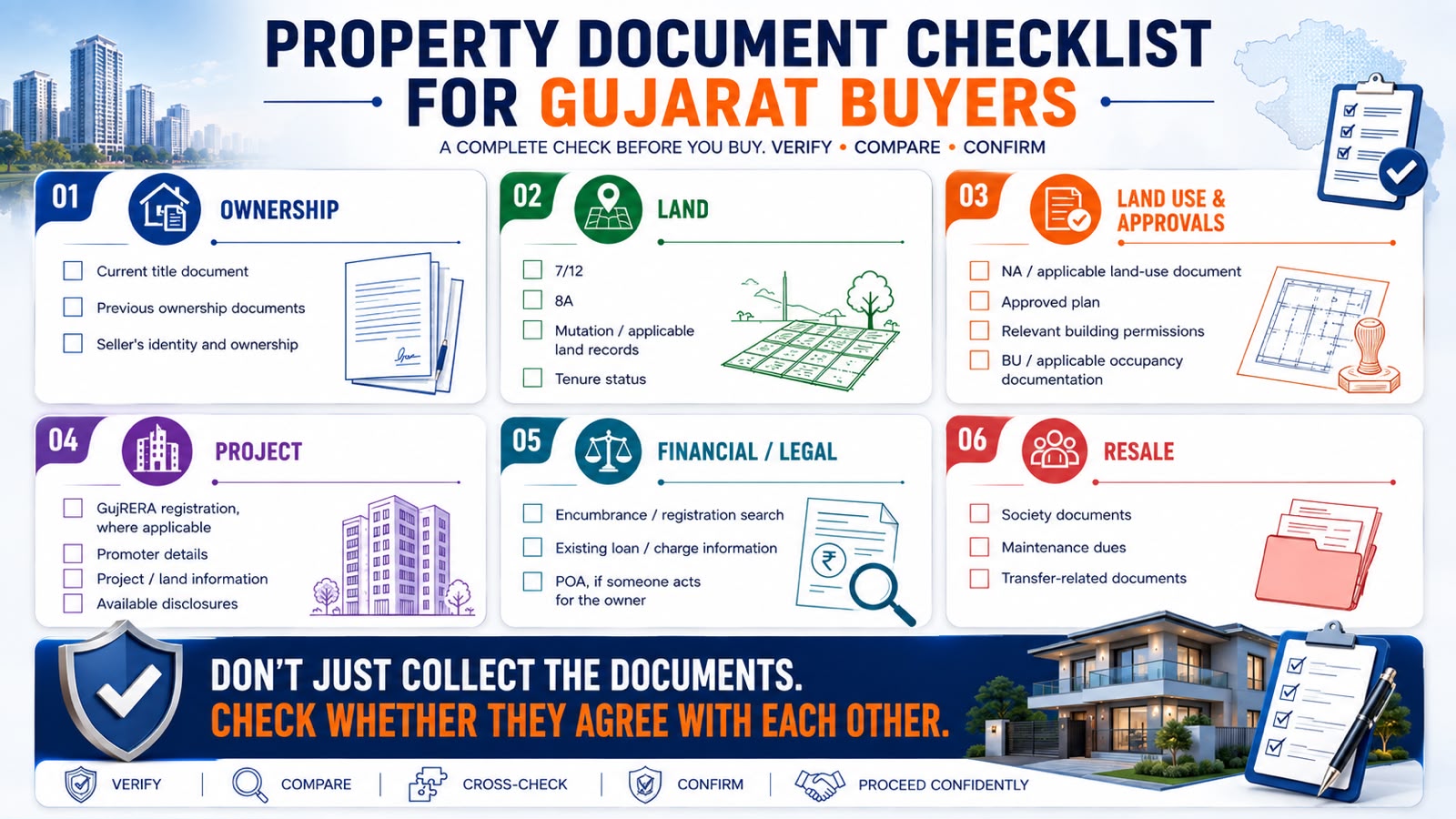
This property documents checklist for Gujarat explains the important documents in simple language, including what to check, why it matters and what to do when something does not match.
Why the Document Set Matters More Than the Brochure
A property brochure is designed to sell the property. It may show the building, amenities, floor plan, location advantages and lifestyle features. Those things are useful when comparing properties, but they do not answer every legal or documentary question a buyer needs to ask.
For example, a brochure may say that a project has three towers, but the buyer still needs to understand what has actually been approved. A salesperson may say that the land is NA, but the buyer should understand what that NA permission covers. A seller may say that the property has a clear title, but the buyer still needs to understand the document from which the seller's rights come.
That is why property verification should not be based on one document or one statement.
Think of the documents as different pieces of the same property story.
| Document / Record | Main question it helps answer |
|---|---|
| Title deed | How did the seller get the property rights? |
| Previous title documents | What is the ownership history? |
| 7/12 | What does the applicable land record show? |
| 8A | What information is recorded about the holding? |
| Mutation / VF6 | What changes have been recorded? |
| Tenure information | Are there conditions or restrictions to understand? |
| NA order | What is the permitted land use? |
| GujRERA | What information is registered about the project? |
| Approved plan | What construction has been approved? |
| BU/occupancy document | Can the completed building be used under the applicable permission? |
| Encumbrance/registration search | Are there recorded charges or transactions within the search scope? |
| Society records | Are there dues or other resale-related matters? |
| POA | Does the person acting for the owner have the required authority? |
The important point is simple:
You are not checking documents just to complete a checklist. You are checking them to answer questions about the property.
How These Documents Work Together
A property document should rarely be checked in isolation. The useful information appears when the documents connect. The title documents help explain ownership, land records help identify the recorded land information, NA documents address land use, GujRERA provides registered project information where applicable, and approved plans and building-use documents address construction and use.
When two documents show different information, the buyer does not automatically have a problem, but there is a question to answer. The safest approach is to identify the difference, find the document or approval that explains it, and obtain professional advice when the issue affects title, transfer rights, land status or building approvals.
A simple way to think about it:
| Question | Documents to look at |
|---|---|
| Who owns it? | Title / ownership documents |
| What land is involved? | 7/12, 8A and other applicable land records |
| What is the permitted land use? | NA / applicable land-use documents |
| What project is registered? | GujRERA, where applicable |
| What was approved to be built? | Approved plans |
| Can the completed building be used? | BU / applicable occupancy documentation |
| Are there recorded charges? | Encumbrance / registration search |
| Is someone acting for the owner? | POA and ownership documents |
Title Deed: The Document That Records the Transfer
The title deed, such as a registered Sale Deed, is one of the key documents used to understand the legal transfer of rights in a property. It records the transaction between the parties and identifies the property being transferred.
For a buyer, the important question is not simply "Do I have the sale deed?" It is whether the document identifies the right seller, the correct property and the rights being transferred to you.
What should you check?
| Check | What to look for |
|---|---|
| Seller's name | Does it match the person/entity selling the property? |
| Buyer and seller details | Are the parties correctly identified? |
| Property description | Does it identify the property you are buying? |
| Survey / Block / City Survey No. | Does the property identifier match other records? |
| Area | Is the stated area consistent with relevant documents? |
| Boundaries | Do they help identify the same property? |
| Registration details | Is the document properly identifiable as a registered transaction? |
| Terms and conditions | Are there any important rights, restrictions or obligations? |
The Ownership History: Don't Look Only at the Latest Document
Checking the current owner's name is only the starting point. A buyer should also understand how that person acquired the property and whether the relevant documents support that transfer.
For example, suppose Mr A is selling you a residential plot in Ahmedabad. His name appears on the latest registered sale deed. The next question is: How did Mr A become the owner?
If Mr A purchased the property from Mr B, the earlier sale deed between B and A forms part of the ownership history. If A inherited the property, the relevant inheritance documents would tell a different story. A gift, partition or another legally recognised transfer may require different supporting documents.
Simple example
Mr. B → Sale Deed → Mr. A → Sale Deed → You
You are buying from Mr. A. The latest sale deed shows A's transaction, while the earlier document helps explain how A acquired the property.
The purpose is not to collect every old document. It is to understand whether the seller's claimed right to transfer the property is supported by the relevant ownership records.
The title deed tells you about the current transfer. The ownership history helps explain how the seller got the right to make that transfer.
7/12 Utara and 8A: How to Read Gujarat Land Records
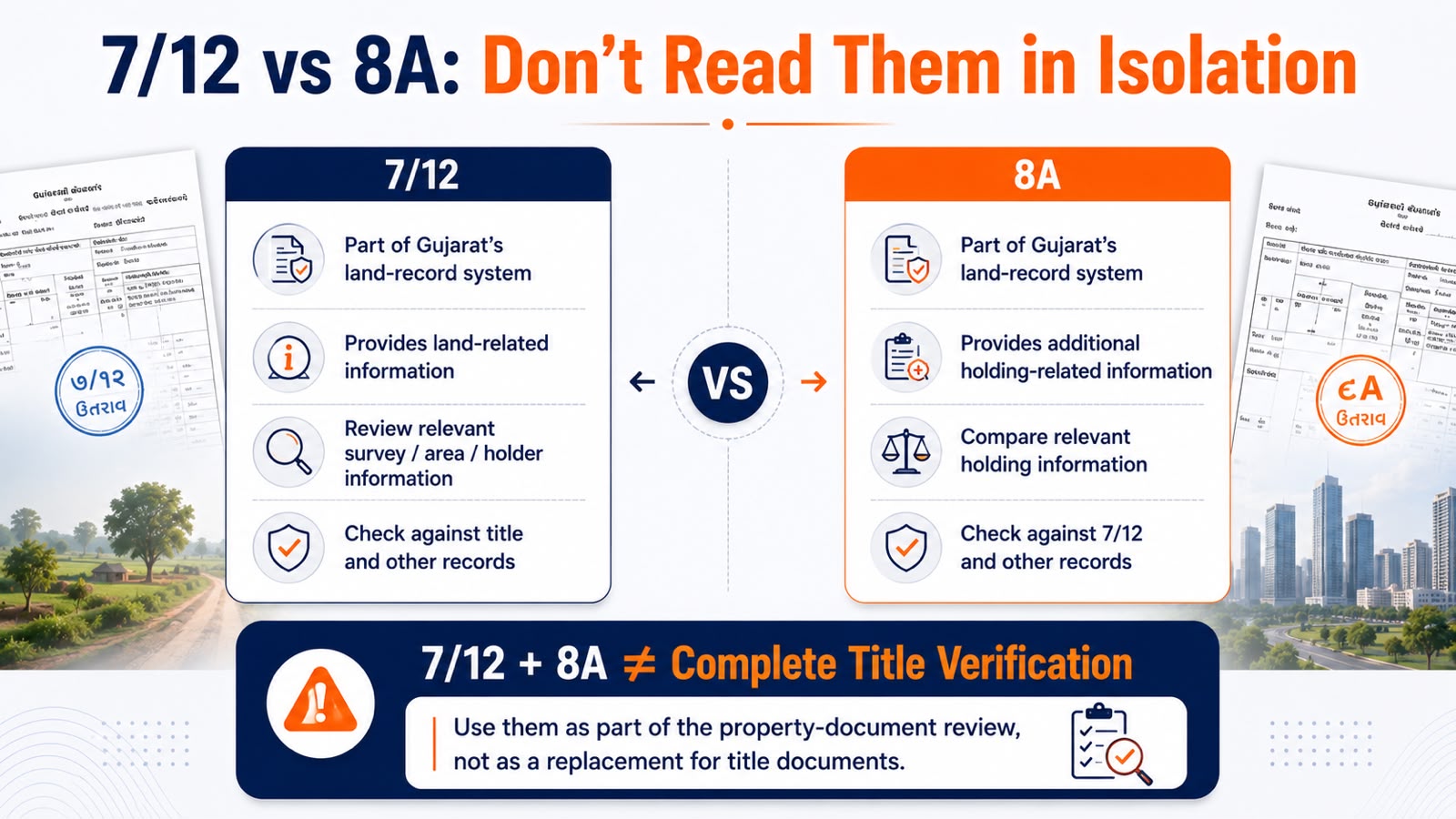
If you are buying land or a property connected to land records in Gujarat, 7/12 and 8A are two records you may come across during document verification. Many buyers, however, make the mistake of treating these records as a final certificate of ownership. They are not a substitute for checking the complete title and supporting documents.
The Gujarat government's land-record system provides access to records such as 7/12, 8A and VF6. For a buyer, the useful approach is not to simply download these records and tick them off the checklist. Instead, look at the information they contain and compare it with the property's title documents, survey details and other relevant records.
What can you look for in a 7/12?
A 7/12 record can contain important information relating to the land, including details such as the survey number, area and recorded holder-related information, depending on the particular record.
For example, suppose you are buying a plot that the seller identifies as Survey No. 125/2. When you check the applicable land record, you should make sure the survey number and other important details correspond to the property being offered to you.
If the seller's name, survey number or area is different from what appears in another document, don't immediately assume that the property is wrong. First find out why the information is different and which document explains the difference.
A practical example
Imagine the seller tells you:
"My name is on the 7/12, so the property is completely clear."
That is not enough to complete your verification.
Suppose the 7/12 shows:
Survey No.: 125/2
Recorded holder: Mr. A
Area: 1,000 sq. m.
You should still compare these details with the title document.
What should you compare?
| 7/12 information | Compare it with |
|---|---|
| Survey number | Title and other land documents |
| Area | Title / property records |
| Recorded holder | Ownership documents |
| Relevant entries | Mutation / supporting records |
| Property identification | Other applicable documents |
The important point
A 7/12 record is an important land record, but it should not be treated as the complete proof of title.
Its real value comes from comparing it with the rest of the property file.
What Is 8A and Why Should a Buyer Check It?
8A is another record in Gujarat's Record of Rights system and provides additional information about the land holding. For a buyer, it is useful when reviewed alongside the 7/12 and other property documents.
The key is to compare the information, rather than checking 8A in isolation. If the name, area or other important details differ from the title or land records, ask for the document that explains the difference.
8A is one part of land-record verification, not a replacement for title documents.
Tenure Status: The Small Detail Buyers Often Skip
Tenure is not the easiest property term for a first-time buyer.
But it can matter because certain land may have conditions or restrictions attached to its tenure.
The important thing is not to panic when you see a tenure entry that you do not understand.
Instead, ask what it means for this particular property and this particular transaction.
Ask these questions:
- What is the current tenure status?
- Are there any conditions attached to it?
- Does the property require any special permission for transfer?
- Is there a document explaining the current status?
- Has the tenure changed from an earlier position?
NA Order: What Does Non-Agricultural Actually Mean?
NA means Non-Agricultural. An NA order relates to the permitted use of land, such as residential or commercial use, subject to the applicable order and its conditions.
A common mistake is to assume:
NA permission = Building approval
They are not the same. NA permission deals with the permitted use of the land, while building approval deals with what can be constructed on that land. Therefore, an NA order alone does not tell you the approved number of floors, buildings, layout or whether later changes were approved.
What Should a Buyer Check?
When reviewing an NA order, focus on the details that identify the land and its permitted use:
| Check | What it tells you |
|---|---|
| Survey / Block number | Whether the order covers the relevant land |
| Area | Whether the land details are consistent |
| Permitted use | What use has been allowed |
| Order number & date | Helps identify the official order |
| Conditions | Whether any conditions need attention |
If the NA order does not appear to cover all the land being used for the project, don't assume it is an error and don't ignore it either. Ask for the relevant supporting or subsequent document that explains the difference.
The key point: NA permission addresses land use; it does not replace building approval.
GujRERA Project Search: Don't Stop at the RERA Number
For projects that fall within the scope of RERA, registration is generally required, subject to the exemptions provided under the law. GujRERA is Gujarat's official real estate regulatory authority and its portal provides registered project information for buyers to review.
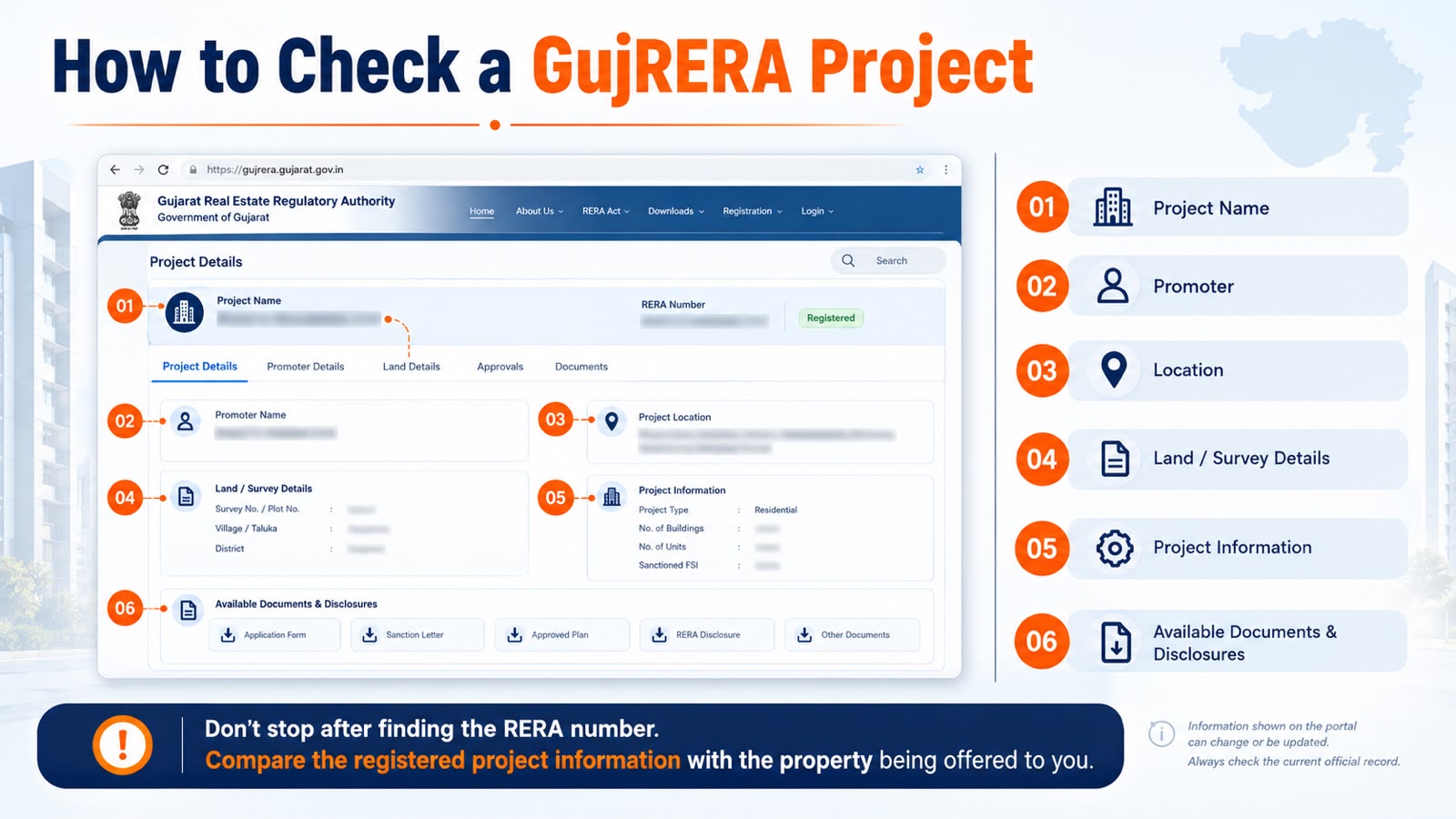
For a buyer, however, finding a RERA registration number is only the beginning. The more useful check is to compare the information on the official GujRERA portal with the project being offered to you. This can help you identify differences in the project name, promoter, location, land details or other disclosed information that may need clarification.
Practical comparison
| Sales information | What you should compare |
|---|---|
| Project name | Registered project name |
| Builder / promoter | Registered promoter |
| Location | Registered location |
| Survey details | Land details where available |
| Towers | Project information |
| Units | Project information |
| Possession timeline | Registered project timeline |
| Plans/documents | Available project documents |
The official GujRERA portal should be the starting point for the project search.
How to Read GujRERA Without Getting Confused
A GujRERA project page can contain a lot of information, but a buyer does not need to understand every field at once. The easiest approach is to check it step by step, starting with the details that identify the project and then moving to the information that affects your purchase.
Step 1: Confirm the Project
First, make sure you are viewing the correct project.
Check the project name, location and other identifying details against the brochure, booking documents or information provided by the seller.
Ask: Am I looking at the same project I am being offered?
Step 2: Check the Promoter
Look at the registered promoter's name and compare it with the developer or entity dealing with you.
This helps you understand whether the GujRERA registration relates to the project being marketed to you.
Step 3: Check the Land and Location Details
Where relevant information is available, compare the registered location, survey numbers and other land-related details with the documents provided for the property.
Ask: Does the registered project information relate to the land on which this project is being offered?
Step 4: Compare the Project Information
Check the available information about buildings, units, project configuration and timelines against the current sales information.
The information does not have to look identical in every document, but important differences should have an explanation.
Step 5: Investigate Differences
If you find a difference, don't immediately call it a red flag.
Projects can have updated information, revised approvals or other changes. Instead, ask:
"Which document or update explains this difference?"
The simple rule: Don't try to read the entire GujRERA page. Verify the information that identifies the project and affects the property you are buying.
Approved Plan: What Was Actually Allowed to Be Built?
The approved plan is important because it gives you a picture of what has been sanctioned by the relevant authority.
This is where the buyer should stop relying only on the brochure.
A brochure can show a beautiful project layout.
The approved plan tells you what has actually been approved.
Compare:
| Brochure says | Approved document says | What to do |
|---|---|---|
| 16 floors | 16 floors | Continue checking |
| 16 floors | 14 floors | Ask whether there is a later approval |
| 3 towers | 2 towers | Ask for clarification |
| Different layout | Different layout | Check latest approved plan |
Real-world example
Imagine a project brochure shows:
Tower A — 16 floors
But the plan you received shows:
Tower A — 14 floors
Don't immediately call it illegal.
Ask:
"Is this the latest approved plan?"
There may be a revised permission.
The problem is not that two documents are different.
The problem is when nobody can explain why they are different.
BU Permission and Occupancy: Important for Completed Properties
If you are buying a property that is already completed, the question changes slightly.
You are no longer asking only:
"Can this building be constructed?"
You also need to understand:
"Can the completed building be used under the applicable permission?"
This is where Building Use (BU) permission and applicable occupancy documentation become important.
For Ahmedabad, the applicable development regulations provide for Building Use Permission and connect its grant with the use of the building according to the sanctioned drawings.
Don't rely only on:
"People are already living there."
People occupying a building does not replace the need to check the applicable official documentation.
Check:
- Building/project identity
- Address/location
- Relevant authority
- Date
- Permitted use
- Applicable sanctioned drawings
- Conditions, if any
Occupancy Certificate vs BU Permission
Buyers often search for "occupancy certificate Ahmedabad" because they hear the term online.
The exact terminology and applicable document can depend on the local authority and type of property.
That is why it is better not to assume that every Gujarat property will have exactly the same document under exactly the same name.
For an Ahmedabad property, for example, the relevant BU documentation can be important.
The practical question is:
"What official permission/document applies to this completed building, and does it cover the property I am buying?"
That is a better question than simply asking:
"Where is the OC?"
Encumbrance Certificate: Is There Any Charge on the Property?
An encumbrance certificate or relevant registration search can help a buyer identify registered transactions or charges within the records and period covered by the search.
This can be particularly useful in resale transactions.
For example, the property may previously have been financed through a bank loan.
The seller says:
"The loan has been completely paid."
That may be true.
But the buyer should still ask for the relevant closure/release documentation and check the applicable records.
Resale Property: Check the Society Side Too
When buying a new property, most of the attention goes toward the developer and project.
A resale flat is different.
You are also stepping into an existing building and its society or association.
There could be outstanding maintenance, repair contributions or other building-level matters.
Before buying a resale flat, ask about:
- Current maintenance dues
- Major repair contributions
- Society transfer process
- Parking arrangement
- Any known outstanding amount
- No-dues confirmation, where applicable
Example
You negotiate a flat for:
₹65 lakh
Everything looks good.
After agreeing on the price, you discover that the seller has outstanding maintenance and repair-related dues.
It may not destroy the transaction.
But now you have an issue that should have been discovered earlier.
That is why resale-document checking should cover both property ownership and building-level obligations.
Power of Attorney: When the Seller Is Not the Owner
This is one area where buyers should be particularly careful.
Sometimes the person sitting in front of you is not the owner.
They may be acting under a Power of Attorney.
A POA can authorise someone to act on behalf of another person. But simply holding a POA does not make that person the owner of the property.
So if someone says:
"I have the POA, so I can sell it."
don't stop there.
What Should a Buyer Check in a Power of Attorney?
- Who is the actual owner?
- What does the POA authorise?
- Does it cover this property?
- Does it give the person authority for the proposed transaction?
- What document will actually transfer the property rights?
Important legal point
The legal effect of a POA depends on its wording, purpose, execution and the transaction involved.
So avoid the simple rule:
"Unregistered POA is always invalid."
That statement is too broad.
If a property transaction involves a POA, the safest approach is to have the actual POA and proposed transaction documents reviewed by a property lawyer.
A Practical Case Study: Checking a ₹72 Lakh 2 BHK in Ahmedabad
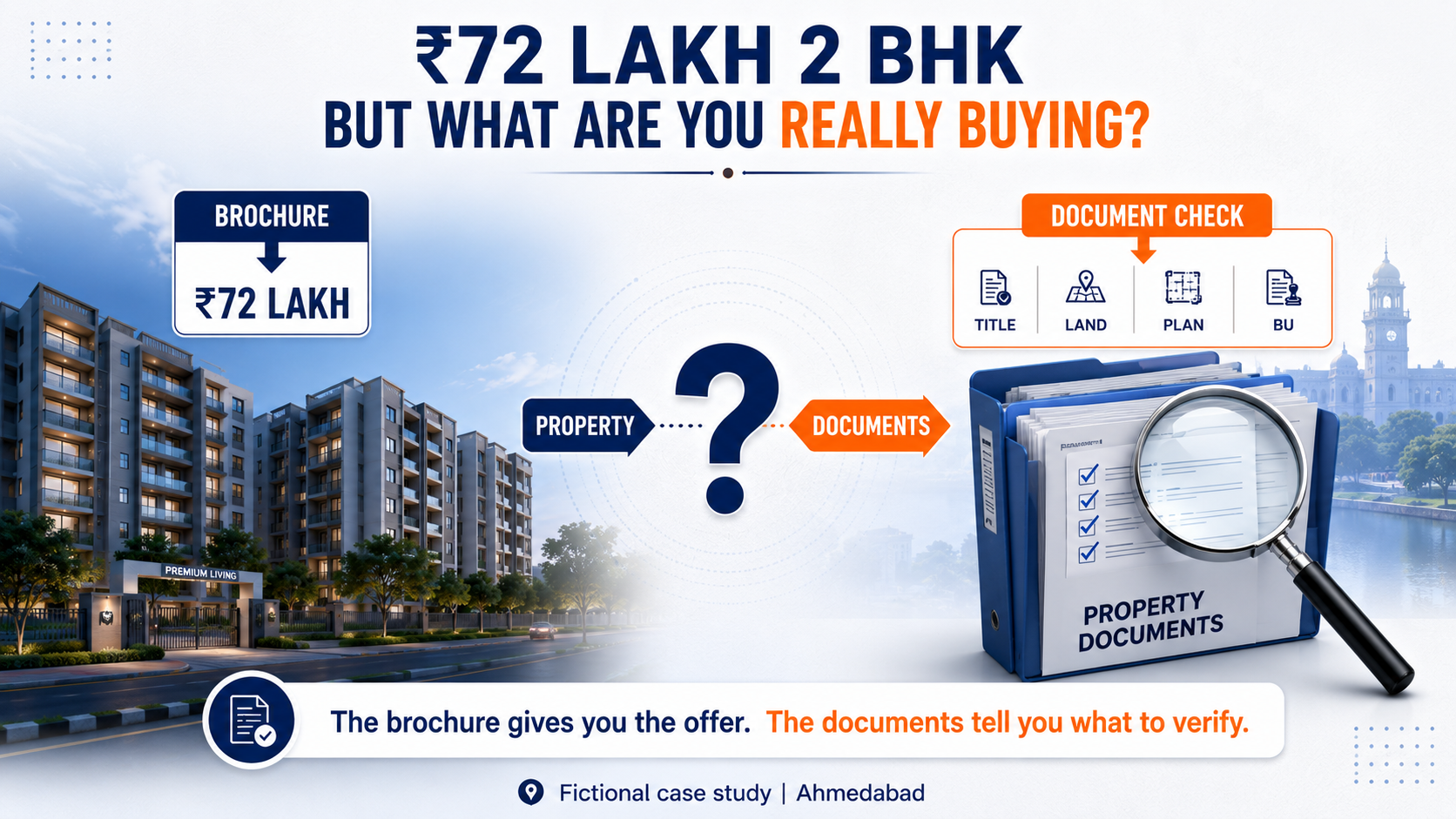
A document checklist becomes easier to understand when you see how a real buyer might use it. The following is a fictional example created only to demonstrate the verification process; it does not refer to any specific project or developer.
Suppose a buyer is considering a 2 BHK apartment in Ahmedabad priced at ₹72 lakh. The seller provides a brochure, price sheet, GujRERA details, land documents, NA order, approved plan and possession information. At first glance, the file appears complete.
Instead of assuming that a complete file means everything is verified, the buyer starts comparing the important details across the documents.
Finding 1: The Survey Number Does Not Match
The project information refers to:
Survey No. 125/1 + 125/2
But one of the documents provided mentions only:
Survey No. 125/1
This does not automatically mean there is a problem. The missing survey number could be covered by another document, a subsequent order or another relevant record.
Rather than rejecting the property or accepting a verbal explanation, the buyer asks:
"The project refers to Survey No. 125/1 and 125/2. Can you show me the document that covers Survey No. 125/2?"
This is the right approach to document verification: identify the difference, ask what explains it, and verify the explanation through the relevant document.
What the buyer learns
The purpose of the check is not to find faults in every document. It is to make sure that the land being used for the project is properly connected across the relevant records.
If the additional document explains the difference, the buyer can continue the review. If the difference remains unexplained, it should be investigated further before making a significant financial commitment.
What You Get With EXIO Property Advisory Firm
Finding a property is easy. Understanding whether the property deserves your attention is harder. Buyers often receive brochures, price sheets, approvals and project details from different sources, but comparing all of that information can be time-consuming—especially when important details are spread across multiple documents.
What EXIO Does Differently
EXIO helps buyers explore expert-verified property options with important project information brought together in one place. Instead of starting every property search from a blank page, buyers can review key details such as:
- Project and developer information
- Location and property type
- Configuration and available units
- Price and area details
- Possession timeline
- RERA information, where applicable
- Project approvals and available documentation
- Amenities and project specifications
- Location and investment insights
Properties featured through EXIO are evaluated through its 50-point technical, legal and spatial audit, helping buyers identify projects that meet defined verification criteria.
What This Means for a Buyer
EXIO is not a replacement for a property lawyer, government authority or independent technical professional. Instead, it helps buyers start with better information and understand which properties deserve a closer look.
Whether you are comparing two 2 BHKs in Ahmedabad, evaluating a new project in Gandhinagar or looking at an investment opportunity, the objective is to reduce the noise and make the initial property search more informed

Frequently Asked Questions
Before buying property in Gujarat, check the relevant title and ownership documents, 7/12 and 8A land records where applicable, mutation records, tenure details, NA permission, GujRERA information for qualifying projects, approved plans, BU or applicable occupancy documents, encumbrance/search records and society documents for resale properties.
Property ownership should be checked by reviewing the current title deed and the documents showing how the seller acquired the property. The relevant land records, such as 7/12, 8A and mutation information, should also be compared where applicable. A title review by a property lawyer can provide a more complete legal assessment.
Gujarat provides online access to land-record information through its official land-record services. Buyers can use the relevant survey or property details to locate the applicable record and then compare the information with the title and other property documents.
7/12 and 8A are different records within Gujarat's Record of Rights system. They provide different pieces of information about the land and holding. Depending on the property, both can be reviewed along with mutation records and title documents.
A buyer can review the project's GujRERA registration details and available disclosures, along with the relevant land, title, approval and project documents. The exact documents required can vary depending on the project and transaction.

