
 Login
 Check & match property
 Investment Advisory
 List Your Project
 Contact Us

The paperwork is ready, the payment is arranged, and the appointment is here. But what happens after you walk into the Sub-Registrar's Office?
From document checks and witness signatures to biometric verification and the final registration process, property registration in Gujarat involves several steps that buyers rarely understand beforehand. Whether you're visiting Memnagar or Bopal in Ahmedabad, Nanpura in Surat, or Akota in Vadodara, knowing what happens next can make the entire process easier to navigate.
Here’s what to expect, step by step, on registration day.

Before You Go - The Document Set, in Order
Do not arrive with unorganised folders or loose papers. Scrutiny officers at Gujarat Sub-Registrar Offices (SROs) handle dozens of files daily; an improperly ordered file is the primary cause of desk rejections and delayed token generation.
Organise your documents into one original dossier and two complete self-attested photocopy sets strictly in this order:
-
Appointment & Challan Receipts: The printed GARVI 2.0 booking confirmation with visible barcode, the Cyber Treasury registration fee cyber-receipt, and the physical e-Stamp certificate issued by SHCIL.
-
The Final Sale Deed (Dastavej): Printed on legal-size ledger paper with an unprinted 2-inch blank margin on the left side of every page for government endorsement seals, barcode stickers, and volume-page stamps.
-
Identity & Tax Proofs:
-
Buyer(s): Original physical Aadhaar card + PAN card (with 2 self-attested photocopies).
-
Seller(s): Original physical Aadhaar card + PAN card (with 2 self-attested photocopies).
-
If any party lacks a PAN: Duly filled Form 60/61 is legally required.
-
-
Ownership Chain & Revenue Proofs:
-
Latest Property Card (City Survey areas) or e-Dhara 7/12 & 8-A Extracts (rural/agricultural plots).
-
Sanctioned architectural layout plan and Rajachitthi/BU (Building Use) Permission.
-
Latest Municipal Property Tax Bill & clearance receipt (AMC, SMC, VMC, RMC).
-
Prior registered title deeds showing an unbroken chain of ownership.
-
-
Clearances & Compliance: Society NOC and the Form 26QB challan/acknowledgement for 1% TDS deduction under Section 194-IA if the property valuation is ₹50 Lakhs or higher.
-
Witness Packet: Self-attested copies of Aadhaar cards and PAN cards for both witnesses.
-
Photographs: 4 recent passport-size colour photographs of buyers, sellers, and Power of Attorney holders.

E-Stamping and How to Pay in Gujarat
Gujarat does not use physical non-judicial stamp papers for conveyances. All stamp duties must be remitted digitally via the Stock Holding Corporation of India Limited (SHCIL) or through the GARVI 2.0 portal (garvi.gujarat.gov.in).
Current Verified Duty & Fee Calculation
-
Valuation Baseline: Duty is calculated on whichever is higher: the actual sale consideration agreed in the contract, or the government-notified Jantri rate (circle rate).
Unsure whether your property's sale price meets the government baseline? Read our complete breakdown: Jantri Rate in Ahmedabad: What It Means for Property Buyers.
- Stamp Duty Rate: 4.9% across all buyers (composed of 3.5% basic stamp duty + 1.4% surcharge).
- Registration Fee: 1% of the assessed property valuation.
- The Sole-Female Buyer Waiver: Sole female buyers (or co-purchasers who are all female) receive a 100% waiver on the 1% registration fee.
- Joint Male-Female Purchases: If a husband and wife (or any male and female co-buyers) purchase property jointly, the full 1% registration fee is payable. There is no partial rebate.
| Ownership Structure | Stamp Duty | Registration Fee | Total Government Levies |
| Sole Male Buyer | 4.9% | 1.0% | 5.9% |
| Sole Female Buyer | 4.9% | 0.0% (Exempt) | 4.9% |
| Joint (Male + Female) | 4.9% | 1.0% | 5.9% |
| Joint (Female + Female) | 4.9% | 0.0% (Exempt) | 4.9% |
(Note: Keep ₹200 to ₹500 in physical cash notes for on-desk folio fees of ₹10 per page and Index-2 printing charges of around ₹50, where counter UPI scanners often encounter connectivity lags.)
Booking the Sub-Registrar Appointment
Walk-in registrations are not permitted under the automated GARVI system. Every appearance requires a pre-booked digital slot.
-
Access GARVI 2.0: Log in to
garvi.gujarat.gov.in. -
Public Data Entry (PDE): Enter buyer and seller identities, property boundaries (Chaturseema), TP/FP numbers, and Jantri valuation to generate a unique PDE ID.
-
Fee Remittance: Pay the registration charges and e-stamp via Cyber Treasury/e-Payment.
-
Reserve SRO Slot: Navigate to the "Slot Booking" tab, select your jurisdictional office (e.g., Ahmedabad SRO-5 Narol, SRO-1 Vadaj, Memnagar, Bopal, or Surat Nanpura), and select an open 15-to-30-minute window.
-
Print the Token Slip: Print the confirmation sheet displaying the time, office location, and QR/barcode.
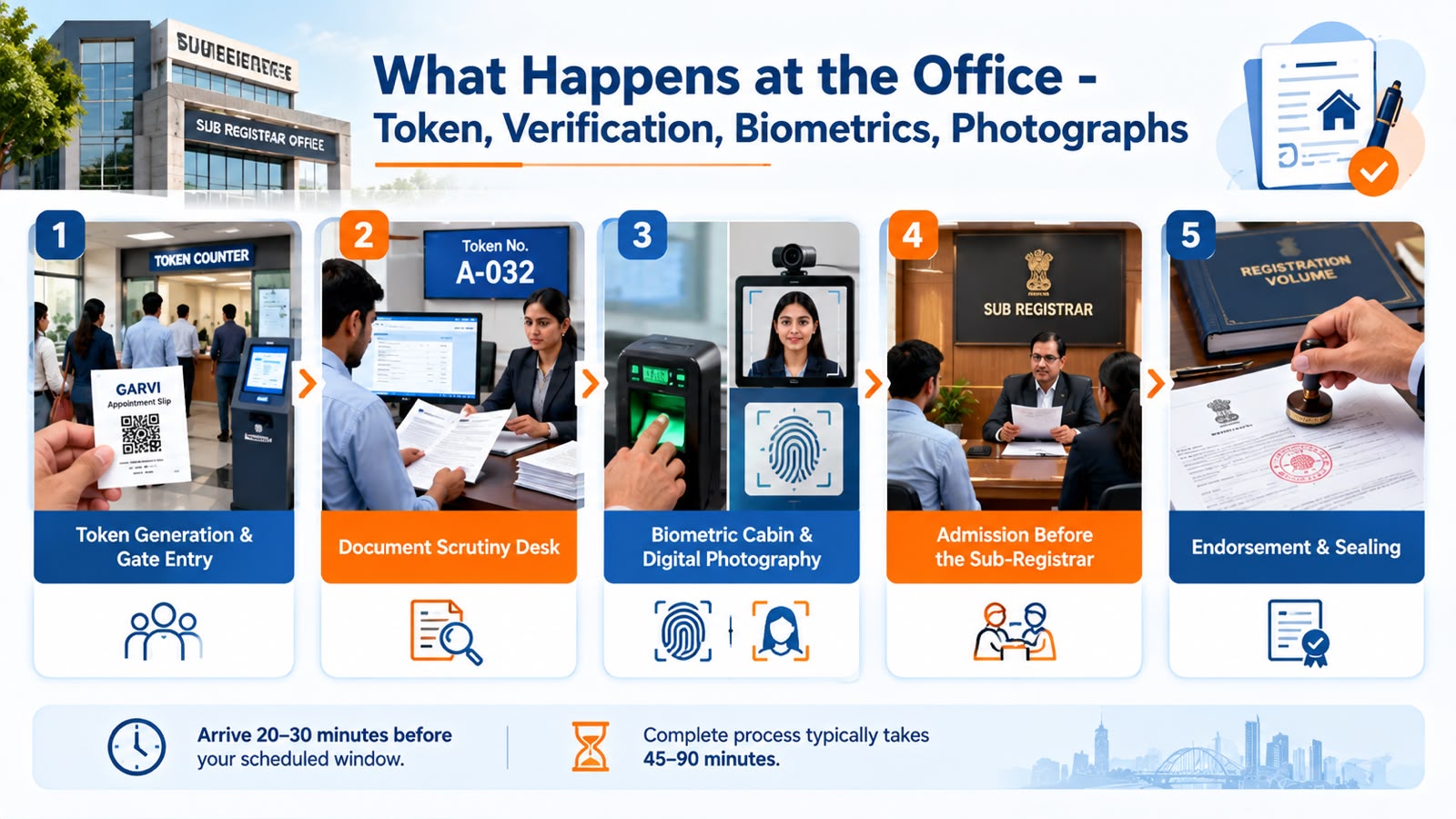

What Happens at the Office - Token, Verification, Biometrics, Photographs
Plan to arrive at the SRO 20 to 30 minutes before your scheduled window. The complete on-ground procedure typically takes 45 to 90 minutes.
1. Token Generation & Gate Entry: All parties, bank reps, and witnesses must be physically present.
Present your printed GARVI appointment slip at the intake counter. The attendant scans the barcode to ensure your slot is active and confirms that all participants are on-site before issuing a digital queue token.
2. Document Scrutiny Desk:Timing: Approx. 10–15 minutes.
When your token number appears on the monitor, proceed to the scrutiny officer. The clerk cross-verifies the physical draft deed against the data submitted in the GARVI database, auditing boundary limits, Jantri metrics, PAN records, and TDS Form 26QB payment receipts.
3. Biometric Cabin & Digital Photography: Keep hands clean and free of heavy henna or ink.
Both buyers, sellers, and both witnesses move to the biometric booth. A digital webcam takes a live facial photograph, and an optical scanner records digital thumbprints directly into the central state database.
4. Admission Before the Sub-Registrar: Statutory oral inquiry under the Registration Act.
All parties enter the Sub-Registrar's main chamber. The officer directly asks the seller statutory questions: "Have you received the agreed consideration in full?" and "Are you transferring this property willingly without duress?" Payment instrument references (Cheque/DD numbers, RTGS UTR codes) cited in the deed are confirmed.
5. Endorsement & Sealing: Legal registration complete.
Satisfied with the testimony, the Sub-Registrar affixes the government seal, records their official digital and physical signatures, and issues a formal registration volume and page number.
Witnesses: Who Can, Who Cannot
Under Sections 32 and 34 of the Registration Act, 1908, witnesses serve as legal identifiers, confirming under oath that the individuals executing the deed match the government IDs presented.
| Who CAN Be a Witness | Who CANNOT Be a Witness |
| Any Indian citizen aged 18+ with mental legal capacity | Minors (below 18 years of age) |
| Relatives, neighbours, friends, or property brokers | Anyone carrying only soft copies/photocopies of IDs |
| Adults with an original physical Aadhaar or Voter ID | A named buyer, seller, or direct financial beneficiary of the sale deed |
| Individuals able to sign consistently | Anyone unable to attend the biometric and photo capture session in person |
Both witnesses must sit for live webcam photographs, place their thumbprints on the digital scanner, and provide self-attested identity photocopies.
Reading the Deed Before You Sign It
Never let typing clerks or real estate intermediaries rush you into signing. Take five uninterrupted minutes at the SRO waiting lobby to run through this checklist:
-
Name Spelling & Identity Numbers: Ensure names, parentage, PAN, and Aadhaar numbers match your government identity cards character for character.
-
Property Schedule & Boundaries: Confirm the North, South, East, and West boundaries (Chaturseema), Flat/Plot number, Block number, and Town Planning (TP) / Final Plot (FP) numbers.
-
Financial Consideration: Confirm that the advance token, bank loan disbursement, and balance figures match in both numbers and written words.
-
Payment Instrument Identifiers: Verify that the RTGS UTR numbers, Demand Draft numbers, and bank account details in the text match your payment receipts.
-
TDS Compliance: Ensure your Form 26QB acknowledgement reference and TDS deduction figures are accurately cited.
After Registration - The Index Copy and What to Keep
Leaving the Sub-Registrar Office with your token receipt does not conclude the ownership transition.
-
Original Deed Collection: In computerised Gujarat SROs, physical deeds are scanned into the central database. If the scanning queue is clear, original stamped deeds are often returned to the buyer on the same afternoon or within 2 to 3 business days. (Note: If the purchase is financed by a mortgage, the bank's representative will retain the pickup slip to collect the original deed directly for their vault.)
-
Downloading the Index-2 (સૂચિ-૨):
-
The Index-2 is the state's certified ownership extract summarising the transaction.
-
Access
garvi.gujarat.gov.in, navigate to "Online Services" > "Index-2 Details", enter your SRO, registration year, and document number to download your signed digital copy.
-
-
Completing Revenue Mutation (Namfer):
-
SRO registration records the deed between buyer and seller; mutation updates the municipal or revenue ownership records.
-
Urban Properties: Submit your Index-2 copy to the local municipal ward office (AMC, SMC, VMC) to complete property tax name transfer (Namfer).
-
Rural/Agricultural Land: Check the AnyROR portal to confirm that the SRO system has triggered the automated pencil entry (Kachha Nond / Form 6 Entry).
-
NRI and POA Registration - What Changes
When either the buyer or seller is a Non-Resident Indian (NRI), or when execution occurs via a Power of Attorney (POA), stricter compliance standards apply:
-
Mandatory Registered POA: An unregistered or notarised-only POA cannot be used for property conveyances in Gujarat. The POA must be formally registered under the Registration Act.
-
Overseas Execution Protocol:
-
The POA must be executed before an Indian Consular/Embassy officer or an authorised Notary Public in the country of residence.
-
If executed in a Hague Convention country, the POA must carry an official Apostille certification.
-
Once the document reaches India, it must be presented to the Collector of Stamps / District Registrar for adjudication and stamping within 3 months before it can be presented to an SRO.
-
-
TDS on NRI Sellers (Section 195): The standard resident 1% TDS under Section 194-IA does not apply when purchasing from an NRI. The buyer must deduct TDS at 20% (plus applicable surcharge/cess), or the seller must present a valid Lower/Nil Tax Deduction Certificate under Section 197 issued by the Income Tax Department.
What Goes Wrong, and How to Avoid It
| Common Roadblock | Cause | Corrective Action |
| Margin Rejection | Deed printed with standard 1-inch margins | Re-print the deed immediately with a 2-inch left margin on all pages before approaching the scrutiny desk. |
| Biometric Scan Failure | Faint or worn fingerprints in elderly parties | Ask the scrutiny clerk to activate the Aadhaar OTP verification or officer manual photographic override. |
| Appointment Token Lock | Arriving 45+ minutes late for your slot | Report to the SRO head clerk for an emergency queue insertion, or reschedule via the GARVI portal for the next available slot. |
| TDS Mismatch Rejection | Form 26QB details do not match the seller's PAN | File an expedited PAN correction challan via the income tax TRACES portal before attending the SRO. |
| Title Chain Discrepancy | Missing an intermediate succession link | Carry certified copies of all historical deeds, probate orders, or death/succession certificates. |
Disclaimer
This article provides general educational and procedural guidance on property registration in Gujarat. EXIO is an independent real estate advisory firm and is not a government authority or a law firm. Registration requirements, stamp duty, Jantri rates, fees, and Sub-Registrar Office (SRO) procedures may change in accordance with applicable laws, government notifications, and local administrative requirements. While reasonable care has been taken to present the information accurately, readers should verify the latest requirements with the relevant government authorities before proceeding with a property transaction. This article does not constitute legal advice, tax advice, or a substitute for professional guidance. Readers are encouraged to consult a qualified advocate or property legal professional for transaction-specific advice and independent title verification before executing a conveyance deed.

Frequently Asked Questions
Gujarat SROs are open from 10:30 AM to 6:10 PM, Monday through Saturday (closed on 2nd and 4th Saturdays, Sundays, and public holidays). Public document presentations and biometric verifications usually conclude by 4:30 PM.
Under Section 23 of the Registration Act, a property deed must be presented for registration within 4 months from the date of execution (signing). If delayed due to unavoidable circumstances, the Registrar can permit registration within an additional 4-month window (up to 8 months total) subject to a penalty of up to 10 times the registration fee. Beyond 8 months, the deed cannot be registered.
Your paid stamp duty and registration fee do not expire or get forfeited. You can log in to the GARVI 2.0 portal (garvi.gujarat.gov.in) with your Data Entry Number (PDE ID), navigate to "Manage Appointment", and reschedule for the next available open slot at your Sub-Registrar Office without paying any extra government fees.
If worn or faint fingerprints cause repeated optical scanner failures for senior citizens, the Sub-Registrar follows state IGR contingency protocols. The officer can verify the individual via an Aadhaar-linked OTP authentication or record a manual, officer-attested biometric exemption alongside high-resolution live webcam photographs.
Yes, using a Registered Power of Attorney (POA). The POA must be signed before an Indian Consular/Embassy officer abroad (or apostilled in a Hague Convention country) and sent to Gujarat, where it must be adjudicated and stamped by the Collector of Stamps within 3 months of receipt before presentation at the Sub-Registrar Office.


