
 Login
 Check & match property
 Investment Advisory
 List Your Project
 Contact Us

Have you ever revisited a property after a year and wondered why its price has increased so much? Is it simply builder markup, or is something bigger changing across Ahmedabad's real estate market?
From rising land and construction costs to government charges and expanding infrastructure, several factors influence what buyers pay today.
But how much of this increase is justified by market fundamentals, and what does it mean for someone planning to buy a property?
Let's break down the real economics behind Ahmedabad's rising property prices.
1. The Real Cost Breakdown: Why Construction Costs Have Doubled
A residential flat is not just four walls of cement and bricks; it is an assembled industrial product subjected to commodity inflation. Over the last three to five years, basic construction costs per square foot have seen an industry-wide rise.

Essential Raw Material Escalation
Raw materials account for roughly 50% to 60% of direct on-site civil expenditure. Developers face steady increases across baseline inputs:
-
TMT Steel & Cement: Primary structural commodities subject to global energy and raw material rate fluctuations.
-
River Sand & Aggregates: High regional transport costs, quarry licensing fees, and local supply restrictions have made bulk aggregates significantly more expensive.
-
Aluminium & Architectural Glass: Premium facade works, anodised sliding windows, and structural railings have seen heavy price revisions.
-
Plumbing, Wiring & Finishing: Copper cables, CPVC conduits, branded bathroom fittings, vitrified tiles, and specialised waterproofing chemicals have risen due to petrochemical and metal inflation.
Even a small increase in these materials significantly impacts overall construction budgets, which is why understanding how to evaluate construction quality on-site is critical before committing to a purchase.
Specialised Labour Shortages and Wage Inflation
Modern high-rise towers (typically 14 to 22+ storeys across West Ahmedabad) require structural engineers, MEP consultants, RERA compliance officers, licensed crane operators, precision masons, and waterproofing technicians. General labor shortages coupled with mandatory safety compliance have driven daily contractor wage bills substantially higher.
2. Land Scarcity & The Gujarat Jantri Rate Revision
Land is a non-renewable asset. The biggest driver separating suburban budget housing from prime urban housing is the base cost of land.
The Impact of Jantri Rate Revisions
In Gujarat, the government-notified base value for property registration is the Jantri rate (circle rate). Recent state revisions in Jantri rates have directly affected developer balance sheets and buyer outlays:
-
Higher Acquisition Capital: When base Jantri values rise, land transactions become more capital-intensive, setting a higher starting floor price for any newly launched project.
-
Cost of Extra FSI (Floor Space Index): To build vertically, developers purchase Paid FSI or Premium FSI from municipal authorities (AMC/AUDA). Premium FSI fees are pegged directly to Jantri rates. When Jantri benchmarks rise, the statutory fee required to construct higher floors increases proportionally.
-
Stamp Duty & Registration: Buyers must pay stamp duty and registration fees on either the agreed sale value or the government Jantri value, whichever is higher.
To look up current benchmark rates across your micro-market, see our step-by-step tutorial on how to check and calculate Jantri Rate in Ahmedabad (2026 Guide).
3. Ahmedabad Micro-Market Price Landscape
Ahmedabad’s growth is asymmetric, heavily directed along western transit corridors and peripheral ring routes.
| Zone | Key Localities | Typical Price Band (Per Sq. Ft.) | Primary Growth Catalyst |
| Ultra-Prime West | Bodakdev, Ambli, Sindhu Bhavan Road (SBR), Thaltej | ₹8,000 – ₹13,000+ | High-net-worth demand, luxury high-rises, corporate headquarters |
| Established Growth | Shela, South Bopal, Science City, Bopal | ₹3,600 – ₹9,000 | Excellent schools, retail, social infrastructure, SP Ring Road access |
| North-West Corridor | Gota, Chandkheda, Vaishnodevi Circle, Tragad | ₹4,800 – ₹7,000 | Proximity to SG Highway, GIFT City connectivity, Metro accessibility |
| GIFT City Influence | Raysan, Koba, Kudasan, Gandhinagar PDPU belt | ₹5,200 – ₹7,500 | International financial services hub, tech influx, direct expressway |
| Industrial / East | Naroda, Nikol, Odhav, Vastral | ₹3,200 – ₹4,500 | Manufacturing corridors, mid-income end-user demand |
Note: Property prices are indicative, subject to market fluctuations, and may change over time based on project construction milestones and specific developer specifications.
4. Infrastructure Development as a Price Multiplier
Property values do not appreciate in isolation; they follow civic infrastructure. Ahmedabad has experienced rapid public infrastructure investment:
-
Ahmedabad Metro Rail Network: Phase 1 and Phase 2 expansions have connected APMC/Vasna to Motera, and extended further toward Gandhinagar and GIFT City. Properties within a 1 to 2 km radius of active metro stations have seen enhanced rental yields and resale value.
-
SP Ring Road Six-Laning & Flyovers: The widening of the Sardar Patel Ring Road and new grade separators along SG Highway have eliminated long-standing commute bottlenecks, allowing suburban pockets like Shela and Vaishnodevi to mature into prime residential districts.
-
The Sabarmati Riverfront Expansion: Phased expansion continues to elevate the aesthetic and civic status of surrounding river-facing catchments.
5. Modern Lifestyle Amenities: The Shift from "Flats" to "Gated Communities"
A decade ago, standard residential offerings included simple covered parking, a modest lobby, and a basic elevator. Today, homebuyer preferences have fundamentally shifted toward integrated lifestyle living:
-
Multi-tier clubhouses, temperature-controlled swimming pools, and dedicated banquet halls
-
Pre-installed EV charging stations, solar energy setups for common utilities, and rainwater harvesting units
-
Multi-level automated basement parking and high-speed passenger elevators
-
Smart gated access, 24/7 CCTV surveillance, and advanced fire sprinkler infrastructure across all floors
These amenities significantly increase initial engineering outlays and structural MEP work, raising delivery costs while improving long-term livability and asset durability.
6. Project Construction Stages & Price Escalation
One of the most misunderstood dynamics in real estate is why a project's price increases several times between ground breaking and handover. This escalation reflects a clear risk-to-value progression:

-
Excavation & Foundation Stage: Entry prices are lowest because the buyer assumes the longest waiting horizon and early execution risk.
-
RCC Structure Completion: As towers reach their full height, risk drops dramatically, prompting developers to issue scheduled price revisions.
-
Ready Possession / OC Received: At this stage, buyers can physically inspect the carpet area, view, and fixtures. Goods and Services Tax (GST) does not apply to fully completed units with an Occupancy Certificate (OC), which offsets part of the premium for ready-to-move properties.
7. Cost of Ownership: Budgeting Beyond the Base Square Foot Rate
When evaluating real estate in Ahmedabad, calculating affordability solely on the base quote leaves buyers unprepared for total acquisition costs. A complete budget must account for statutory and one-time expenses:
-
Base Property Cost: Carpet area rate × applicable chargeable area.
-
Goods and Services Tax (GST): 1% for affordable housing (units up to ₹45 Lakh subject to carpet limits) or 5% for standard residential units (without Input Tax Credit). Applicable only to under-construction properties.
-
Stamp Duty & Registration: In Gujarat, standard stamp duty is 4.9% with an additional 1% registration fee (women buyers are exempt from the 1% registration fee).
-
AUDA/AMC Legal & Development Charges: Infrastructure connection charges, legal drafting, and meter installation costs.
-
Advance Society Maintenance & Sinking Fund: Upfront corpus fund collected for community maintenance.
To calculate your exact registration outlay, refer to our line-by-line breakdown in the Gujarat Stamp Duty & Property Registration Charges 2026 Cost Sheet
8. Answers to Common Buyer Dilemmas
"Is the real estate price rise in Ahmedabad genuine or just marketing hype?"
The price rise in Ahmedabad is genuine and driven by fundamental market economics rather than marketing hype. Developers face real, industry-wide cost escalations, including rising wholesale prices for steel and cement, higher skilled labour wages, increased land acquisition costs, and higher municipal compliance charges. Combined with major infrastructure growth like the Metro expansion and Ring Road upgrades, these rising input costs create a higher baseline for property development across the city.
"Should I wait for Ahmedabad property prices to come down?"
Waiting for property prices to decline in a Tier-1 growth city like Ahmedabad has historically proven counterproductive. While speculative commercial land may see localised price plateaus, end-user residential housing in key corridors (SG Highway, Shela, Science City, Gota) rarely corrects downward. The cost of land and construction materials rarely deflates; waiting usually means paying a higher base rate later or having to compromise on unit layout and floor choice.
"Is real estate in Ahmedabad a safe hedge against inflation?"
Yes. Real estate is a physical asset backed by land and commodities. When macro inflation pushes up fuel, labour, and building materials, replacement costs for new construction automatically climb. This ensures existing properties appreciate in tandem with general economic inflation.
9. Final Advice for Homebuyers & Investors
Property price growth in Ahmedabad is supported by genuine economic activity, infrastructure expansion, and industrial employment rather than unchecked speculation.
To navigate this appreciating market effectively:
-
Verify RERA Filings: Check the project on the GujRERA portal for approved timelines, litigation, and layout sanctions.
-
Match Timeline to Finances: If you need immediate occupancy or rental income, focus on near-completion units. If your priority is maximum capital appreciation and lower cash outflow, consider early-stage projects by financially sound, established developers.
-
Look at the Micro-Market Infrastructure: Choose pockets benefiting from active infrastructure improvements, such as upcoming Metro stations, newly sanctioned flyovers, or high-capacity ring roads, to secure long-term value appreciation.
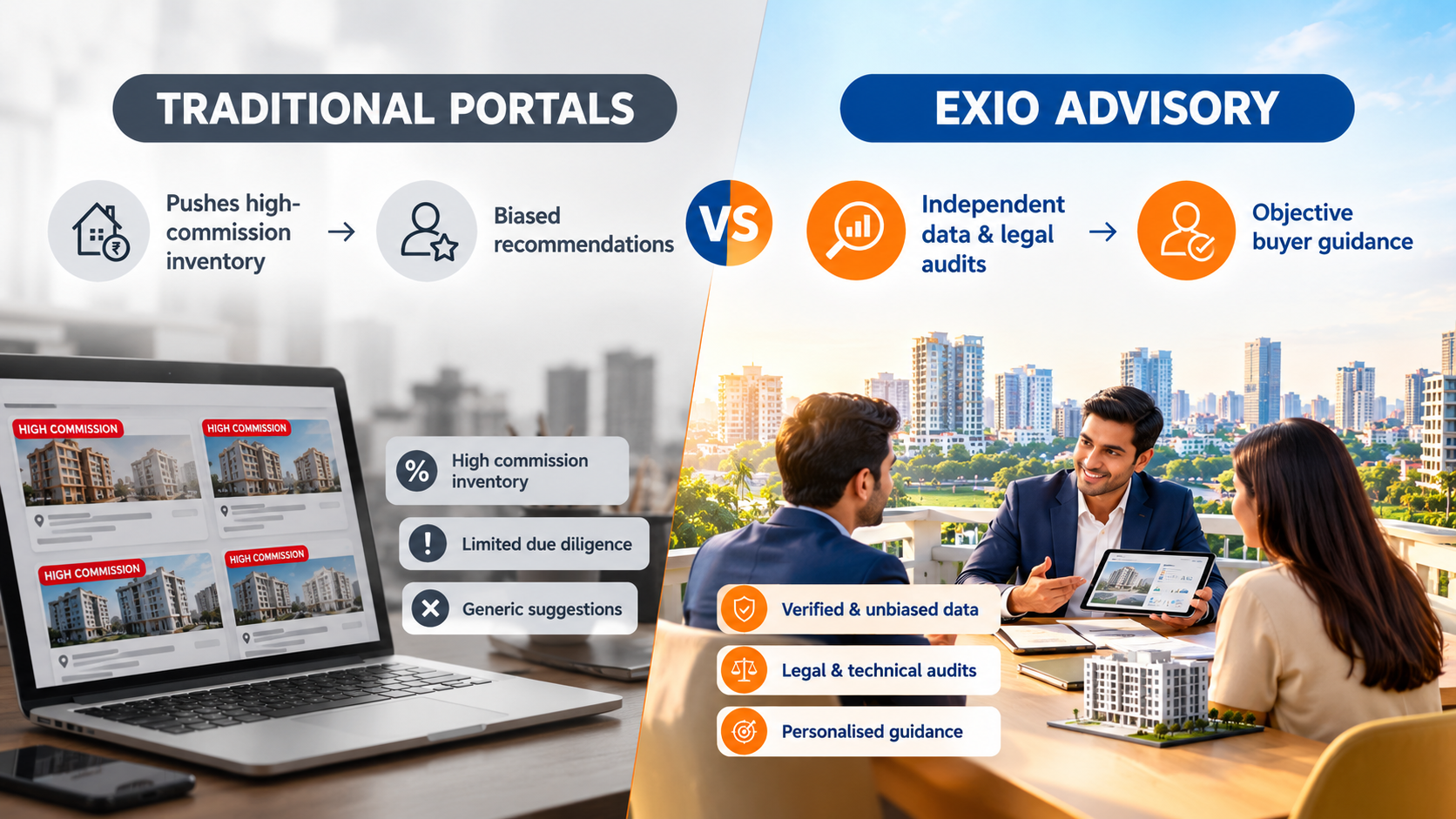

How EXIO Helps First-Time Homebuyers in Ahmedabad
Choosing the right property means looking far beyond sales brochures and sample flats. EXIO is an independent real estate advisory firm that helps buyers evaluate properties through technical inspections, legal background checks, ground-level neighbourhood research, and project comparisons. Instead of simply pushing inventory, EXIO checks whether a specific apartment or commercial space actually matches your financial goals.
What EXIO Checks Before You Put Money Down
-
50+ Point Property Inspection: We check every project for structural build quality, true usable room sizes, legal titles, government approvals, and practical day-to-day liveability.
-
Ground-Level Neighbourhood Research: Compare Ahmedabad areas based on real tenant demand, actual highway and metro access, and future supply pipelines, not just advertised growth claims.
-
Builder Background Verification: Look past big brand names to check whether the developer delivers projects on time, uses durable construction materials, and maintains healthy finances.
-
True Usable Space Analysis: Compare properties by their actual living area (RERA carpet area) so you never overpay for wasted common corridors or inflated super built-up claims.
-
Net Return Calculations: Get realistic profit projections that factor in government stamp duty, society maintenance bills, local property taxes, and expected vacancy periods.
-
Pre-Screened Projects: Access a curated list of legally clear, RERA-compliant projects so you do not waste time visiting problematic or delayed sites.
Already have a flat or office in mind?
Get an Independent Project Audit
Before you hand over token money or sign anything, let us run a ground check on it.
-
We calculate your actual usable carpet area (so you don’t pay for wasted corridors).
-
We check GujRERA records, land titles, and past builder delays.
-
We tell you honestly if the price is fair or inflated for that area.
(Send us the project name or brochure for an honest review)
Not sure where to invest your budget?
Book a Free 1-on-1 Consultation
Whether your budget is ₹50 Lakh or ₹2 Crore+, talk directly with our research team before you start visiting sites.
-
Find the right area for your goal (steady monthly rent vs. long-term appreciation).
-
Compare residential flats vs. commercial offices without sales pressure.
-
See only pre-verified, RERA-approved properties that pass our safety checks.
(No sales pitch. Just ground-level facts and numbers)
Disclaimer
The information provided in this article is for general informational and educational purposes only and does not constitute financial, legal, or investment advice. Property prices, statutory charges (including Jantri and FSI fees), and infrastructure timelines are indicative and subject to change per market conditions and regulatory updates. Readers are advised to exercise independent due diligence, verify project details and approvals directly on the official GujRERA portal, and consult a certified legal or financial advisor before making any purchase or investment decisions.

Frequently Asked Questions
Property prices in Ahmedabad are rising due to a combination of higher raw material costs (cement and steel), rising skilled labor wages, increased land acquisition costs, and major civic infrastructure projects like the Metro and Ring Road upgrades. In addition, higher statutory compliance charges and strong buyer demand across commercial and residential hubs continue to push base rates upward.
No. Price revisions reflect measurable cost increases across the entire building industry rather than an individual developer's decision. Builders face higher wholesale procurement costs for raw materials, revised government Jantri benchmarks, and higher municipal development fees, all of which directly determine the final project ticket size.
West and North Ahmedabad along major transit belts are recording the strongest appreciation. High-demand corridors include Sindhu Bhavan Road (SBR), Ambli, Science City, Shela, South Bopal, Gota, Vaishnodevi Circle, and the Gandhinagar/GIFT City corridor. Proximity to the SG Highway, SP Ring Road, and Metro Phase 2 drives this localized value surge.
The Jantri rate is the state government's minimum benchmark rate for land and property valuation. When Jantri rates increase, developers pay higher statutory fees for land acquisition and Premium Floor Space Index (FSI) to build high-rises. These higher pre-construction compliance costs are factored directly into the retail price per square foot.
Historically, residential prices in well-connected Ahmedabad micro-markets rarely decrease. Because underlying land values and construction commodity costs continue to rise, waiting often results in paying higher per-square-foot rates or missing out on preferred floor plans and unit views.
Yes. Real estate is a tangible asset backed by land and physical materials. As general economic inflation drives up machinery, fuel, labor, and building materials, replacement construction costs escalate. This structural cost floor protects existing property values and generates long-term capital appreciation alongside rental yield growth.
When purchasing a flat in Ahmedabad, you should budget an extra 10% to 12% over the base cost to cover statutory and ancillary expenses:
Stamp Duty & Registration: 4.9% stamp duty plus 1% registration fee (women buyers are exempt from the 1% registration fee).
GST: 1% for affordable housing (under ₹45 lakh subject to carpet area rules) or 5% for standard under-construction housing.
Other Charges: AUDA/AMC infrastructure charges, electricity/meter deposit, legal fees, and society maintenance/sinking funds.
Real estate prices naturally increase across construction milestones as project risk drops:
1. Launch / Excavation Stage: Lowest entry price, but with the longest construction timeline
2. Structure / Slab Completion: Prices rise as the physical tower becomes visible and completion certainty improves.
3. Possession / Ready-to-Move: Highest market price point, offering zero construction risk and 0% GST on completed units with an Occupancy Certificate (OC).
