
 Login
Login
 Investment Advisory
 Contact Us

If you had ₹1 crore to invest in property in Gujarat today, would Ahmedabad or Gandhinagar give you the better opportunity? At first, Ahmedabad may seem like the obvious choice. It has a larger real estate market, established residential neighbourhoods, major employment centres, extensive commercial activity and strong demand across areas such as Shela, South Bopal, Gota, SG Highway, SBR and Ambli. Gandhinagar, however, presents a very different proposition, with planned sectors, greener surroundings and growing economic influence from GIFT City, particularly across Kudasan, Sargasan, Raysan, Randesan and Koba.
But which city actually offers better value in 2026? A lower property price per sq. ft. does not necessarily mean a cheaper home. A property near a major infrastructure project does not automatically guarantee higher returns. And a premium project close to GIFT City may not always be a better investment than a well-priced property in an established Ahmedabad micro-market.
So the real questions are bigger:
- Is Ahmedabad better for property investment and resale liquidity?
- Is Gandhinagar better for long-term growth and planned living?
- Which city offers better options for a 2 BHK, 3 BHK or 4 BHK?
- Where can buyers find better rental demand and potential ROI?
- And could the Ahmedabad–Gandhinagar growth corridor offer better opportunities than either city alone?
This 2026 Ahmedabad vs Gandhinagar real estate comparison answers these questions using property prices, best residential areas, rental demand, investment factors, connectivity, GIFT City influence, infrastructure growth, lifestyle and property due diligence, helping homebuyers and investors compare the two markets at both the city and micro-market level.
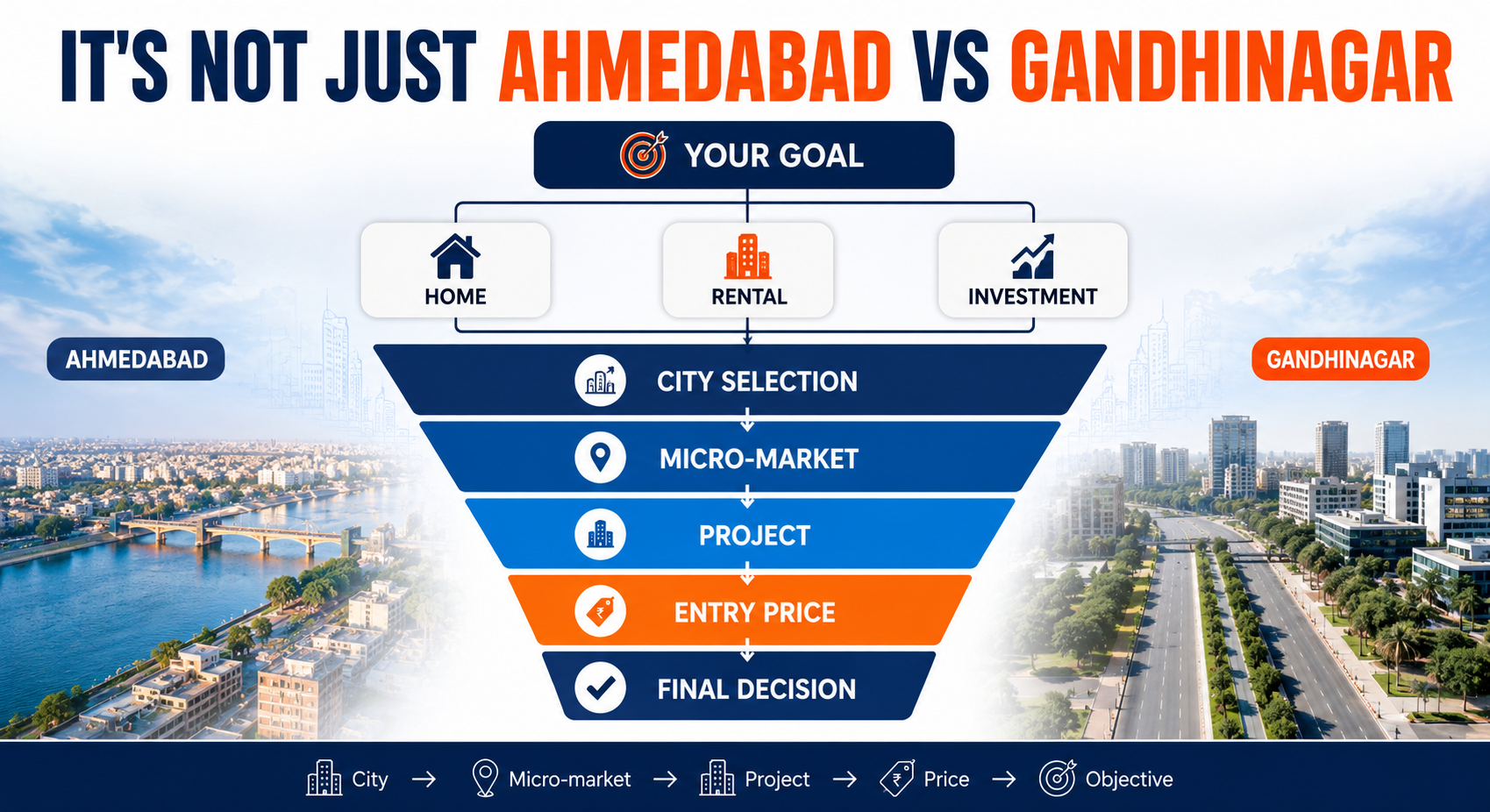
Quick Review: Ahmedabad vs Gandhinagar: Which Is Better for Property in 2026?
For most buyers, Ahmedabad remains the stronger choice for an established property market, wider housing options, consistent domestic rental demand, and rapid resale liquidity. Gandhinagar becomes significantly more attractive for buyers seeking master-planned urban development, proximity to GIFT City, lower density, greener surroundings, and long-term capital appreciation along the GIFT City growth corridor.
However, the right choice changes as soon as your budget, target asset type, micro-market, and core objective shift:
-
A ₹70 Lakh first-time homebuyer, a ₹1.5 Crore family upgrader, and a ₹3 Crore commercial investor require fundamentally different strategies.
-
Comparing Shela with GIFT City, or Gota with Kudasan, purely on city-wide average rates produces an inaccurate conclusion.
Priority-Wise Comparison Matrix: Ahmedabad vs. Gandhinagar
| Buyer Priority & Decision Factor | Ahmedabad Market Stance | Gandhinagar Market Stance |
| Property Market Depth | Strong Advantage (Deep, multi-segment market) | Growing (Expanding rapidly across outer sectors) |
| Choice of Residential Properties | Strong Advantage (Affordable high-rises to luxury villas) | Good (Sector schemes, new gated townships) |
| Rental Demand | Generally Stronger (Consistent city-wide domestic base) | Strong in Selected Corridors (High near GIFT & Infocity) |
| Resale Liquidity | Generally Stronger (Faster secondary market exits) | Micro-Market Dependent (High near Kudasan/Raysan) |
| Planned Urban Development | Good (Town Planning schemes across AUDA limits) | Strong Advantage (30-sector grid & GUDA zoning) |
| Green & Lower-Density Living | Good (Select suburban pockets) | Strong Advantage (Wider avenues & dense tree canopy) |
| GIFT City Proximity | North Ahmedabad Benefits (Motera, Chandkheda, Bhat) | Strong Advantage (Direct walk-to-work & fringe access) |
| Established Commercial Market | Strong Advantage (SG Highway, SBR corporate offices) | Growing (IT parks, institutional & fintech centers) |
| Lifestyle & Social Infrastructure | Strong Advantage (Retail high-streets, dining, hospitals) | Good & Expanding (Quiet, institutional, family-centric) |
| Long-Term GIFT City Exposure | Indirect (Spillover transit benefits) | Strong Advantage (Primary economic growth catalyst) |
| Twin-City Connectivity | Strong (SG Highway, SP Ring Road & Metro Phase 2) | Strong (Direct high-speed expressway & Metro access) |
Which City Scores Higher? Ahmedabad vs Gandhinagar 1–10 Scorecard
There is no single winner between Ahmedabad and Gandhinagar real estate. The better choice depends on what matters most to the buyer: property-market depth, connectivity, rental demand, planned development, lifestyle, GIFT City access or long-term investment potential.
To make the comparison easier, the following 1–10 scorecard evaluates Ahmedabad and Gandhinagar across the factors that typically influence a residential property purchase or investment.
EXIO Scorecard: Scores are comparative indicators, not guaranteed returns or property-price forecasts. Individual projects and micro-markets can perform very differently from the city-level score.
| Factor | Ahmedabad | Gandhinagar | What It Means |
|---|---|---|---|
| Property Market Depth | 9.5/10 | 7.5/10 | Ahmedabad offers a broader range of established residential and commercial markets. |
| Residential Choice | 9.5/10 | 8/10 | Ahmedabad provides more variety across budgets, configurations and development stages. |
| Rental Demand | 9/10 | 7.5/10 | Ahmedabad has a deeper and more diversified tenant base; Gandhinagar is stronger around selected employment and institutional hubs. |
| Resale Liquidity | 9/10 | 7.5/10 | Ahmedabad generally has a larger pool of buyers and established resale markets. |
| Connectivity | 9/10 | 8.5/10 | Both benefit from strong regional connectivity, but the practical advantage depends heavily on the location. |
| Planned Development | 7.5/10 | 9.5/10 | Gandhinagar's sector-based planning gives it an advantage in organised urban development. |
| Green & Open Environment | 7.5/10 | 9/10 | Gandhinagar generally offers more planned green spaces and lower-density surroundings. |
| Lifestyle & Social Infrastructure | 9.5/10 | 8/10 | Ahmedabad has a more mature ecosystem of retail, healthcare, education, dining and entertainment. |
| GIFT City Advantage | 7/10 | 10/10 | Gandhinagar has the strongest direct geographic relationship with GIFT City. |
| Commercial Market Depth | 9.5/10 | 8/10 | Ahmedabad has a much more established and diversified commercial ecosystem. |
| Long-Term Growth Potential | 9/10 | 9/10 | Both have strong growth drivers, but the drivers are different. |
| Overall Livability | 8.8/10 | 9/10 | Ahmedabad offers a broader urban ecosystem; Gandhinagar scores strongly on planning, greenery and lower-density living. |
| Overall Investment Environment | 9.2/10 | 8.7/10 | Ahmedabad has greater market depth; Gandhinagar has selective opportunities linked to planned growth and GIFT City. |
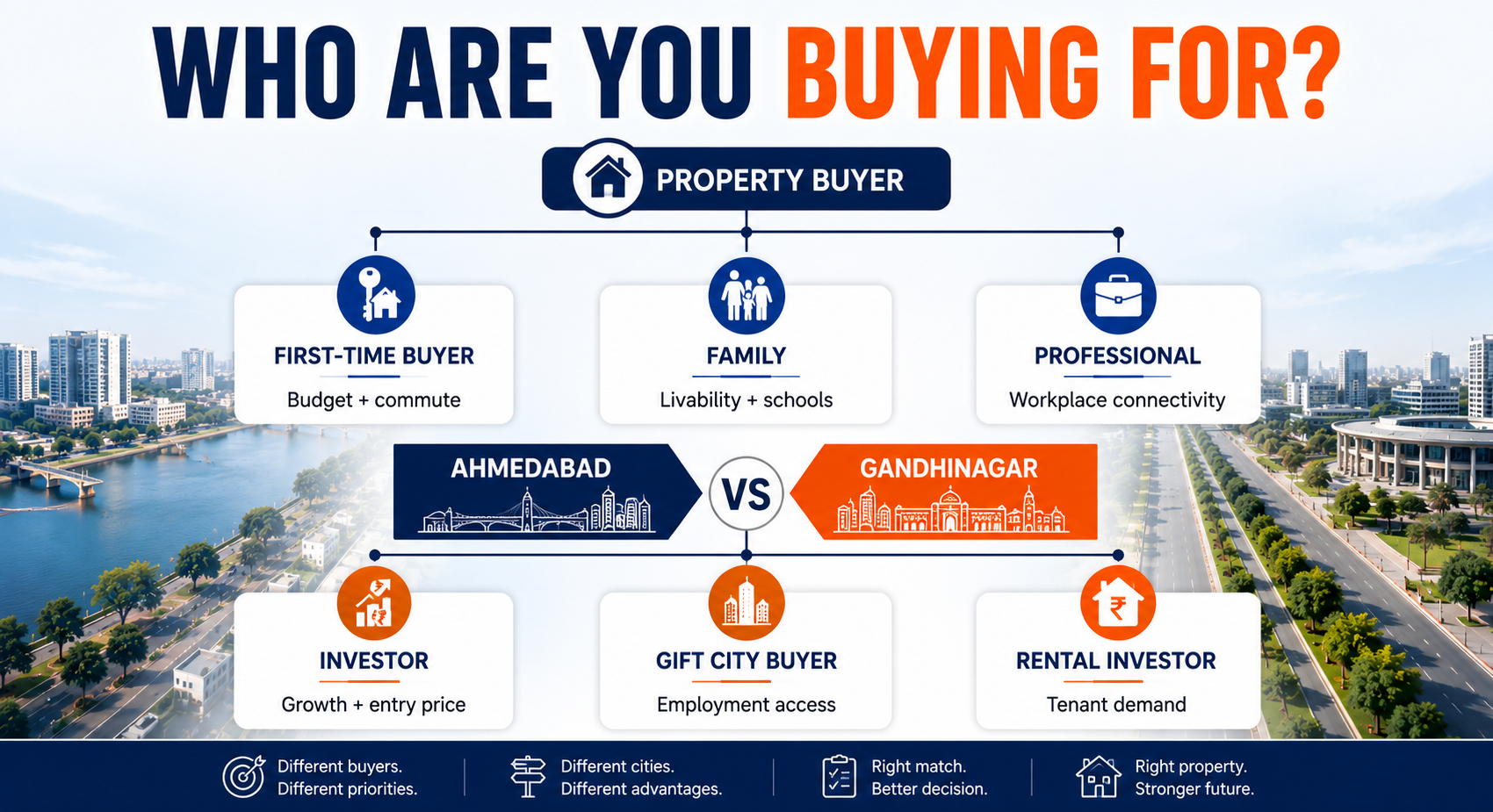
Where Should You Buy? Ahmedabad vs Gandhinagar by Buyer Type
There is no single winner between Ahmedabad and Gandhinagar for every property buyer. The optimal choice depends on why you are buying, where you work, your holding horizon, and what you expect from your investment. A family buying a home for the next 10 years values established schools, hospitals, and everyday convenience differently from an investor targeting future capital appreciation. Similarly, someone working in GIFT City has a completely different location priority from someone commuting daily to Prahlad Nagar or Sindhubhavan Road.
Quick Selection Matrix by Buyer Profile
| Buyer Profile | Recommended Location | Top Micro-Markets to Target | Core Deciding Factor |
| First-Time Homebuyer | Gandhinagar / Outer Ahmedabad | Sargasan, Vavol, Kudasan, South Bopal | 15%–22% more usable carpet area per Rupee |
| Family (End-Use Living) | Ahmedabad (Established) or Gandhinagar Sectors | Bodakdev, Science City, Raysan, Sectors 1–14 | School/hospital density vs. green, low-pollution living |
| Ahmedabad Commuter | Ahmedabad / Transition Belt | Prahlad Nagar, Shela, Vaishno Devi Circle | Keeping daily peak-hour commute under 30 minutes |
| GIFT City Professional | Gandhinagar (Influence Zone) | Raysan, Kudasan, PDPU Road, GIFT Core | Walk-to-work access or a sub-10-minute commute |
| Rental-Yield Investor | Gandhinagar (GIFT / Infocity Belt) | Kudasan, Infocity, Raysan | 4.5%–5.6% gross yields driven by corporate tenants |
| Long-Term Capital Growth | Gandhinagar / Bridge Corridors | Raysan, Koba Circle, GIFT City fringe | High appreciation driven by corporate expansion |
| Immediate Possession | Ahmedabad (Mature Hubs) / Developed Sectors | Gota, Thaltej, Chandkheda, Sargasan | Established municipal water, power, and retail |
1. First-Time Homebuyers: Which City Offers Better Value?
-
The Direct Verdict: Gandhinagar generally offers higher value for space-conscious first-time buyers by providing 15% to 22% more usable carpet area for the same budget. Ahmedabad provides a broader selection of established residential neighbourhoods with immediate retail access.
-
What to Check: Evaluate the all-inclusive total acquisition cost, not just the quoted base price:
Total Out-of-Pocket Cost Base Price + 4.9% Stamp Duty + 1% Registration
-
Where to Look:
-
Gandhinagar: Sargasan, Vavol, Kudasan (Spacious 2 & 3 BHK layouts with integrated clubhouse amenities).
-
Ahmedabad: Gota, South Bopal, Jagatpur, Tragad (Established high-density retail, BRTS, and transit access).
-
2. Families: Ahmedabad or Gandhinagar for Everyday Living?
Families: Ahmedabad or Gandhinagar for Everyday Living?
-
The Direct Verdict: Choose Ahmedabad if your daily routine depends on established private schooling networks (CBSE/IB), multi-speciality tertiary hospitals (KD Hospital, Zydus, Marengo CIMS), and vibrant weekend lifestyle hubs. Choose Gandhinagar if your priority is low-density living, clean air, and a 50%+ urban green canopy.
-
The Living Trade-Off:
-
Ahmedabad: Immediate convenience with supermarkets, coaching hubs, and dining within a 5-minute radius, balanced against higher traffic congestion along SG Highway and internal arterial junctions.
-
Gandhinagar: Planned 30-sector grid with dedicated green belts, wider internal roads, and municipal Narmada water connectivity.
-
3. Professionals Working in Ahmedabad: Where Should You Live?
-
The Direct Verdict: Live on the Ahmedabad side or along the North SG Highway bridge corridor (Vaishno Devi Circle / Tragad). Daily commuting friction outweighs long-term appreciation claims.
-
Commute & Transit Factors:
-
If your office is along Sindhubhavan Road (SBR), Corporate Road, or Prahlad Nagar, choose Shela, South Bopal, or Bodakdev to avoid cross-city highway bottlenecks.
-
If your office is in Central/North Ahmedabad, the operational Ahmedabad Metro Phase 2 connects Motera directly to Gandhinagar, making Motera, Chandkheda, and Sabarmati efficient transit-oriented choices.
-
4. Professionals Working in GIFT City: Should You Consider Gandhinagar?
-
The Direct Verdict: Yes. Living within the Kudasan–Raysan–PDPU Road corridor or central Gandhinagar sectors reduces daily commute times to under 10–15 minutes, providing a significant lifestyle and convenience advantage over commuting from West Ahmedabad.
-
What to Audit Before Buying:
-
Transit Links: Verify direct connectivity via the GIFT City spur road and the operational GNLU–GIFT City Metro line.
-
Living Environment: Differentiate between living inside core GIFT City (higher density, mixed-use commercial rules) and outer residential developments in Raysan/Kudasan (larger family-oriented gated communities).
-
5. Rental-Income Investors: Ahmedabad or Gandhinagar?
-
The Direct Verdict: Gandhinagar delivers higher gross residential rental yields (4.5%–5.6%), while Ahmedabad delivers stronger pre-leased commercial office yields (7.0%–8.2%).
-
Investor Strategy:
-
For Residential Cash Flow: Target 2 & 3 BHK apartments in Kudasan, Infocity, and Raysan that cater to steady corporate demand from BFSI, fintech, and IT professionals.
-
For High Occupancy & Resale Liquidity: Target 2 BHKs in Gota, Prahlad Nagar, or Shela, which maintain low vacancy rates due to local trade and domestic corporate workforces.
-
6. Long-Term Investors: Ahmedabad or Gandhinagar?
-
The Direct Verdict: Ahmedabad offers high-liquidity stability (7%–9% CAGR), while Gandhinagar offers high-velocity capital appreciation (10%–14% CAGR) driven by infrastructure expansion around GIFT City.
-
Market Characteristics:
-
Ahmedabad: A mature, deep domestic secondary market where asset liquidation is faster across both residential and commercial sectors.
-
Gandhinagar: Growth is driven by long-term government infrastructure, global financial institutional leases, and master-planned DP-2041 expansion. Focus selectively on high-absorption pockets rather than treating the capital as a uniform market.
-
7. Buyers Looking for Capital Appreciation: Which City Is Better?
-
The Direct Verdict: Capital appreciation is determined by the entry price and micro-market infrastructure catalysts, not the broad city name.
-
The Growth Equation: Capital Appreciation = Infrastructure Catalysts + Employment Growth + Supply Discipline - Entry Premium
-
Strategy: An overpriced luxury flat in an emerging fringe area will underperform a reasonably priced development situated in an active infrastructure corridor like Vaishno Devi Circle, Raysan, or Chandkheda.
8. Buyers Who Want Immediate Possession: Which City Makes More Sense?
-
The Direct Verdict: For immediate move-ins, prior completion track record and on-ground municipal infrastructure outweigh future master plans.
-
Checklist for Ready-to-Move Units:
-
Statutory Clearances: Confirm an authorised Building Use (BU) Permission and Fire NOC issued by the AMC (Ahmedabad) or GMC (Gandhinagar).
-
Actual Utilities: Verify functional municipal water connections (Narmada line vs. high-TDS borewell) and operational stormwater drainage.
-
Micro-Market Readiness: Mature areas like Thaltej, Satellite, Gota (Ahmedabad) or Sectors 1–16, Kudasan (Gandhinagar) provide immediate access to functional retail, schools, and transit without construction disturbance.
-
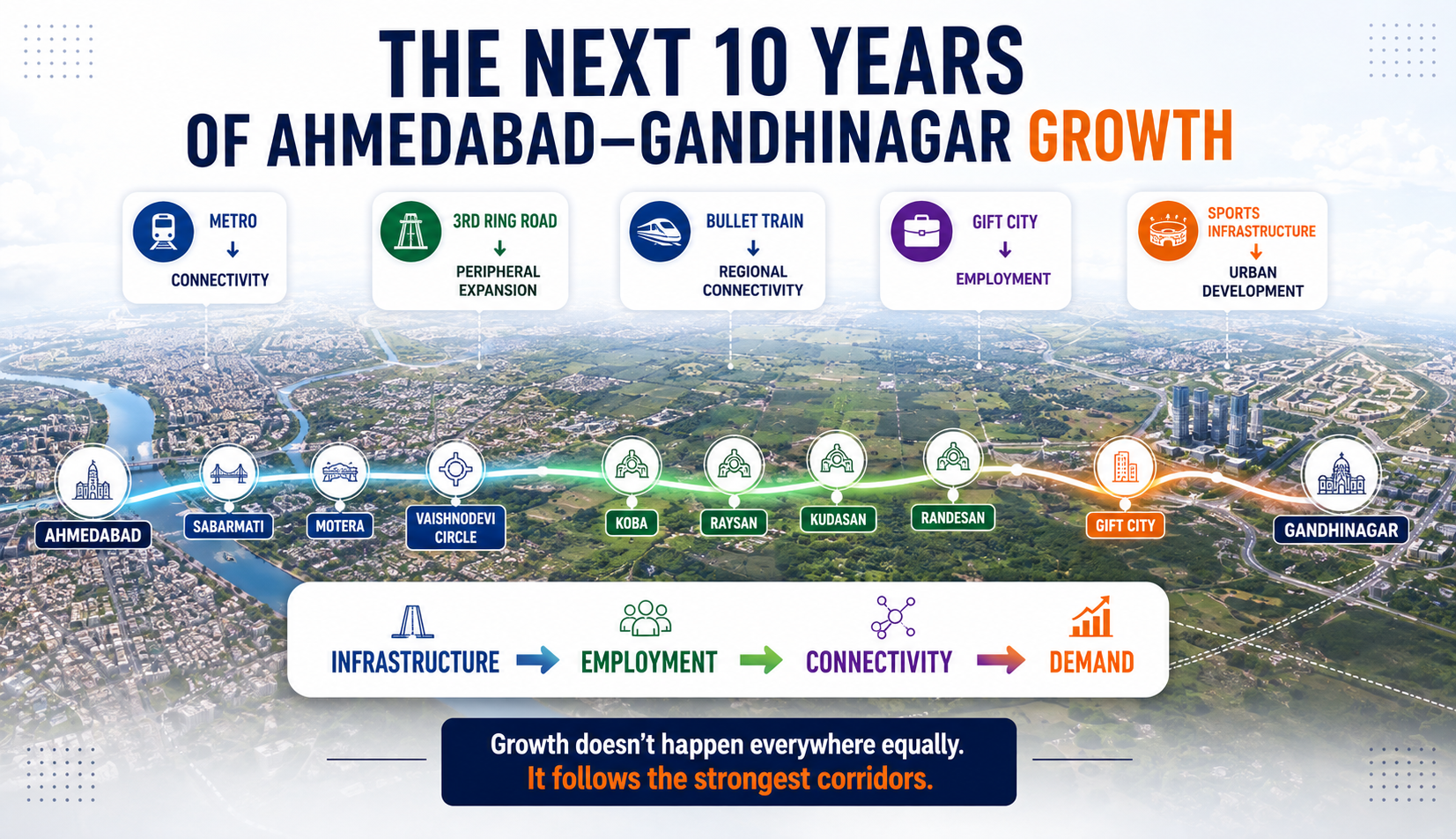
Ahmedabad, Gandhinagar Growth Story (2026–2036)
The next decade of capital appreciation across Gujarat's twin cities is driven by long-term, state-backed infrastructure frameworks. The urban boundary separating Ahmedabad and Gandhinagar has dissolved into an integrated polycentric megacity governed by unified transit, high-speed rail, and global financial zones.
| Infrastructure Catalyst | Project Scope & Corridor Focus | Completion / Status | Direct Impact on Real Estate | Primary Beneficiary Micro-Markets |
| AUDA–GUDA Megacity Merger (DP-2041) | Unified regional master planning covering 5,000+ sq. km. with standardised Town Planning (TP) schemes | Long-Term Blueprint (Horizon 2041) | Removes administrative boundaries; standardizes base and premium FSI (up to 4.0 in TOD zones); drives high-density vertical projects | Sanand, Kalol, Koba, Bhat, Khoraj, Godhavi |
| The 300-Ft 3rd Outer Ring Road | 300-foot-wide radial corridor (50% wider than current SP Ring Road) weaving through peripheral growth clusters | Phase-wise execution under self-financing TP models | Relieves inner highway congestion; accelerates suburban land monetization and planned township development | Outer Shela, Shilaj, Ognaj, Tragad, Kadi–Kalol belt |
| Ahmedabad Metro Phase 2 & 2A | 28.2+ km line connecting Motera $\leftrightarrow$ Mahatma Mandir, with operational GIFT City branch & approved Airport spur | Fully operational main corridors; Airport spur (Phase 2A) in execution | Yields a 12%–18% price premium and lower vacancy within a 1.5 km station radius; compresses cross-city commute to under 30 mins | Motera, Koba Circle, Infocity, Kudasan, Raysan, GIFT City |
| Bullet Train (MAHSR) Sabarmati Hub | 508 km High-Speed Rail corridor terminal integrating Bullet Train, Indian Railways, Metro, and BRTS | Operational integration phase | Cuts Ahmedabad–Mumbai transit to under 3 hours; turns North/Central Ahmedabad into a corporate satellite hub for Mumbai MNCs | Sabarmati, Ranip, Motera, Chandkheda, Usmanpura |
| GIFT City Expansion (1,000+ Acres) | Tripling footprint with riverfront reclamation; adding Global Capability Centers (GCCs), FinTech hubs & universities | Active Phase-wise expansion (2026–2030) | Sustains 4.5%–5.5% residential rental yields in adjacent Gandhinagar sectors due to 100,000+ corporate employee housing demand | Raysan, Kudasan, Randesan, Koba, GIFT Domestic Tariff Area (DTA) |
| 2036 Olympic Ambition & Sports Enclave | 236+ acre Sardar Patel Sports Enclave at Motera (₹6,000+ Cr) plus master-planned athlete villages on SP Ring Road | Multi-stage delivery leading up to international bid | Permanent upgrade of municipal drainage, multi-lane road networks, hospitality zones, and riverside infrastructure | Motera, Bhat, Sughad, Hansol, Northern SP Ring Road |
Detailed Breakdown of the 5 Growth Catalysts
1. AUDA, GUDA & Regional Urban Expansion (DP-2041)
-
Unified Development Plan 2041: The integration of AUDA and GUDA jurisdictions into a single regional authority eliminates conflicting zoning definitions. A unified Development Control Regulation (DCR) standardizes purchasable FSI, making cross-boundary development seamless.
-
Transit-Oriented Development (TOD): Higher allowable FSI along mass transit lines encourages vertical, mixed-use communities while safeguarding designated green belts in Gandhinagar's administrative sectors.
-
The 3rd Outer Ring Road Advantage: Utilising self-financing Town Planning (TP) schemes rather than prolonged land acquisition disputes ensures rapid arterial road execution across peripheral industrial-residential nodes.
2. Metro & Regional Connectivity
-
Seamless Cross-City Mobility: Ahmedabad Metro Phase 2 enables uninterrupted transit from central Ahmedabad directly to Gandhinagar's administrative core (Mahatma Mandir) and the GIFT City financial district.
-
Transit-Linked Valuation Premium: Rental properties within walking distance (1.0 to 1.5 km) of operational stations consistently experience lower vacancy periods and higher rental retention among working professionals.
3. Bullet Train / Sabarmati Multi-Modal Hub
-
Mumbai Corporate Integration: Linking Ahmedabad to Mumbai in under 3 hours encourages corporate firms to establish back-offices and GCCs in Ahmedabad to optimize commercial leasing costs.
-
Urban Infill & Society Redevelopment: Increased connectivity around the Sabarmati terminal is accelerating the redevelopment of aging low-rise residential societies in Central and North-West Ahmedabad into high-density commercial and premium residential towers.
4. GIFT City & Employment-Led Demand
-
The Employment Multiplier: As leading global banks, trading houses, and foreign university campuses scale up physical operations, the influx of high-income professionals drives sustained demand for quality housing.
-
The Outer Residential Belt: With core GIFT City focused largely on high-density commercial and serviced suites, nearby residential corridors (Raysan, Kudasan, Randesan) capture the majority of long-term family leasing demand.
5. Sports Infrastructure & 2036 Olympic Master Plan
-
World-Class Urban Infrastructure: Infrastructure work surrounding the 236-acre Sardar Vallabhbhai Patel Sports Enclave at Motera is driving comprehensive civic upgrades across the North Ahmedabad–South Gandhinagar boundary.
-
Long-Term Capital Preservation: Government-backed civic improvements (stormwater networks, power reliability, public green spaces) ensure strong downside protection for real estate investments in this catchment.
The 10-Year Investor Takeaway:
Strategic capital deployment between 2026 and 2036 should focus on growth-belt transition nodes (Vaishno Devi Circle, Koba Circle, Raysan, Motera) that sit directly at the convergence of Metro Phase 2, DP-2041 radial corridors, and the expanding GIFT City employment zone.
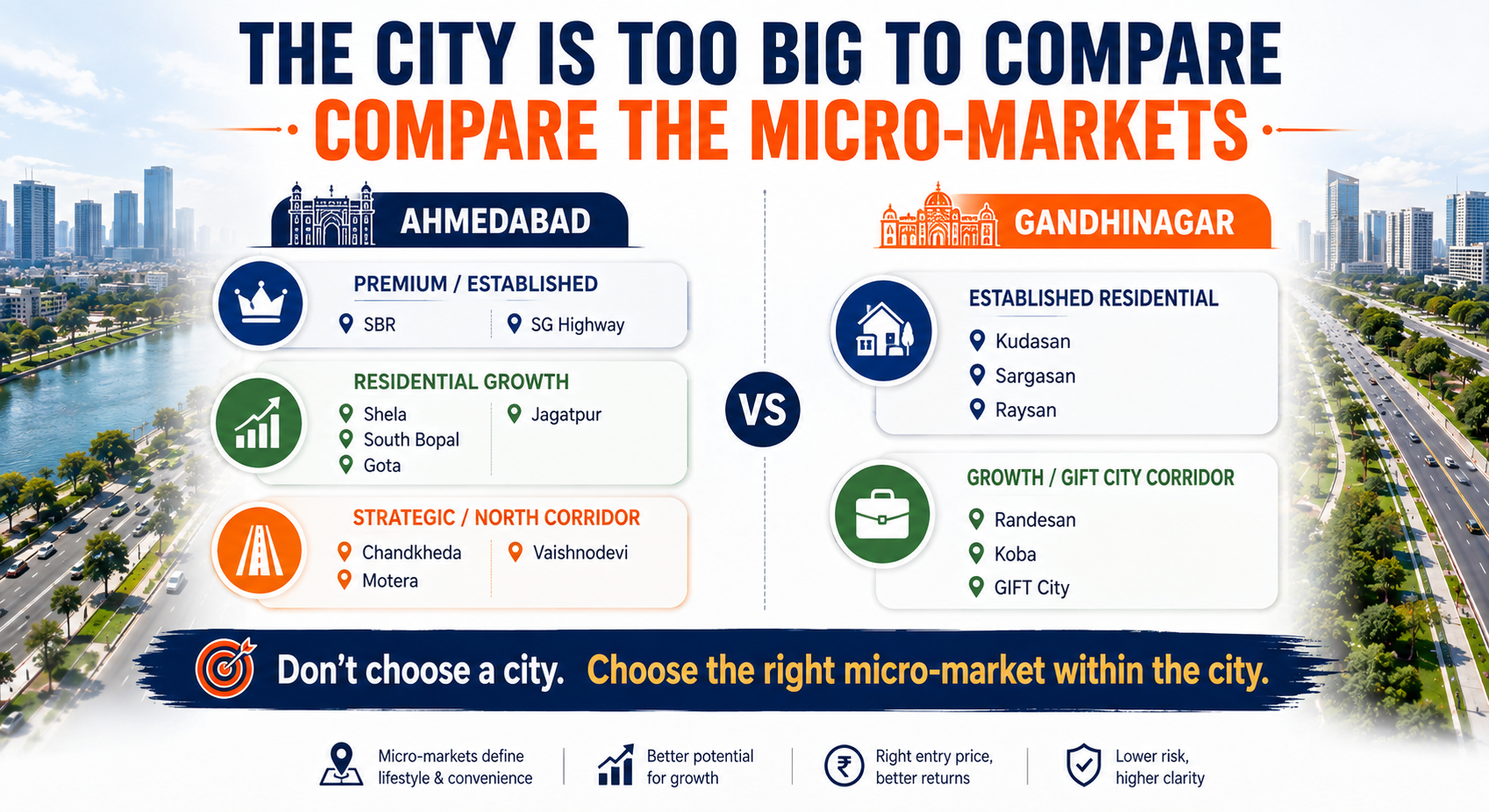
Ahmedabad vs Gandhinagar: Which Areas Should You Actually Consider?
Choosing a city is only the first step. The real decision happens at the micro-market level. Real estate dynamics in Gujarat vary significantly by location: Shela is fundamentally different from Bodakdev, and Kudasan operates under distinct demand drivers compared to Sargasan.
Instead of browsing an unstructured directory of pin codes, evaluate these primary residential corridors across Ahmedabad and Gandhinagar based on pricing, connectivity, and specific buyer profiles.
1. Ahmedabad Micro-Markets: Where to Look
-
Shela & South Bopal (Residential Growth & End-Use):
-
The Profile: Self-contained residential pockets characterised by modern gated communities, integrated clubhouses, and active retail high streets.
-
Why Consider It: Excellent internal livability with established schools and healthcare nearby. Ideal for families looking for modern amenities at a lower price than central western Ahmedabad.
-
-
SG Highway & Sindhubhavan Road / SBR (Premium Residential & Commercial Spine):
-
The Profile: The primary luxury residential and corporate headquarters belt in Gujarat.
-
Why Consider It: Home to high-end 4 & 5 BHK sky villas, fine-dining high-streets, and Grade-A commercial office parks. Best for high-net-worth buyers prioritizing status, social infrastructure, and corporate proximity.
-
-
Gota & Jagatpur (Mid-Segment Residential & Highway Connectivity):
-
The Profile: High-density, fast-absorbing residential markets along northern SG Highway.
-
Why Consider It: Offers practical entry-level 2 and 3 BHK housing with direct road links to SG Highway, Chandkheda, and Sanand/Viramgam industrial corridors.
-
-
Chandkheda & Motera (Established Residential & North Transit Node):
-
The Profile: Mature residential hubs with established social infrastructure, schools, and markets.
-
Why Consider It: Strong connectivity driven by the operational Ahmedabad Metro interchange, proximity to the Narendra Modi Stadium, and direct access to the Sabarmati multi-modal transport hub.
-
-
Vaishnodevi Circle & Shilaj (Developing Corridors & Strategic Connectivity):
-
The Profile: High-growth transition pockets positioned along the SP Ring Road and SG Highway intersection.
-
Why Consider It: Shilaj offers premium low-density living connecting to Sindhubhavan Extension, while Vaishnodevi Circle serves as a strategic launchpad for professionals commuting between Ahmedabad and Gandhinagar.
-
2. Gandhinagar Micro-Markets: Where to Look
-
Kudasan (Established Residential & High Rental Demand):
-
The Profile: One of the most mature private residential markets in Gandhinagar outside the administrative sectors.
-
Why Consider It: Generates the highest residential rental demand and gross yields (4.5%–5.6%) in the capital, supported by an influx of IT professionals from Infocity and corporate staff from GIFT City.
-
-
Sargasan (Residential Livability & Direct Highway Connectivity):
-
The Profile: A quiet, family-focused residential hub situated right along the SG Highway entry to Gandhinagar.
-
Why Consider It: Features spacious 3 BHK layouts with wide access roads and low traffic congestion. Provides a straightforward daily commute toward Ahmedabad while retaining Gandhinagar's green lifestyle.
-
-
Raysan & PDPU Road (Premium Residential & Institutional Ecosystem):
-
The Profile: An upscale, education-led corridor located along the Sabarmati Riverfront development zone.
-
Why Consider It: Attracts professors, senior corporate leadership, and institutional investors. Offers modern 3 & 4 BHK gated schemes with lower density and higher long-term capital stability.
-
-
Randesan (Close-In Proximity to GIFT City):
-
The Profile: A rapidly expanding residential node positioned between Raysan and the GIFT City boundary.
-
Why Consider It: Serves as a more affordable residential alternative to buying inside core GIFT City while keeping commute times under 5 to 7 minutes.
-
-
GIFT City & Koba Corridor (Employment-Led Commercial & Residential Demand):
-
The Profile: The primary international financial, technology, and transit growth spine.
-
Why Consider It: Inside GIFT City, high-density commercial and residential suites cater to global corporate tenants. Along the Koba corridor, developments offer rapid access to Ahmedabad International Airport and Gandhinagar Sector 1.
-
The EXIO Insight: The best area is not necessarily the one with the biggest future-growth headline. It is the micro-market where entry price, transit connectivity, verifiable tenant demand, construction quality, and your specific buying objective align.
Property Prices in Ahmedabad vs Gandhinagar: Where Does Your Budget Go Further?
When evaluating property across the Ahmedabad–Gandhinagar twin-city corridor, Gandhinagar generally offers 15% to 25% more usable carpet area per rupee compared to prime western Ahmedabad. However, raw price-per-square-foot comparisons can be misleading due to stark differences in micro-market maturity, commercial backing, and luxury positioning.
1. Price Per Square Foot & Ticket Size Overview
| City / Corridor | Average Price Range (₹/sq. ft.) | Typical 2 BHK Ticket Size | Typical 3 BHK Ticket Size |
| Ahmedabad (West Prime: SBR/Ambli) | ₹9,500 – ₹14,000+ | ₹90 L – ₹1.3 Cr | ₹1.8 Cr – ₹4.0 Cr+ |
| Ahmedabad (Mid-Ring: Shela/Gota) | ₹5,000 – ₹7,200 | ₹50 L – ₹75 L | ₹75 L – ₹1.25 Cr |
| Gandhinagar (Core GIFT City) | ₹10,200 – ₹13,800 | ₹85 L – ₹1.4 Cr | ₹1.5 Cr – ₹3.2 Cr |
| Gandhinagar (Outer Belt: Kudasan/Raysan) | ₹4,400 – ₹5,600 | ₹45 L – ₹65 L | ₹70 L – ₹1.25 Cr |
2. Budget-Wise Breakdown: What Can You Buy?
-
Under ₹60 Lakhs:
-
Ahmedabad: Compact 2 BHK in peripheral or developing nodes like outer Gota, Hanspura, or eastern pockets like Naroda.
-
Gandhinagar: Spacious 2 BHK or compact 3 BHK in Vavol, Sargasan, or Zundal.
-
-
₹75 Lakhs to ₹1.1 Crore:
-
Ahmedabad: Standard 3 BHK in high-absorption corridors like Shela, South Bopal, or Vaishno Devi Circle.
-
Gandhinagar: Premium, large-format 3 BHK with advanced clubhouse amenities in Kudasan, Raysan, or Randesan.
-
-
₹1.5 Crores to ₹2.5 Crores:
-
Ahmedabad: Premium 3 or 4 BHK high-rise apartment in Science City, Thaltej, or satellite zones.
-
Gandhinagar: High-end penthouse, independent gated villa, or executive serviced suite directly inside the core GIFT City financial hub.
-
-
₹2.5 Crores and Above:
-
Ahmedabad: Ultra-luxury 4/5 BHK sky villas and high-street contiguous units along Sindhubhavan Road (SBR) and Ambli.
-
Gandhinagar: Signature luxury bungalows or large commercial-residential hybrid portfolios near the PDPU/Raysan riverfront belt.
-
3. Key Cost Factors Beyond the Base Price
When calculating where your money stretches further, factor in the total acquisition cost:
-
Loading Ratios: Ahmedabad developers typically factor in 38% to 45% loading (difference between RERA carpet and super built-up area), whereas Gandhinagar residential projects often hover around 32% to 38%, yielding more functional indoor space.
-
Statutory Government Levies: Both cities share identical Gujarat state rates, 4.9% stamp duty (3.5% basic + 1.4% surcharge) and 1.0% registration fee (completely waived for sole female property owners).
-
Indirect Maintenance & IFMS: High-rise complexes on SBR carry higher monthly maintenance deposits (₹3 to ₹5 per sq. ft.) compared to equivalent gated communities in Gandhinagar sectors.
Note: If your priority is maximum indoor space, lower capital entry barriers, and strong residential rental yields (4.5%–5.6%), Gandhinagar’s peripheral sectors (Kudasan, Raysan, Sargasan) stretch your budget significantly further. If your priority is immediate resale liquidity, established lifestyle retail, and corporate office proximity, Ahmedabad's western corridors command a higher pricing premium.
Property Prices in Ahmedabad vs Gandhinagar: Where Does Your Budget Go Further?
A ₹75 lakh budget does not mean the same thing in every part of Ahmedabad or Gandhinagar. The final value depends on location, carpet area, project age, developer, connectivity, amenities and the total cost of purchase. In Ahmedabad, buyers can choose from a wide range of established and developing micro-markets, from premium corridors such as Sindhu Bhavan Road and SG Highway to comparatively value-oriented areas such as Gota and Jagatpur. Gandhinagar offers a different mix, including established residential sectors and growth corridors influenced by GIFT City and improving regional connectivity.
What Can You Expect at Different Budgets?
The exact property available will vary by project and location, but the following framework helps buyers understand how the decision changes as the budget increases.
| Budget Range | Ahmedabad | Gandhinagar | What to Compare |
|---|---|---|---|
| ₹50–75 lakh | More options across mid-segment and developing locations | Selected residential corridors and developing areas | Carpet area, commute, project quality |
| ₹75 lakh–₹1 crore | Wider choice across established and emerging micro-markets | More options in established residential areas and selected growth corridors | Location vs. size vs. amenities |
| ₹1–1.5 crore | Premium residential options in several established locations | Premium projects in selected residential corridors | Developer, location, specifications |
| ₹1.5 crore+ | Premium and luxury segments | Premium and luxury opportunities in selected locations | Quality, exclusivity, resale and long-term demand |
These are budget bands, not guaranteed property-price ranges. Actual prices vary significantly by project, configuration, floor, construction stage, location and specifications.
₹50–75 Lakh: Where Can First-Time Buyers Get Better Value?
At this budget, the biggest trade-off is usually location versus property size.
A buyer may find a larger home farther from established employment centres or a smaller home in a more established location. The same budget can therefore produce very different choices across Ahmedabad and Gandhinagar.
For buyers in this range, compare:
- Carpet area rather than only super built-up area
- Distance from the workplace
- Project possession status
- Developer track record
- Existing infrastructure
- Maintenance costs
- Public transport and road connectivity
- Future development around the project
Best approach: Don't choose a project simply because it offers the highest area for the lowest price. A lower purchase price can lose its advantage if the location creates a long commute or has weaker resale demand.
₹75 Lakh–₹1 Crore: More Choice, More Trade-Offs
This budget generally gives buyers greater flexibility, but it also creates more choices that need to be compared carefully.
In Ahmedabad, buyers can evaluate multiple established and developing residential micro-markets depending on their preferred location and configuration. In Gandhinagar, the same budget can be assessed across established residential areas and selected corridors benefiting from broader regional development.
At this stage, buyers should compare three things together:
1. Location
How well does the property connect to:
- Workplace
- Schools
- Healthcare
- Public transport
- Major roads
- Daily retail
2. Property
What are you actually getting?
- Carpet area
- Layout efficiency
- Construction quality
- Floor
- Parking
- Amenities
- Possession timeline
3. Price
What is the actual acquisition cost?
Don't compare only the headline property price. Include applicable charges such as registration, stamp duty, parking, maintenance deposits, floor-rise charges and other project-specific costs.
A ₹90 lakh property is not necessarily cheaper than a ₹95 lakh property if the second offers substantially better location, usable area or project quality.
₹1–1.5 Crore: Location Starts Matter Even More
At this budget, buyers usually have more flexibility. The decision is no longer only about finding a home that fits the budget; it is about finding a property that justifies where the money is being spent.
In Ahmedabad, this budget can open up options across established premium locations as well as newer growth corridors. In Gandhinagar, buyers can compare established residential areas with selected locations benefiting from proximity to GIFT City and the wider Ahmedabad–Gandhinagar corridor.
At this stage, location can become more important than simply getting additional square footage. A slightly smaller property in a well-connected, established micro-market may make more sense than a larger property in a location that still depends heavily on future development.
Before shortlisting a property, compare:
- Micro-market: Is the surrounding area already established, or is the investment based mainly on future development?
- Connectivity: How easily can you reach workplaces, major roads, metro stations, schools and healthcare?
- Developer track record: Has the developer delivered comparable projects successfully?
- Project quality: Does the construction, planning and specification justify the asking price?
- Neighbourhood: What already exists around the project, and what is realistically expected to develop?
- Resale demand: Would another buyer find this location and property attractive several years from now?
- Total purchase cost: What will you actually pay after applicable taxes, registration and project-specific charges?
At ₹1-1.5 crore, don't ask only, “How much property can I get?” Ask, “Which property deserves this level of capital?”
₹1.5 Crore+: The Decision Becomes More About Quality Than Affordability
Once the budget moves above ₹1.5 crore, the conversation changes again. Buyers are generally comparing premium or luxury properties, where paying more should translate into a meaningful improvement in location, construction, privacy, planning or overall living experience.
At this level, two properties with similar prices can offer very different value. One may have a stronger location and better construction, while another may rely heavily on branding, amenities or a larger floor plan to justify its premium.
For premium buyers, evaluate the property beyond the brochure:
- Location quality: Is the premium supported by the surrounding micro-market?
- Architecture and planning: Is the layout genuinely functional, or is the property simply larger?
- Construction quality: What specifications, materials and execution standards are being offered?
- Density and privacy: How many units, towers and residents will share the development?
- Amenities: Are the amenities genuinely useful, or is the project simply carrying a long amenity list?
- Views and orientation: Are these features likely to remain valuable, or could surrounding development change them?
- Developer credibility: Does the developer have a track record that supports the premium positioning?
- Long-term desirability: Would the property remain attractive to future buyers after the initial launch period?
- Resale potential: Is there likely to be a sufficient pool of buyers at this price point?
For an end user, the priority may be comfort, privacy and lifestyle quality. For an investor, the focus may shift toward demand depth, rental potential, liquidity and long-term capital preservation.
At ₹1.5 crore and above, the objective shouldn't be to buy the most expensive property available. It should be to identify the property where the premium is actually justified.
EXIO Insight
As the budget increases, the question changes from “What can I afford?” to “What deserves my capital?”
That distinction is important in both Ahmedabad and Gandhinagar because price alone does not establish value. The right comparison should consider the project, micro-market, developer, total acquisition cost and the buyer's purpose together.
Rental Income vs Capital Appreciation: Which Is Better in Ahmedabad or Gandhinagar?
Rental income and capital appreciation are two different reasons to invest in property. A property that attracts strong tenants today may not necessarily deliver the highest long-term price growth, while a developing location with future growth potential may take longer to generate strong rental demand.
That is why the better choice between Ahmedabad and Gandhinagar depends on what you want your property investment to achieve.
Ahmedabad vs Gandhinagar: Investment Comparison
| Investment Factor | Ahmedabad | Gandhinagar | What It Means for Investors |
|---|---|---|---|
| Residential Rental Demand | Strong across established residential and employment markets | Growing in selected locations, particularly around GIFT City and employment hubs | Ahmedabad offers broader established demand; Gandhinagar has selected growth pockets |
| Commercial Rental Potential | Diverse commercial ecosystem across multiple business corridors | More concentrated around GIFT City and selected commercial areas | Ahmedabad offers greater market depth; Gandhinagar offers targeted opportunities |
| Capital Appreciation Potential | Mature market with both established and emerging micro-markets | Selected corridors have strong growth drivers linked to infrastructure and GIFT City | Neither city is automatically better; micro-market and entry price matter |
| Resale Liquidity | Generally deeper buyer pool in established markets | Varies significantly by location and project | Ahmedabad may offer broader resale demand, while Gandhinagar depends more on the specific micro-market |
| Best Suited For | Investors seeking established demand and a wider choice of markets | Investors evaluating selected growth corridors and GIFT City-linked demand | The right choice depends on investment objective and holding period |
Rental Income: Where Does the Demand Come From?
For rental-focused investors, the first question should be who is likely to rent the property and why?
Ahmedabad has a broad employment and residential ecosystem, creating rental demand across several established locations. Gandhinagar's rental market is more closely tied to specific demand centres, including government and institutional activity, education, professional employment and the growing GIFT City ecosystem.
Before buying for rental income, evaluate:
-
Existing rental demand in the specific locality
-
Typical rent for comparable properties
-
Vacancy periods
-
Tenant profile
-
Proximity to employment and education hubs
-
Public transport and road connectivity
-
Maintenance and society charges
-
Competing rental inventory
-
Furnishing and property-management costs
A property with a higher advertised rental yield is not automatically a better investment if it experiences frequent vacancies or has high ongoing costs.
Capital Appreciation: What Actually Drives It?
Capital appreciation depends on more than the reputation of a city or a property's proximity to a major infrastructure project.
Key factors include:
-
Entry price: Buying at a realistic valuation leaves more room for future appreciation.
-
Connectivity: Roads, metro connectivity and access to employment centres can influence demand.
-
Employment growth: New business and employment hubs can create additional housing demand.
-
Supply: Excessive new inventory can affect future resale competition.
-
Micro-market maturity: Established areas and developing corridors can have very different growth profiles.
-
Project quality: Construction quality, planning and developer credibility influence long-term desirability.
-
Holding period: A short-term buyer has different requirements from someone investing for 7–10 years.
Gandhinagar's investment story is increasingly connected with the wider regional development around GIFT City and improving Ahmedabad–Gandhinagar connectivity. Ahmedabad, meanwhile, offers a larger and more diversified property market with both mature and developing micro-markets.
The important point is that infrastructure creates an opportunity, not a guaranteed return.
Ahmedabad or Gandhinagar: Which Is Better for Investors?
There is no universal winner.
Ahmedabad can make more sense for investors who prioritise established demand, a broader tenant and buyer pool, and access to multiple residential and commercial micro-markets.
Gandhinagar can be attractive for investors willing to evaluate selected growth corridors, particularly where employment, connectivity and development around GIFT City support genuine demand.
However, neither conclusion should be applied to every property in the city.
A premium project in an oversupplied location can perform differently from a well-priced project in an established demand centre. The same principle applies to an emerging Gandhinagar corridor.
Rental Yield vs Capital Appreciation: Which Should You Prioritise?
Your investment objective should determine what you measure.
If your priority is regular rental income, focus on tenant demand, realistic rent, vacancy risk and operating costs.
If your priority is long-term appreciation, focus more heavily on entry valuation, infrastructure, employment growth, supply, project quality and resale demand.
If you want both, look for a property where the rental case and long-term location fundamentals support each other rather than maximising one metric at the expense of the other.
EXIO Insight
Don't ask which city has the higher return. Ask which property has the stronger investment case at today's entry price.
Ahmedabad and Gandhinagar should not be treated as single investment markets. Each contains multiple micro-markets with different demand, supply, connectivity, rental activity and development characteristics.
Ahmedabad vs Gandhinagar: Which Is Better for Property Investment in 2026?
For pure property investment in 2026, Ahmedabad is the lower-risk, high-liquidity capital preservation market, while Gandhinagar is the high-yield, growth-oriented expansion market.
Quick Investment Scorecard (2026 Benchmarks)
| Investment Parameter | Ahmedabad Stance | Gandhinagar Stance | Top Micro-Market to Target |
| Residential Gross Rental Yield | 3.0% – 3.8% | 4.2% – 5.5% (Furnished/GIFT belt) | Kudasan, Raysan, Infocity Corridor |
| Commercial Pre-Leased Yield | 7.0% – 8.2% | 6.0% – 7.2% | SG Highway, Sindhubhavan Road (SBR) |
| 5-Year Projected Capital CAGR | 7% – 9% (Steady) | 10% – 14% (High Upside) | Raysan, Koba Circle, GIFT City Fringe |
| Secondary Market Exit Speed | High (30–60 days) | Moderate (60–120 days) | Shela, Gota, Satellite, Kudasan |
| Primary Tenant Demographics | Local trade, healthcare, service executives | FinTech talent, BFSI analysts, IT engineers | Infocity, GIFT City SEZ/DTA |
The 3 Core Investment Strategies in 2026
1. The Residential Rental Cash-Flow Play: Gandhinagar (Kudasan, Raysan, Sargasan)
-
Why It Works: Corporate tenants from GIFT City and Infocity prefer living 5–10 minutes from their offices in modern gated communities.
-
The Math: A ₹65–75 Lakh 2 BHK in Kudasan generates ₹25,000–₹32,000/month when furnished for corporate executive leasing, delivering an all-inclusive gross yield of 4.5% to 5.5% (compared to city-wide averages of 3.2%–3.8% in Ahmedabad).
2. The Institutional Commercial Cash-Flow Play: Ahmedabad (SG Highway / SBR)
-
Why It Works: Ahmedabad is Gujarat's commercial engine. Grade-A office buildings along the western transit spine host multinational Global Capability Centres (GCCs), national corporate HQs, and tech firms with 5-to-9-year lock-in lease agreements.
-
The Math: Pre-leased office suites deliver dependable 7.0% to 8.2% annual net yields with standard 15% contractual rent escalations every 3 years.
3. The Maximum Capital Growth Play: The GIFT City Influence Belt
-
Why It Works: Infrastructure additions, such as the operational Ahmedabad Metro Phase 2, new riverfront reclamation zones, and global financial institutional setups, continue to drive percentage-based price growth across adjacent sectors (Raysan, Randesan, Koba).
Investment Due Diligence: 3 Realities to Verify Before Deploying Capital
-
Core GIFT City vs. Influence Belt Yields: Property inside core GIFT City commands high capital rates (₹10,500–₹14,000+/sq. ft.), which compresses entry rental yields to ~3.0%–3.5%. For rental cash flow, outer residential sectors (Kudasan/Raysan at ₹4,500–₹5,500/sq. ft.) offer a higher rent-to-price ratio.
-
Resale Liquidity Timelines: Ahmedabad's large domestic buyer pool ensures faster liquidity if you need to exit. Gandhinagar investments should be evaluated with a 3-to-7-year holding period to capture the full infrastructure appreciation curve.
-
Statutory Acquisition Costs: Always factor in the Gujarat property acquisition load (4.9% Stamp Duty + 1.0% Registration Fee + 5% under-construction GST) when calculating your net annualized ROI.
Final Investment Verdict
-
Choose Gandhinagar if: You are investing in residential property to maximise monthly rental cash flow (4.5%–5.5%) and capture high-percentage capital growth driven by GIFT City's institutional expansion.
-
Choose Ahmedabad if: You are investing in Grade-A commercial real estate for institutional cash flows (7.0%–8.2%), or want a residential property with fast secondary-market resale liquidity.
How EXIO Helps You Make a Better Property Decision
Choosing between Ahmedabad and Gandhinagar is only the foundation. The decisive factor is whether the individual property you select aligns with your target budget, family requirements, and long-term investment return goals. As an independent real estate advisory firm and property consultancy in Ahmedabad and Gandhinagar, EXIO approaches real estate through rigorous research, direct developer transparency, and technical due diligence, moving beyond basic listing aggregators and traditional brokerage.
What EXIO Audits Before Recommending a Project
1. RERA & Statutory Legal Verification (20% Weight):
Every project is cross-referenced against the GujRERA portal and state revenue records (AnyRoR). We audit title deeds, Non-Agricultural (NA) zoning orders, environmental clearances, and verify that buyer payments flow strictly into the sanctioned 70% project escrow account to prevent diversion of construction funds.
2. Builder Track Record & Financial Stability (20% Weight):
We evaluate the developer's historical execution velocity, past delivery track records, litigation history, and financial stability to safeguard buyers against construction delays.
3. Construction Quality & Spatial Efficiency (25% Weight):
Our engineering teams analyze structural specifications (e.g., aluminum formwork/Mivan vs. conventional RCC), internal floor-to-ceiling heights, plumbing layouts, and actual usable RERA carpet areas to ensure developer loading remains balanced (avoiding hidden 45%+ common area loading).
4. Location Infrastructure & Micro-Market ROI (20% Weight):
We evaluate municipal potable water availability (Narmada line vs. high-TDS borewells), stormwater drainage resilience, planned Town Planning (TP) road reservations, and proximity to major employment hubs like GIFT City, Infocity, or SG Highway.
5. Amenities & Functional Usability (15% Weight):
Amenities are audited for operational practicality and long-term maintenance costs (such as EV charging infrastructure, dedicated car parking ratios, and clubhouse design) rather than superficial marketing claims.
Full Blog about EXIO Audit system: How the Exio Rating Actually Works: Inside the 50+Point Audit
Why an Independent Real Estate Advisory Approach Matters
A property can feature an attractive marketing brochure or an appealing launch price and still fail to meet a buyer's core requirements:
-
An emerging high-rise in Raysan may deliver high rental yields for an investor targeting corporate tenants in GIFT City, but could be impractical for a family with daily commutes to corporate centers on Sindhubhavan Road.
-
A residential project in Shela or Gota might offer high resale liquidity, but require careful evaluation of internal carpet efficiency and local traffic congestion.
EXIO starts with your buying objective, whether capital preservation, rental cash flow, or long-term family living, and evaluates properties against that standard.
The EXIO Advisory Methodology
-
Objective Mapping: Define your holding horizon, target yields, and spatial needs.
-
Micro-Market Shortlisting: Filter specific corridors across Ahmedabad and Gandhinagar based on commute and infrastructure catalysts.
-
50-Point Technical & Legal Audit: Eliminate projects with documentation gaps, high loading, or structural compromises.
-
Direct Developer Connection: Engage directly with verified developer leadership at transparent pricing, with zero broker spam and full technical clarity.
-
For Homebuyers & Investors: Consult with an EXIO Real Estate Advisor in Ahmedabad
-
For Developers & Builders: Submit Your Project for 50-Point Technical Verification & Onboarding
Disclaimer
All property prices, square-footage figures, rental yields, market data and statutory charges mentioned in this guide are indicative and provided for general market reference only. Actual property values and costs may vary depending on factors such as location, floor, unit orientation, developer pricing, construction stage, specifications, applicable charges and individual transaction terms. This publication is provided for general informational purposes and does not constitute an offer, solicitation, legal advice, financial advice or investment recommendation. Buyers and investors should independently verify applicable project RERA registration details, title and ownership records, Building Use (BU) permissions, approvals and other relevant documents before making any financial commitment. EXIO does not guarantee property prices, rental returns, capital appreciation or investment outcomes. Readers should seek appropriate legal, financial or professional advice based on their individual circumstances before proceeding with a property transaction.

Frequently Asked Questions
For Luxury End-Users: Sindhubhavan Road (SBR), Ambli–Bopal Road, Bodakdev, and Satellite.
For Family Living & Mid-Segment Budgets: Shela, South Bopal, Science City, and Vaishno Devi Circle.
For High-Density Value & Investors: Gota, Jagatpur, Tragad, and Chandkheda.
The top micro-markets in Gandhinagar include:
Raysan & PDPU Road: Premium high-rises and executive housing with Sabarmati riverfront access.
Kudasan & Infocity Belt: Highest tenant occupancy and gross rental yields.
Sargasan & Randesan: Family-centric gated communities with direct highway connectivity to Ahmedabad.
GIFT City (SEZ/Non-SEZ): High-capital commercial suites and walk-to-work serviced apartments.
Buying inside GIFT City is best for commercial investors and high-net-worth buyers targeting global institutional tenants, walk-to-work convenience, and high capital prestige at entry rates above ₹10,500/sq. ft. Buying in adjacent areas (Kudasan, Raysan, Koba) offers lower capital entry barriers (₹4,400–₹5,600/sq. ft.), standard family amenities, and strong tenant demand from professionals working inside GIFT City.
AUDA (Ahmedabad Urban Development Authority) governs urban growth, high-density Transit-Oriented Development (TOD) along the BRTS and Metro, and higher base FSI in Ahmedabad. GUDA (Gandhinagar Urban Development Authority) governs the master-planned grid sectors, enforcing lower building density, wider road setbacks, and designated green zones surrounding Gandhinagar.
Statutory property acquisition costs in Gujarat are:
Total Stamp Duty: 4.9% (3.5% basic stamp duty + 1.4% municipal/district surcharge).
Registration Fee: 1.0% of the transaction value.
Female Buyer Concession: The 1.0% registration fee is 100% exempted for sole female property buyers in Gujarat.
Before paying a booking token,
verify:7/12 & 8-A Land Records: Revenue ownership chain via the Gujarat government's AnyRoR portal.
Non-Agricultural (NA) Order: Collector-issued residential/commercial zoning clearance.
Active GujRERA Registration: Sanctioned project completion dates and 70% construction escrow accounts on gujrera.gujarat.gov.in.
Building Use (BU) Permission & Fire NOC: Authorised AMC/GMC municipal occupancy clearance for completed buildings.
Ahmedabad Metro Phase 2 directly connects Motera in Ahmedabad to Mahatma Mandir and GIFT City in Gandhinagar. Residential and commercial developments within a 1.0 to 1.5 km radius of operational metro stations have seen higher rental occupancy, shorter vacancy cycles, and a 12% to 18% valuation premium over non-transit-connected corridors.
Choose Ahmedabad if your priority is resale liquidity, large domestic secondary markets, established school/hospital infrastructure, or commercial office cash flow (SG Highway).
Choose Gandhinagar if your priority is
higher residential rental returns (4.5%–5.6%), percentage-led capital growth driven by GIFT City, and planned, low-pollution living environments.
Gandhinagar offers higher residential rental yields (4.5% to 5.6%), concentrated in the Kudasan, Raysan, and GIFT City influence zones due to strong corporate tenant demand. Ahmedabad yields 3.0% to 3.8% for residential properties, but delivers higher commercial pre-leased yields (7.0% to 8.2%) along the SG Highway and Sindhubhavan Road (SBR) corporate corridor.
In Ahmedabad, residential property prices range from ₹5,000 to ₹7,200/sq. ft. in developing suburbs (Gota, Shela, South Bopal) and ₹8,500 to ₹14,000+/sq. ft. in prime luxury corridors (Bodakdev, Ambli, SBR). In Gandhinagar, rates range from ₹4,200 to ₹5,600/sq. ft. across residential sectors (Kudasan, Raysan, Sargasan) and ₹10,500 to ₹13,800/sq. ft. within the core GIFT City development zone.


